Fungus Gnats in Houseplant Soil: Identify Them and Break the Cycle
A few tiny flies hovering above your pothos may look like a minor nuisance. When they reappear every time you water, however, simply swatting the adults does not solve the problem. Fungus gnats spend much of their life in damp organic material; the flying insects you notice are only the most visible stage. A successful response starts by finding where larvae are developing and deciding whether your plant, rather than a nearby drain or another pot, is the source.
The good news is that an ordinary infestation in established houseplants is usually more annoying than dangerous. University of Maryland Extension describes fungus gnats as harmless to people and generally not a significant source of injury to indoor plants. That makes a calm, targeted strategy preferable to throwing away healthy plants or applying multiple pesticides on the same day.
Identify the insects before treating the soil
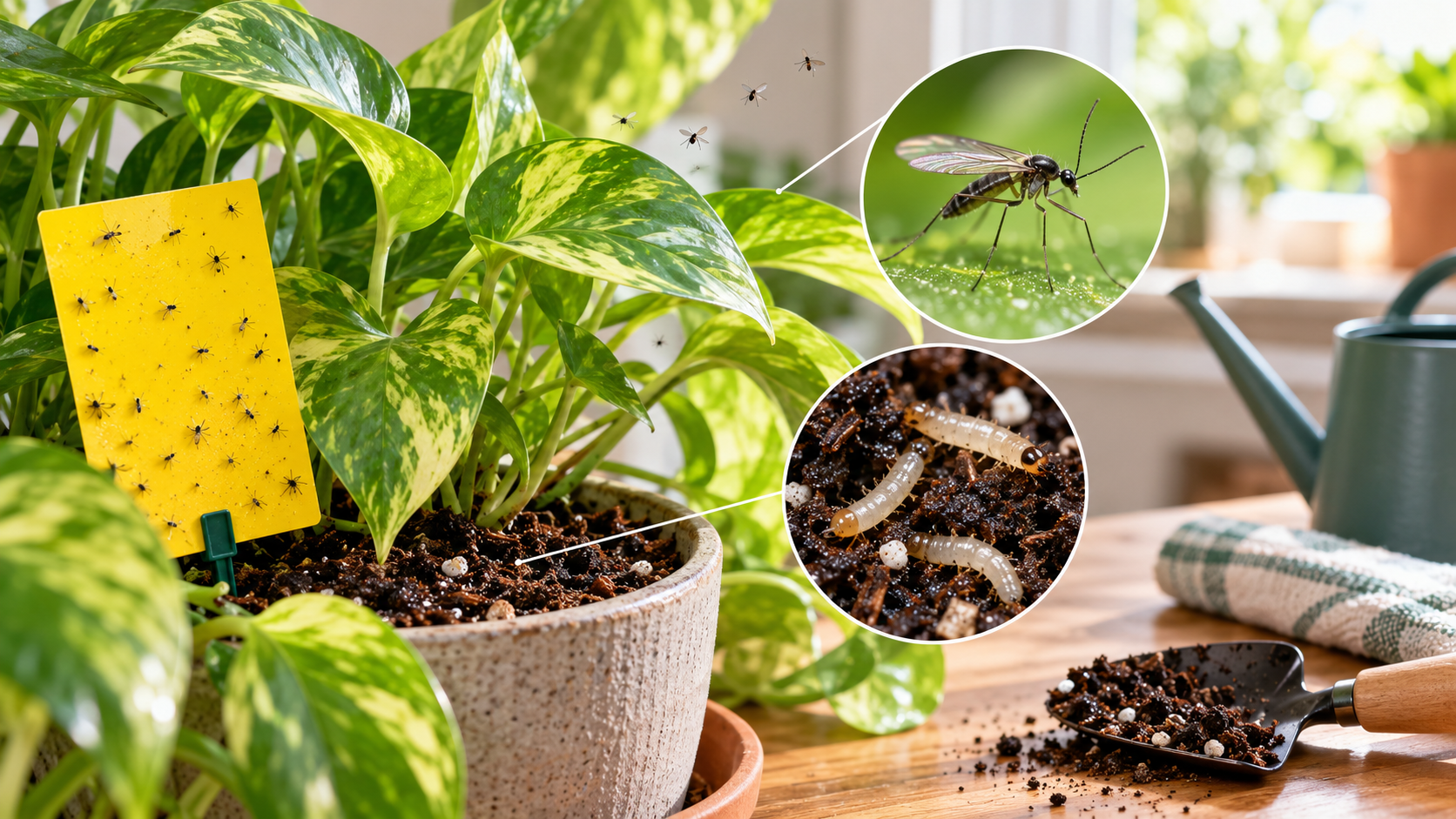
Adult fungus gnats are small, dark flies with delicate wings and noticeably long legs. They often move in short flights over the potting surface, rise when the pot is disturbed, or gather near a window. Their behavior is a clue, not proof: fruit flies may be attracted to produce, while drain flies breed in accumulated wet debris around plumbing. Looking at the location of repeated activity is more helpful than guessing from size alone.
Place a yellow sticky monitoring card close to the soil surface of the suspected pot, avoiding contact with leaves or curious pets. Do not distribute cards everywhere initially; you want to identify a likely source. Check it at the same time each day and record whether numbers are increasing, stable, or declining. A small card covered with adults tells you that insects are active, but it cannot tell you how many larvae remain in the pot.
Larvae are pale, slender, wormlike creatures, commonly with a darker head. They remain within moist growing media and may be difficult to see without disturbing the surface. If you investigate, move only a little of the top medium with a clean tool and put it back gently. Avoid excavating the entire root ball of a healthy plant to confirm a nuisance pest. In severe cases, tenderness in young roots or seedlings deserves closer attention; an established mature plant with a few flying gnats often needs moisture management rather than emergency surgery.
A practical test for the source
Move the suspected pot away from other plants for several days if you can do so without creating extreme light or temperature conditions. Note whether adult activity continues in the original area. Inspect adjacent pots, saucers, decorative cachepots, and organic debris beneath shelves. You can temporarily cover a suspected drain or growing medium with breathable screen, as recommended by Maryland Extension, and look for flies appearing under or around the covering. Do not tightly seal a living plant in an airtight bag.
If adults are also concentrated around a sink, consider the possibility of a drain-related breeding site. Treating every plant while ignoring wet plumbing residue is a common reason an apparently successful treatment fails. Conversely, if the insects are most abundant immediately after watering a particular pot, begin with that pot rather than assuming the entire apartment is affected.
Understand why the pot stays attractive
The larvae develop in damp media where fungi and decomposing organic material provide food. Repeated watering, poor air circulation around crowded containers, and a medium that remains consistently wet can favor their development. A large pot containing a comparatively small root system may dry slowly even when the surface looks normal. Decorative containers that retain drainage water create another reservoir of unwanted moisture.
This does not mean every fungus gnat problem proves the plant has been overwatered. An appropriate moisture level for a fern, for instance, can differ substantially from that of a succulent. Temperature, room light, container size, and the composition of the mix also influence drying. The objective is not to make the roots bone-dry; it is to remove unnecessary persistent wetness while maintaining conditions that suit the species.
Test the medium below the top crust with a wooden skewer or your finger where safe, and lift the pot to learn its weight after watering versus near its normal watering point. Empty the outer cachepot or saucer after excess water drains. For most plants, changing watering frequency without also correcting a pot that cannot drain will be disappointing. If roots are already unhealthy or the medium smells sour, review the separate RootLuma guide to early signs of root rot rather than treating a fly problem as the only issue.
When allowing the surface to dry is not enough
A dry-looking surface can disguise persistently wet lower layers, especially in a deep plastic pot or a dense, old mix. On the other hand, an airy mix may dry on top quickly while continuing to provide appropriate root moisture. This is why one-day rules such as “always wait seven days before watering” are unreliable. Check the plant’s actual water use and keep a simple record of pot weight, room conditions, and the days on which adults appear.
Avoid covering the soil with a thick impermeable layer solely to block flies. A decorative barrier can make it difficult to inspect or water correctly and may leave moisture trapped below. If you use a mineral top dressing, choose a depth and material appropriate to the plant and monitor the underlying soil rather than assuming the visual barrier cures the infestation.
Choose controls that match the life stage
There are two separate jobs: monitoring and reducing the adults, and interrupting development of larvae. Sticky traps can help with the first. They may reduce some adults but will rarely stop a persistent source on their own. Replacing traps frequently without changing the breeding environment can create the illusion of action while insects continue emerging from the medium.
For a persistent soil-breeding infestation, a product containing Bacillus thuringiensis subspecies israelensis (Bti) may be appropriate only if its label permits the intended use on indoor potting media and names the relevant pest. Bti targets susceptible larvae; it is not a spray that eliminates every insect in the room. Read application directions for concentration, timing, storage, and reapplication. Labels vary between countries and products, and advice copied from a lawn or mosquito-water treatment may be wrong for a houseplant pot.
Biological control is not a substitute for correcting chronic saturation. The most sensible plan combines a suitable moisture routine with monitoring and, only if needed, a targeted labeled treatment. Avoid pouring bleach, undiluted peroxide, household detergent, or essential-oil mixtures into soil. These household recipes may injure roots and do not offer reliable instructions for breaking the insect’s life cycle.
Do not water a drought-sensitive plant to the point of severe wilting merely to kill larvae. Likewise, moving a shade-adapted plant into harsh sunlight to “dry it fast” can cause leaf scorch. A measured change should address the breeding conditions without introducing a more serious horticultural problem.
A two-week monitoring plan that tells you something
The timeline below is a practical observation schedule, not a promise that every infestation disappears in fourteen days. Development and emergence depend on temperature and other conditions, so counts may fluctuate as existing pupae become adults.
When Observation Action
Day 1 Count or photograph adults on a fresh trap; examine each likely pot Identify the source, check drainage and hidden standing water
Days 2–4 Check pot weight and the moisture below the surface Adjust watering only as species requirements allow
Days 5–7 Compare new trap captures and flying activity If breeding continues, consider an appropriate labeled larval treatment
Days 8–10 Inspect neighboring pots and saucers again Correct secondary damp sites instead of adding unrelated sprays
Days 11–14 Compare trend with the Day 1 baseline Continue effective controls or reassess the source if counts remain high
Use roughly the same trap position and observation time so trends mean something. A decreasing number of captured adults is encouraging but not proof that every larva has died. New leaves, root condition, and the plant’s ordinary hydration also matter. If the plant begins wilting despite damp soil, investigate root health rather than responding with more water automatically.
For households with several new plants, separation remains valuable. The RootLuma houseplant quarantine guide explains how to observe unfamiliar plants before placing them alongside an established collection. With fungus gnats, quarantine reduces confusion about which container introduced or supports the population.
Mistakes that make an infestation last longer
Treating the flying adults as the entire problem. A trap may look impressive after three days, but it will not change the wet organic medium that supports development. Pair counts with an investigation of moisture and potential sources.
Using the same watering rule for every species. An established peace lily and a drought-tolerant succulent should not be forced into identical dry-down schedules. The acceptable adjustment is the one that preserves healthy roots for that plant.
Repotting immediately without evidence. Disturbing all roots can stress a plant that is otherwise healthy. Repot if an old, compacted, persistently saturated mix is itself part of the problem, not as a reflexive pest response. If you do repot, use a suitable clean container and fresh medium, not a pot vastly larger than the original root ball.
Assuming every black fly comes from the pot. Check bins holding decaying fruit, sink traps, and other humid residues. Correct identification saves time and avoids treating clean soil.
Applying products without reading the label. A pesticide that is registered for an outdoor crop or standing water is not automatically suitable for houseplant soil inside a home. Follow the local product instructions, including precautions for children, pets, and edible plants.
What improvement should look like
In many homes the first meaningful change is fewer adults emerging around the main pot. The second is a watering pattern that allows the upper medium to become appropriately less hospitable between waterings. The third is continued plant growth without signs of root stress. Those three indicators are more useful together than chasing a zero count on a single day.
If adults persist despite a sensible moisture routine, examine your assumption about the source before escalating treatment. Multiple pots may be involved. Some insects may be arriving from an untreated drain or new bag of damp potting mix. In a crowded collection, one wet container hidden behind a large decorative plant can maintain activity even as visible pots improve.
A decline in older leaves is not necessarily proof that larvae are damaging roots. Leaf yellowing may reflect season, normal aging, light change, excess water, nutrients, or root disease. Compare symptoms with the timing of the insect problem and investigate the most credible cause separately.
Frequently asked questions
Will fungus gnats bite people? The common dark-winged fungus gnats associated with houseplants do not bite. Their presence can be irritating, especially near windows and lamps, but panic treatment is unnecessary.
Can I eliminate them by stopping watering entirely? Not safely for every plant. Reducing persistent wetness is often useful; withholding necessary water until foliage collapses is not a responsible control strategy.
Do yellow sticky traps kill larvae? No. They monitor and catch flying adults. Larval control targets the medium, and the choice of product and timing must follow its label.
Should I discard the potting mix? Usually not for a modest infestation in a healthy established plant. Replace medium when its structure, contamination, or root condition provides an independent reason.
Why do the flies return after treatment? Existing life stages may still emerge, other containers may remain damp, or the real source may be a drain or another organic residue. Recheck those possibilities before repeating an unnecessary treatment.
A realistic goal
You do not need to sterilize your home or turn plant care into an insect-eradication campaign. Identify the insect, locate the breeding site, make moisture management appropriate for the plant, and use targeted controls only where justified. A short written baseline can show whether the steps work. That is a more durable solution than a succession of dramatic remedies aimed at whichever flies happen to be visible today.
References
University of Maryland Extension — Fungus gnats
University of Minnesota Extension — Insects on indoor plants