Powdery Mildew on Houseplants: White Patches Versus Dust
A pale film has appeared on a leaf. At first glance it could be ordinary dust, mineral residue from misting, dried potting mix, or a plant disease. The distinction matters: cleaning dusty foliage may be routine care, while rubbing an infected leaf and returning it to the crowded shelf can allow a genuine disease problem to continue unnoticed.
Powdery mildew is a group of fungal diseases that create a white or gray, powder-like growth on susceptible living plant tissue. It is not the same as white growth on the surface of potting mix, and it is not a single fungus that spreads equally to every kind of houseplant. Different powdery mildew fungi have different host ranges. A careful diagnosis starts with the location and behavior of the mark, not the assumption that every white patch needs a spray.
Recognize a typical powdery mildew pattern
On an affected houseplant, powdery mildew may begin as small white patches on the upper leaf surface, though growth can also appear on lower surfaces, stems, or buds. These spots may enlarge and merge into a diffuse coating. Some plants respond with leaf curling, yellowing, poor growth, or distorted new tissue. Other plants look relatively healthy even when the fungal growth is conspicuous.
The coating is often superficial and powdery in appearance. This helps explain its common name, but it does not mean every pale surface film is fungal. Visible colonies may appear in circles, irregular areas, or along sheltered sections of a leaf. Distribution depends on the host, the fungus, and the local environment.
The Iowa State University Extension overview of powdery mildew on ornamental plants identifies humid conditions, shade, and limited air circulation as common contributing factors. It also notes that treatment products primarily protect uninfected tissue rather than reversing damage already present. That distinction should shape your expectations before you reach for a fungicide.
Separate powdery mildew from everyday residue
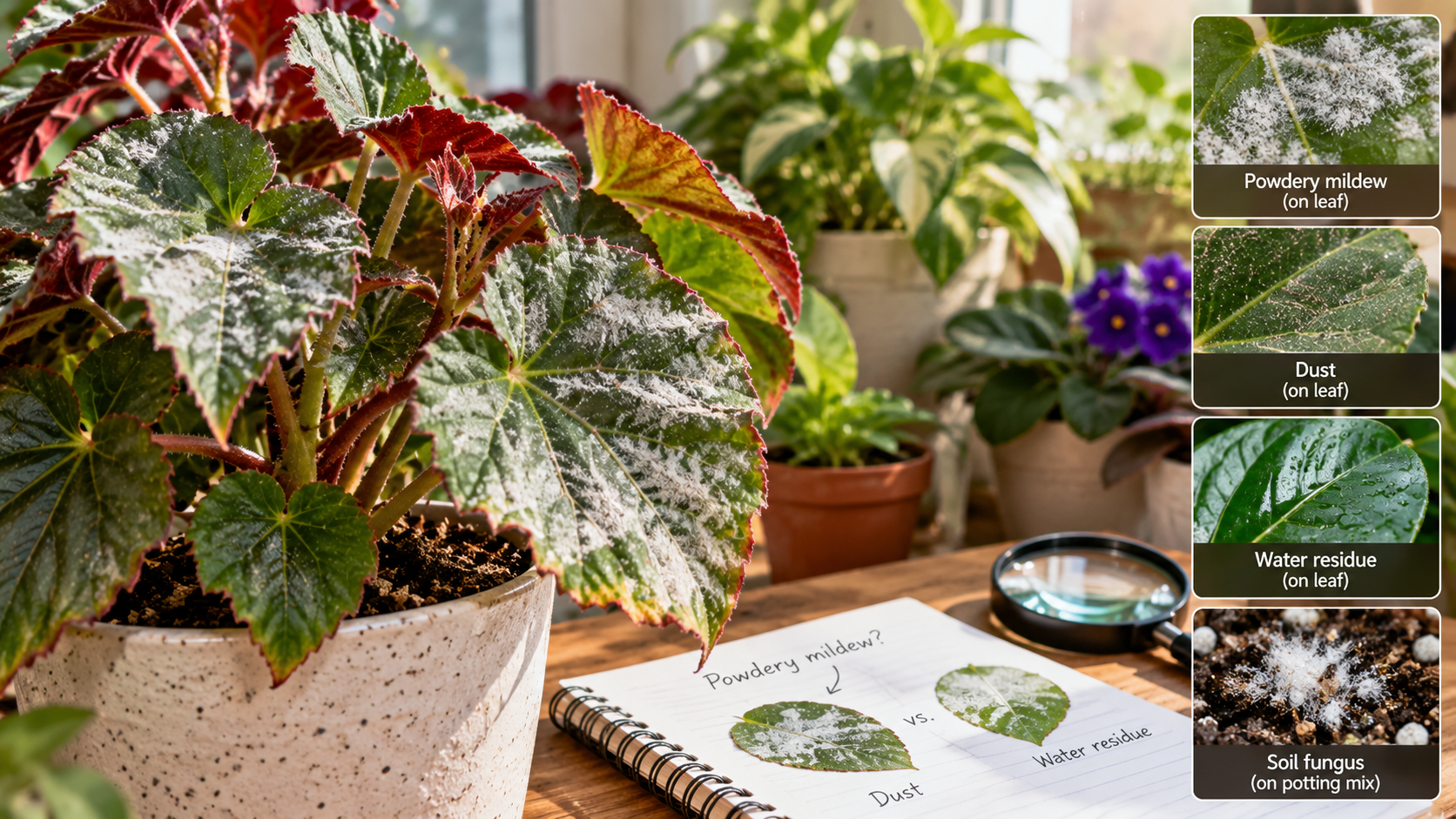
Dust generally accumulates wherever air currents and leaf surfaces collect fine particles. It can be more noticeable on wide, horizontal leaves or plants positioned near frequently opened windows. Mineral deposits often follow the pattern of water droplets, especially on glossy leaves misted with hard tap water. Dried splashes of potting mix may be restricted to the lower leaves after repotting or watering.
Powdery mildew behaves differently over time. New colonies may appear on tissue that was previously clean, and irregular patches can grow even after the room is dusted. A severely affected leaf may develop discoloration or distortion around the area. None of these observations by itself proves the disease, but the combination raises confidence.
Look at the plant before wiping anything. Photograph the patch and its location, note whether it appears on multiple leaves, and check for related symptoms. On a robust, smooth-leaved plant, you can gently test an inconspicuous area with a clean, barely damp cloth. If the material wipes away, that observation alone is still inconclusive: some fungal structures may also be removed from the surface. Do not rub fragile, hairy, or velvety leaves aggressively just to perform a test.
A white mass at the base of a stem might instead be mealybugs. A cottony insect colony may have distinct individual insects or waxy clusters at leaf joints. The white growth on damp potting soil can be saprophytic fungi feeding on organic material in the media; it is a separate issue from powdery mildew on leaves. Keep the site of the symptom clear when seeking advice, because confusing soil fungi with leaf disease can lead to the wrong solution.
Why powdery mildew sometimes develops indoors
An indoor plant can spend its life in conditions favorable to the host and still develop disease when several local factors align. Dense leaf growth reduces air movement inside the canopy. A plant pushed into a dim corner may stay damp or humid for longer after moisture-producing activities elsewhere in the room. A tightly packed shelf can put susceptible leaves within a short distance of each other and make routine inspection difficult.
Unlike several other foliar diseases, powdery mildew does not always require free water standing on leaves to spread. Humidity and host susceptibility can be important even if you never mist the plant. That does not mean every humid room has mildew. Ventilation, sunlight or suitable supplemental light, plant health, and the specific pathogen also matter.
A change in season can expose a problem that summer growth concealed. Heating may alter airflow around indoor plants, windows may be closed, daylight becomes shorter, and plants are moved closer together to keep them away from cold glass. The mildew may appear to arrive suddenly even though your watering schedule has not changed.
Some genera, including begonias and African violets, can be affected by powdery mildew. However, the disease and treatment tolerance vary with the plant. A cultural adjustment suitable for a tough, smooth-leaved ornamental is not necessarily safe for a delicate flowering African violet.
Inspect and isolate before applying anything
Move the plant away from neighboring susceptible plants while you investigate. Isolation is a sensible precaution when an infectious disease is plausible, even if the final diagnosis remains uncertain. Check nearby plants for similar colonies, especially those with overlapping foliage. Avoid brushing affected leaves across healthy plants as you move the pot.
Document where colonies are present. Note the number of affected leaves, whether new shoots are distorted, and whether the white patches were already present when you bought the plant. Look closely at the undersides and leaf axils in good light, where pests or a different disease might be hiding.
Clean fallen plant material from the surface of the pot and surrounding shelf. When pruning, use clean tools, remove clearly badly affected leaves only if enough healthy foliage remains, and seal the prunings for disposal. Avoid sending actively diseased material into an indoor propagation station or exchanging cuttings from the plant.
You do not need to remove every leaf bearing a tiny spot. Overpruning can weaken a small houseplant, reduce the leaf area it needs to recover, and leave you with less healthy growth than the original condition threatened. Instead, prioritize heavy colonies, badly distorted foliage, and positions that make further infection more likely.
Adjust the environment without creating a new problem
Start with spacing. If leaves are pressed together, move pots apart so air can travel between crowns. Make sure a fan, if used, does not blast fragile foliage or create a cold draft; gentle room circulation is more useful than wind directed at one leaf. Move the plant to an appropriately brighter position for its species, rather than assuming direct sun will cure every fungal problem.
Review watering alongside the substrate condition. Keep roots adequately moist for the plant, but do not let a pot remain saturated merely because you are concentrating on leaves. Water in a way that minimizes unnecessary foliage wetting when this is appropriate for the plant. Empty excess runoff from cachepots and saucers. Better root-zone care supports recovery, although changing watering alone is not guaranteed to stop a foliar pathogen.
Control excessive room humidity when it remains high for long periods and there is condensation or other evidence of poor ventilation. Do not try to make the air extremely dry: very dry conditions can stress some tropical plants and worsen other problems such as spider mites. The goal is a balanced microclimate with appropriate moisture and movement, not a single universal humidity number.
If a plant is in a terrarium or enclosed display, inspect neighboring plants and evaluate whether the enclosure is appropriate for a species prone to mildew. Opening an enclosure can change humidity very quickly; make gradual adjustments where the plants are sensitive. Avoid relocating a diseased plant to an area with much lower light simply because it is farther from the rest of the collection.
What treatment can realistically achieve
A fungicide is not a leaf-cleaning solution. Many fungicides function principally as protectants: their value is in limiting further infection under specified conditions, not restoring scarred or distorted tissue. Product suitability varies widely by plant, pathogen, country, and whether the treatment location is indoors. Iowa State Extension points out that many fungicides recommended for outdoor situations are not labeled for indoor houseplants.
If you are considering a product, identify the plant and probable disease first, and read the full label. Confirm indoor use is permitted and that the host plant, disease, dilution, application method, and necessary precautions are covered. Pay attention to phytotoxicity warnings. Oils and sulfur-containing products, for example, can injure certain plants or interact badly if used too close together. Never substitute dish detergent, baking soda mixtures, essential oils, or other household substances for a tested plant treatment on the assumption that natural means harmless.
When a plant is badly infected, not especially valuable, and difficult to isolate, removing it from the collection may be a reasonable disease-management choice. This is not defeat. Protecting a larger collection sometimes matters more than continuing to treat one weakened specimen with an uncertain diagnosis.
For persistent or unusual cases, ask a local extension plant clinic to examine photographs or a sample following its submission instructions. Laboratory confirmation is particularly useful when the visible signs do not fit the expected pattern or several treatments have failed.
Example: distinguishing a dusty shelf plant from a true outbreak
Imagine two plants on the same shelf. The first is a pothos beside an open window. Its broad leaves have an even layer of gray dust, especially on upward-facing surfaces. You wipe one leaf with a damp cloth and the film disappears; two weeks later, little has returned and new growth is normal. The observation is consistent with ordinary dust, and there is no basis for disease treatment.
The second plant is a begonia on a crowded lower shelf. It develops irregular white circular areas on several leaves, including recently expanded leaves that were clean the previous week. A few leaves begin curling where the coating develops. You separate it from neighboring plants, photograph the symptoms, remove severely affected tissue, improve spacing and suitable light, and ask a plant clinic for diagnostic assistance if the problem progresses. That response follows the evidence rather than prescribing a fungicide based on color alone.
In each case, the useful result is not the amount of white material removed today. It is whether healthy new leaves develop without fresh colonies and whether neighboring plants remain symptom-free.
Monitor new growth instead of chasing old marks
Establish a weekly check with a consistent photo angle. Look for newly appearing colonies on previously clean leaves, changes in leaf distortion, and new infection on adjacent plants. Old areas may not return to a pristine appearance even when conditions improve. If you keep removing or spraying the same scarred leaf, you can create more stress without gaining new information.
If the disease appears stable, continue appropriate cultivation and observation. If fresh colonies repeatedly form, revisit the diagnosis and the environmental factors that may be sustaining infection. Consider whether a crowded arrangement, unsuitable light, or a plant particularly susceptible to mildew needs a permanent change of location.
Avoid treating the absence of obvious symptoms for a few days as proof that the disease is gone. Fungal growth and symptom visibility can vary with environmental conditions. It is reasonable to keep an affected plant separate while you establish that new growth and nearby plants remain free of the problem.
Keep disease prevention practical
Inspect new plants before buying them, including the undersides of leaves and flowers. Give a suspicious plant a separate observation period at home rather than placing it directly in the center of your collection. Keep shelves easy to clean and avoid accumulating old foliage. Choose plants that match the light and ventilation you can genuinely provide rather than relying on sprays to compensate for an unsuitable site.
It also helps to distinguish plant appearance from plant health. A few older leaves with residual marks may coexist with vigorous, clean new growth. Another plant may look comparatively green while its youngest leaves develop fresh colonies. Prioritize the direction of change over a perfect photograph.
Powdery mildew management begins with identifying the pattern of living fungal growth and separating it from dust, minerals, pests, and soil-surface organisms. An accurate diagnosis, proportionate cleanup, suitable light and spacing, and a realistic expectation of treatments are more dependable than repeatedly wiping or spraying every white leaf.
References
Iowa State University Extension — Powdery Mildew: Ornamental Plants
Iowa State University Extension — Two Common Houseplant Diseases