Yellow Sticky Traps for Houseplants: Monitoring Without Overreacting
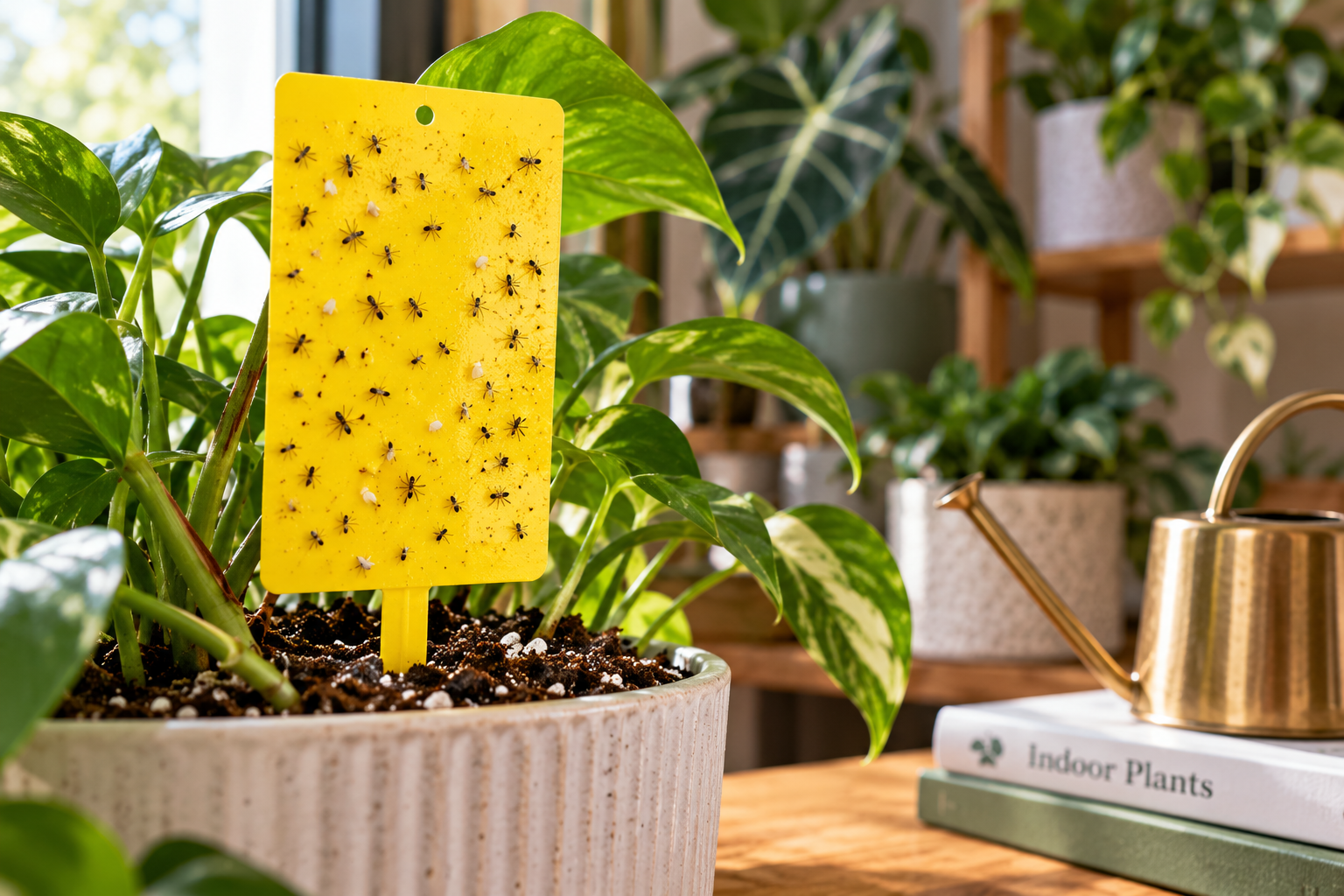
A yellow card speckled with tiny flies can look like proof that a houseplant infestation is out of control. The same card can also be an excellent early warning that lets you find a small problem before it spreads. What matters is knowing what a sticky trap measures—and, just as importantly, what it cannot tell you.
Yellow sticky traps attract and catch some flying insects. They are useful for observing trends, locating an active source, and checking whether changes in care coincide with fewer adults. They do not identify every insect perfectly, monitor every life stage, or solve a root-zone problem on their own. The best use is as a low-cost observation tool within an evidence-based pest plan, not as a permanent decoration covered with insects.
What yellow cards actually catch
Color can attract various small flying insects, including fungus gnats and whiteflies; some other pests may also land on the adhesive surface. Attraction differs by species, light conditions, trap placement, and the surrounding plants. A yellow card is not a universal magnet for all insects, and a catch of five tiny flies does not reveal how many eggs or larvae are hidden in a potting mix.
Look at captured insects rather than assuming they are all fungus gnats. Fungus gnat adults often look like delicate dark flies with long legs. Whiteflies are tiny pale insects commonly associated with foliage. Winged aphids and other visitors may also appear. A hand lens or close photograph helps distinguish broad groups, although expert identification may be necessary for difficult specimens.
The Iowa State University Extension guide to houseplant insect problems explains that yellow sticky cards can capture adult fungus gnats but do not stop larvae already in the potting medium from developing. This distinction should govern every decision made from a trap count.
If you notice a few springtails in damp mix, remember that they jump rather than fly. A trap card is not a sensible way to measure that soil population. Similarly, spider mites living on leaf undersides are not reliably assessed by counting tiny insects stuck on a card placed at pot level.
Place the card where the question is
Start by deciding what you want to know. If small flies hover over one pot, position a card near the soil surface without sticking it into foliage. If white insects rise from leaves when the plant is disturbed, placing a card near the foliage may be more informative. Consistent placement improves comparison over time.
Avoid crowding a card against a fan, bright lamp, or window where unrelated insects might collect. A trap by a frequently opened door may catch outdoor visitors in addition to pests breeding inside. That can make one pot appear responsible for insects that arrived from elsewhere.
Use the adhesive safely. Keep it away from children, pets, hair, and delicate leaves that can become stuck and torn. Remove protective backing only when you are ready to place it; dispose of used cards according to local rules rather than leaving them on floors or tables.
If your collection occupies several shelves, label cards by location. A simple code such as “lower shelf, fern” is more useful than a pile of undated traps. One card near each suspected hotspot can help locate a source without covering every surface with adhesive.
Count trends, not just one dramatic card
A heavily covered trap could mean sustained insect activity, or it could mean the card has been sitting there for months. Replace or date cards at a consistent interval. Record roughly how many target insects appear over a defined period, then compare the next period under similar conditions.
Exact counting is not always necessary. A scale such as none, a few, moderate, or many can be helpful for a household, provided you apply it consistently. If you want a numerical record, use the same card size and placement each time. Changing cards, locations, and counting intervals together makes the trend hard to interpret.
Trap catches also change with temperature and season. Adult insects may emerge in waves even if the conditions in the pot have not changed in the last twenty-four hours. After a care adjustment, wait long enough to see a meaningful pattern rather than declaring failure when one newly emerged adult appears the next day.
A trap that catches fewer flies is encouraging, not proof of eradication. Adults may simply be less active or less attracted under new lighting, while larvae remain. Combine trapping with inspection of the likely breeding source and plant condition.
Read fungus gnat results correctly
Adult fungus gnats are often a nuisance rather than direct feeders on healthy houseplant foliage. Their larvae usually inhabit damp organic media, feeding mainly on fungi and decaying material, though heavy populations may harm young or weak roots. Persistently wet mix and poor drainage can support their development.
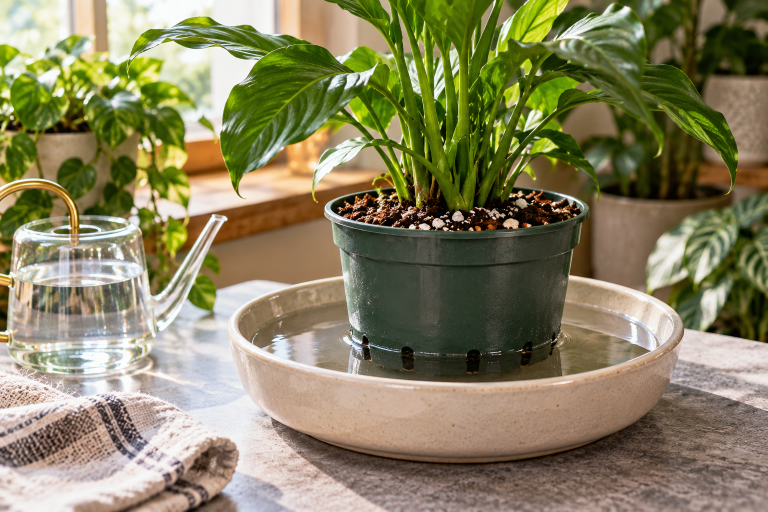
If the yellow card near a pot collects gnat-like flies, inspect that pot’s moisture and drainage. Look for water pooled inside a decorative cachepot, decomposing leaves on the surface, or a large volume of mix around a small root system. These are practical factors you can change without reaching immediately for a pesticide.
You may also need to look beyond the plants. University of Maryland Extension notes that gnat-like flies can breed in other damp areas, including drains. A card beside a kitchen window cannot prove that a particular plant is the sole source. Check nearby wet locations before blaming the pot with the nearest sticky trap.
When appropriate for the species, allow the upper layer of mix to dry between irrigations and avoid continuous standing water. Do not intentionally desiccate a moisture-sensitive plant simply to drive trap catches to zero. Effective cultural control should improve the growing conditions, not replace one problem with severe drought stress.
Adult traps do not directly treat soil larvae
Trapping adults can reduce nuisance numbers and reveal trends, but it is not equivalent to removing the immature stages in the pot. New adults may continue to emerge for a period after you correct a damp substrate. This lag is expected in a pest with multiple life stages.
For a significant and correctly identified fungus gnat problem, some locations have products containing Bacillus thuringiensis subspecies israelensis (Bti) labeled for larvae in potting media. Product availability and allowed uses vary, and not every Bti product is registered for indoor houseplants. Follow the actual local label and avoid off-label doses or home mixtures.
Do not treat a home full of plants merely because two flies appeared on a card. If the plants are healthy and adult numbers are low, sanitation and moisture management may be sufficient. An intervention should match the pest, stage, and level of harm.
Sticky cards can also fail to show whether a biological treatment worked if their placement changes. Maintain a consistent monitoring method before and after any properly justified intervention.
What a trap cannot diagnose about thrips or whiteflies
Some thrips may be caught on colored traps, but identification and crop context are more complicated. Thrips can shelter in flowers and new growth, where they cause feeding injury. A card can alert you to a possible flying pest but cannot replace examining the plant for slender insects, silvery injury, and dark deposits.
Whiteflies spend immature stages attached to leaf undersides. Catching adults may indicate activity but does not reveal how many nymphs remain on foliage. Turn leaves over and inspect them. Relying only on card counts can delay a useful diagnosis of a sap-feeding pest.
Blue traps are sometimes used to monitor certain thrips in production settings, but changing color at home is not a substitute for knowing the insect. Different trap designs and targets produce different catch patterns. Do not compare counts between incompatible trap types as though they measured the same population.
When in doubt, use a hand lens and a few good photos. Record the host plant and symptoms. An insect caught on a card near a healthy collection may be an incidental visitor rather than a breeding infestation.
A practical example with three plants
Imagine three houseplants on one shelf: a pothos, a small fern, and a succulent. Small black flies have begun appearing nearby. The owner puts one labeled card beside each pot for the same number of days. Most of the gnat-like insects appear on the card near the fern.
Rather than spraying the fern, the owner checks the plant and surrounding setup. Its inner pot is sitting in accumulated water inside a decorative vessel. The other two pots drain freely. The owner empties standing water, removes decomposing surface litter, and adjusts irrigation to meet the fern’s needs without leaving the bottom saturated.
The next set of cards catches fewer flies over comparable intervals. Some adults still emerge, so the owner continues monitoring without increasing intervention immediately. The fern maintains healthy new growth. This combination of plant condition and a declining trap trend is stronger evidence of improvement than one empty card.
Now suppose the largest catch occurs on a card beside an open window rather than beside any plant. The owner checks nearby damp drains and considers insects entering from outside. The card remains useful, but its meaning changes once its location is considered.
Common mistakes with sticky trap results
Treating every speck as the same pest. Small insects have different life cycles and diets. Identify the broad group before deciding what to do.
Ignoring the date. A card with a month’s catch cannot be compared fairly with one used for two days. Label start and replacement dates.
Moving cards repeatedly. Placement alters catch rates. Use comparable positions for trend monitoring.
Assuming zero catches means zero insects. Some stages do not fly, and attractiveness varies. Examine plants and growing media when symptoms suggest a problem.
Using the card as a pesticide substitute. Cards may capture adults but do not necessarily remove eggs, larvae, or nymphs. Fix breeding conditions and use appropriate pest-specific measures when necessary.
Buying ever more traps instead of checking water. If a pot remains waterlogged, adding ten cards does not restore root aeration.
Set a monitoring endpoint
There is little value in trapping indefinitely without a question. Start when you notice flying insects, identify the likely target, and monitor for a meaningful interval. If catches decline and plants stay healthy after changes in care, you can reduce the number of cards. Replace them again if symptoms recur or a new plant is introduced and needs observation.
For a large collection, occasional cards in known hotspots may be useful as an early warning. This is not the same as declaring the entire home perpetually infested. Good housekeeping, appropriate moisture, and regular inspection often provide a calmer baseline than leaving conspicuous traps everywhere.
Keep the records modest: location, card date, likely insect, approximate count, pot conditions, and action taken. The purpose is to make the next decision better, not to turn houseplant care into a surveillance system.
Safety and disposal
Sticky adhesives can catch beneficial or incidental insects as well as the target pest. Indoors, use only as many cards as the monitoring task requires. Position them away from pets, children, and areas where people handle food. Avoid placing an exposed card where it might attach to delicate new foliage as a plant grows.
Dispose of full cards promptly and wash hands after handling them. Do not use household solvents on plant leaves to remove stuck adhesive unless the product is specifically appropriate; physical damage or chemical injury may be worse than a small torn section of leaf.
A yellow sticky trap is best viewed as a measurement aid. It can reveal that flying pests are present and show a useful trend after a sensible change. It cannot tell the entire story of soil larvae, plant health, or treatment success. Combine its signal with direct inspection, and you will make far fewer unnecessary interventions.
A final practical check is whether the plant itself has changed. An empty trap beside a declining plant still deserves attention to the roots and leaves; a full trap beside an otherwise healthy pot may simply call for better moisture management. Let the observations guide the response rather than making the color of a card the center of plant care.
References
Iowa State University Extension — Diagnosing Houseplant Problems Caused by Insect Pests
University of Maryland Extension — Fungus Gnats
University of California IPM — Houseplant Problems