Bottom Watering Houseplants: How Long, When, and When Not To
A dry houseplant pot set into a shallow bowl of water may seem to drink from the bottom on its own. Sometimes that is exactly what happens: moisture travels upward through fine pores in the potting mix, rewetting roots without a stream of water hitting the leaf crown. Other times the pot sits in a saucer for an hour and the upper mix remains dusty, or the root zone stays saturated longer than the plant can tolerate.
Bottom watering is a technique, not a universally superior care philosophy. To use it well, you need to understand how your particular medium absorbs water, know when the root zone is sufficiently moist, and remember that the same pot still needs drainage and occasional attention to dissolved salts. The goal is controlled rehydration, not keeping a reservoir under every plant permanently.
How water rises through a potting mix
When a porous growing medium contacts water, capillary forces can pull moisture into the spaces between its particles. Fine-textured components generally wick differently from coarse bark or large mineral particles, so two pots of identical size may absorb water at very different rates. A peat-heavy mix that has dried severely can also become difficult to rewet until its particles are properly moistened.
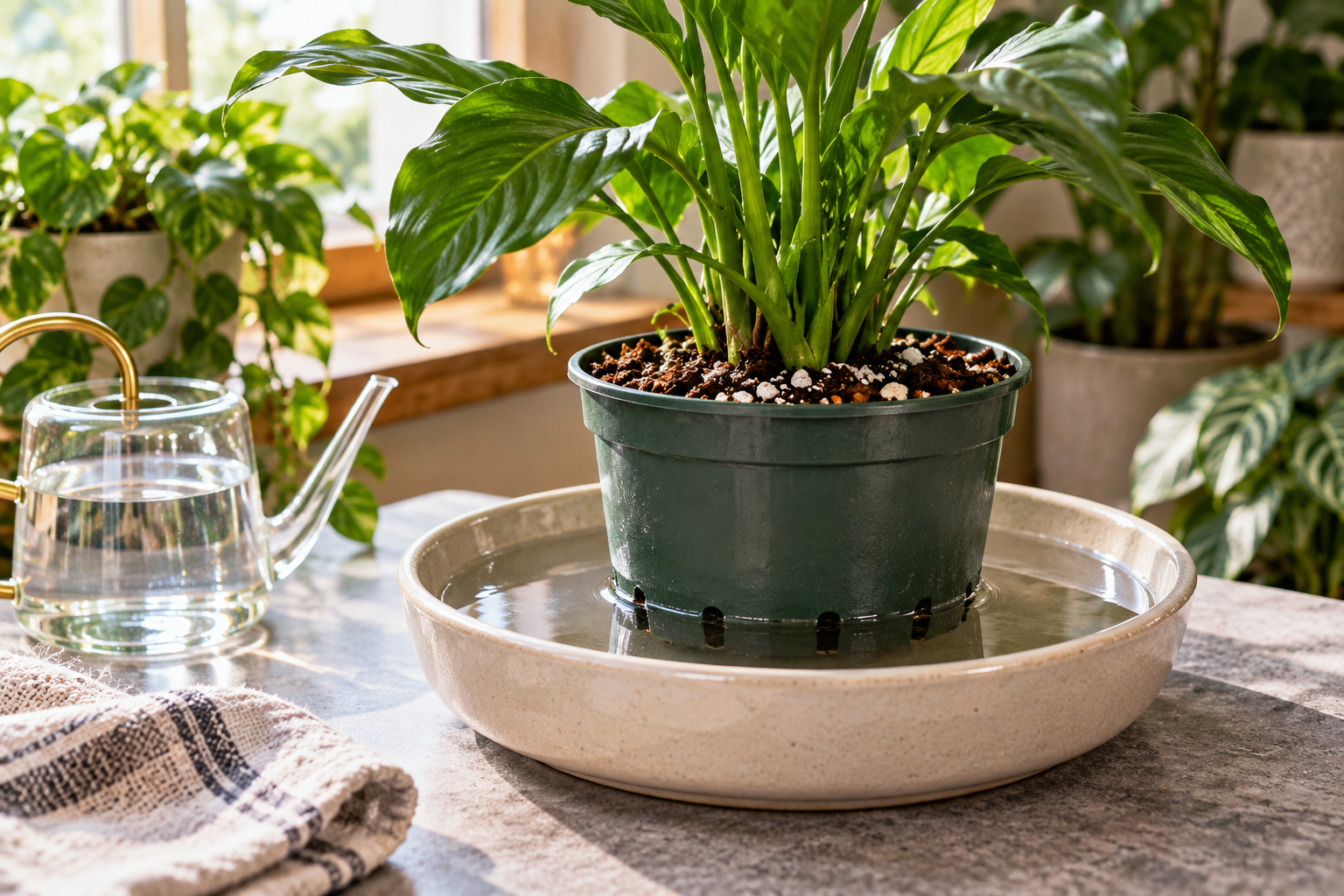
A nursery pot with open drainage holes can draw water upward when its bottom is placed in a shallow tray. If the holes are blocked, the medium does not contact the water effectively, or the mix is too coarse for the height of the pot, the movement may be patchy. Water at the very bottom does not guarantee the entire root ball has become evenly moist.
This is why a fixed statement such as “bottom water every plant for exactly twenty minutes” is not reliable. Some small pots rehydrate quickly, while taller containers and unusually dry media may take longer. Temperature and medium composition also matter. Judge the result by the moisture distribution, not simply the clock.
When bottom watering is useful
The method can be convenient for a small pot where overhead watering splashes the crown or disturbs loose surface material. It may be useful for seedling trays designed to absorb water from a lower tray and for some foliage plants with leaves that are awkward to wet. In each case, keep the main objective clear: supplying enough moisture to the root zone without leaving the container standing in excess water afterward.
A plant that tends to develop surface algae from careless overhead splashing might benefit from a neater technique, but do not assume bottom watering completely prevents algae. Moisture can still reach the surface, particularly with a fine medium. Likewise, water drawn from below does not sterilize the pot or eliminate fungus gnat habitat if the medium remains wet.
Bottom watering can also help an owner who routinely pours a little water on the center of a pot and assumes it has hydrated every root. Submerging the lower portion briefly may wet more evenly if the medium wicks well. The method is not automatically better than thorough top watering that drains freely; both can work when done thoughtfully.
When top watering is the simpler choice
Choose top watering when the medium is extremely coarse and does not wick high enough to reach roots, when a container is too large or heavy to lift safely, or when you need to flush accumulated salts through the mix. For a broader diagnosis of a drooping plant, consult RootLuma’s guide to overwatering versus underwatering before changing the watering method. A plant in a tall pot of chunky orchid bark may not rehydrate adequately from a shallow saucer, even though a small pot of fine coir nearby does.
If the plant is visibly stressed and the root ball is dry at the top but sodden at the base, do not add another soak before investigating. In that situation the issue may be uneven water distribution, compacted media, damaged roots, or an unsuitable container. Changing the direction of watering will not fix every structural problem.
Top watering is also important for examining how well a pot drains. Water moving freely through the medium gives feedback that an invisible reservoir sometimes conceals. If the surface repels water, premoisten the mix carefully or consider whether its age and composition justify refreshing it.
Set up a safe bottom-watering session
Use a clean tray or basin large enough that the pot stands upright. Add water deep enough to contact the drainage holes and the lower portion of the medium but not so deep that the pot floats or the plant crown becomes submerged. The exact depth depends on pot design, so avoid using the rim of a decorative cachepot as an automatic fill marker.
Place the pot in the tray and allow the mix to absorb water. For a small pot, check after a relatively short interval; do not disappear for the afternoon and assume the plant will stop taking water at the ideal point. Gently feel the upper or middle growing medium or compare the pot’s weight with its usual dry and watered weight.
Once the root zone has absorbed an appropriate amount, lift the pot out. Let excess water drain fully over a sink or a safe surface. Return it to a saucer or cachepot only after most dripping has stopped, and empty any water that collects afterward. The step that often gets skipped is this final drainage, which matters as much as the initial soak.
How long is long enough?
Duration is a test, not a prescription. Check the medium after a short soak and extend only if the water has not reached enough of the root zone. A broad range of timings found online is not a substitute for checking. Pot height, water contact, medium texture, and initial dryness change the result too much for a single universal answer.
For a pot that remains dry at the top, first decide whether top-layer dryness actually matters for that plant. Some roots occupy the lower region, and the surface can appropriately dry between irrigations. If the entire ball remains dry, try a different method rather than leaving the pot indefinitely in standing water.
Watch what happens after removal. A fully rehydrated pot usually feels heavier, and the growing medium should no longer pull away from the sides as severely if it was merely dry. But a heavy pot with yellowing leaves is not proof of success; it can signal that water is remaining where unhealthy roots cannot use it.
The hidden issue: mineral salts
Most irrigation water contains dissolved minerals. Fertilizers add more soluble nutrients and salts. Plants take up water and elements in differing proportions, and some dissolved substances can remain in the growing medium. When water is supplied exclusively from below, there may be less downward movement to carry accumulated salts out through drainage holes.
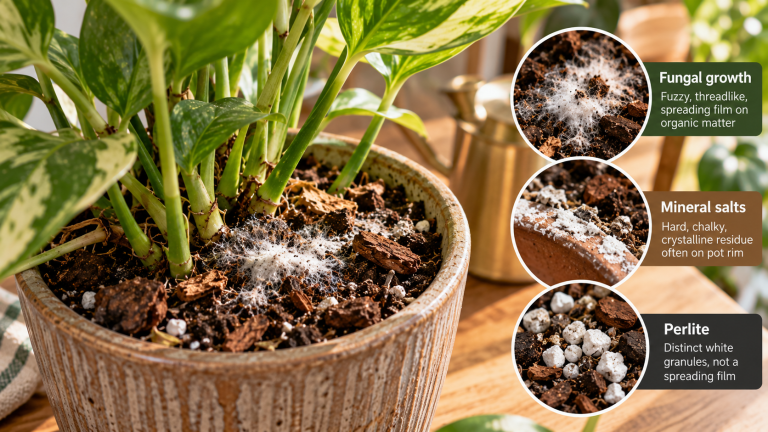
A whitish crust on the surface or rim can indicate mineral deposits, although not all white material is salt. Persistent tip burn or poor growth can have multiple causes, so do not diagnose a salt problem from one mark. Review fertilization rate, water source, drainage, and plant condition together.
Periodic thorough top watering, allowing water to flow out of the drainage holes, can help move soluble salts through an appropriate potting medium. The University of Maryland Extension watering guide describes both top and bottom watering and advises emptying water left in the saucer. Maryland Extension also explains why mineral and fertilizer salt deposits may require top-down flushing. Perform this over a sink or somewhere runoff can be discarded; do not let the drained solution be reabsorbed from the same saucer. Where water quality is problematic, adjusting fertilizer habits or water source may be more important than simply increasing the flushing frequency.
This is also why keeping the pot over a permanent water tray is not the same as occasional bottom watering. Long-term reservoirs require design considerations, and salts may behave differently in closed systems. A standard plastic nursery pot sitting forever in a filled saucer is not an automatically safe self-watering planter.
Special cases: seedlings, succulents, and African violets
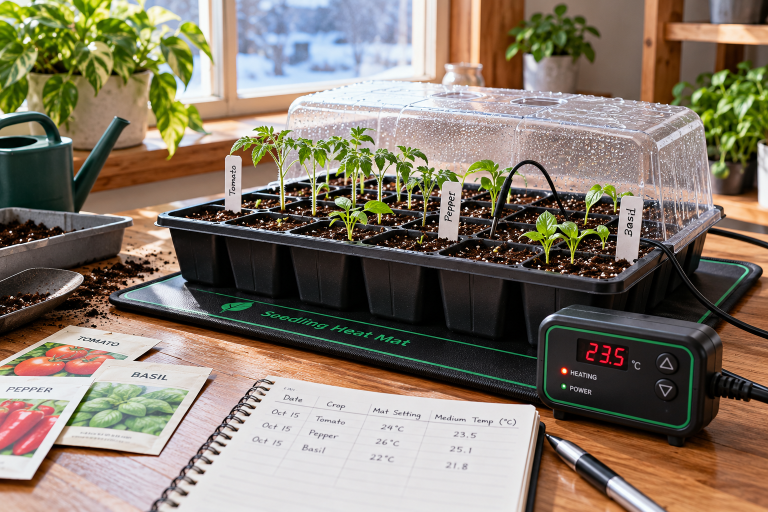
A shallow seed-starting tray may be designed for moisture uptake from below, which limits disruption of delicate seeds at the surface. The tray must still be emptied after rehydration, and seedlings need adequate air circulation to reduce prolonged wetness. Bottom watering is not a treatment for damping-off disease.
Succulents can be bottom watered, but the method should not erase their normal need for aerated roots and suitable drying between irrigations. A thick-leaved plant growing slowly in cool conditions may need water less often, regardless of whether it comes from above or below. A pot that stays wet for days after every soak deserves closer inspection.
African violets are sometimes bottom watered to avoid wetting foliage, especially when cold water or sun exposure could create cosmetic leaf issues. Even there, perpetual standing water is not desirable. Verify that the medium wicks effectively and drain the pot after a suitable uptake period. The method should fit the species and pot rather than become an inflexible household rule.
A case study: a dry peat mix that resists wetting
An apartment grower has a six-inch pot of foliage plant in an older, peat-heavy mix. Water poured from above races down a narrow channel and leaves most of the pot dry. The plant wilts soon afterward even though runoff appeared instantly. The grower suspects that the plant is thirsty and tries a lower soak in a basin.
The container begins drawing water up from the drainage holes, but the top still looks dry after the first short check. The grower waits a little longer while observing, then removes the pot when the inner root zone is sufficiently rehydrated. Excess drains away and the plant is returned to its normal position.
If the mix repeatedly becomes water-repellent or compacted, the grower considers repotting with a more suitable medium rather than repeating very long soaking sessions forever. The bottom-water test helped diagnose uneven wetting; it was not proof that all future irrigation must come from below.
Compare that with a plant in chunky bark. A shallow soak may wet only the bottom pieces and leave upper roots dry. Thorough overhead watering or a different soaking method may be more effective there. The same technique has different outcomes because the media are different.
Common mistakes to avoid
Leaving water in the saucer overnight. Once sufficient moisture has been absorbed, prolonged standing water can reduce aeration and create avoidable root stress. Empty the remaining water.
Soaking every pot for the same number of minutes. The height, composition, and dryness of a root ball affect uptake. Check instead of relying on a universal timer.
Assuming a dry surface means the entire pot is dry. Probe the root zone gently or compare pot weight. A wet bottom can coexist with a dry top.
Never flushing fertilizer residues. Exclusive bottom watering can complicate salt management. Use an appropriate occasional top watering and discard runoff.
Using bottom watering to fix a diseased plant without diagnosis. If roots are rotting or a substrate is unsuitable, the direction of water application alone will not repair them.
Confusing a brief soak with a permanent reservoir. A purpose-built self-watering system differs from simply leaving any plant in a full tray.
An observation checklist you can actually keep
At the start, note the pot’s weight and the moisture level where roots are active. Use a shallow clean tray and check uptake periodically. After removing the pot, confirm that free water drains away and that the container is not left sitting in runoff. During the following days, note whether leaves remain firm and whether the medium dries at a suitable pace.
If a plant repeatedly stays saturated, revise the routine. If water never reaches enough of the medium, choose an alternative technique. If white crusts or leaf damage increase, review fertilizer and water quality. The simplest successful routine may alternate methods according to the condition of the pot rather than insisting that one direction of watering is always superior.
Bottom watering works best when it solves a specific problem: controlled rehydration of a medium that wicks. It is not a shortcut around understanding the roots. Water wisely, let the pot drain, and let evidence from the plant determine what happens next.
References
Oklahoma State University Extension — Soilless Growing Mediums
University of Maryland Extension — Watering Indoor Plants
University of Maryland Extension — Mineral and Fertilizer Salt Deposits on Indoor Plants