When and How to Fertilize Houseplants Without Overdoing It
A well-kept plant collection depends on decisions that can be checked later, not on quick fixes that change several variables at once. This guide explains when and how to fertilize houseplants without overdoing it, with an emphasis on observations that can be made in an ordinary home. The central principle is that fertilizer supplies nutrients; it cannot compensate for poor light, damaged roots, chronic overwatering, or other basic growing problems. That matters here because nutrient demand usually rises when a plant is actively producing new tissue and falls when growth slows. Fertilizer is useful only when roots are healthy enough to use it and the plant is actively growing under adequate light. For plant-care questions, the condition of the root zone and the quality of new growth usually deserve more attention than one damaged older leaf. The sections that follow focus on practical evidence, common mistakes, and a routine that can be repeated without turning plant care into a complicated project.
Separate a Real Trend From a One-Off Change
Useful evidence is spread across more than one part of the setup. Look closely at active new growth, healthy roots, time since repotting, fertilizer already present in the mix, season, and the concentration on the product label. When two or three of those details agree, you have a stronger basis for action than you would get from one dramatic symptom. The best clues are usually the ones you can observe again after the adjustment, because they give you a built-in way to judge the response. Checking neighboring plants can also be useful because a shared pattern may point to an environmental condition instead of an individual plant problem. In this particular care decision, concentration and frequency matter together; applying a strong solution less often is not automatically safer than a dilute, measured approach. The purpose of the check is to build enough agreement between clues that the following step is defensible and easy to evaluate.
Why This Pattern Develops
The biology and the environment meet at one central idea: Fertilizer supplies nutrients; it cannot compensate for poor light, damaged roots, chronic overwatering, or other basic growing problems. If that relationship is missed, it is easy to respond to the appearance of the problem without addressing what is actually driving it. A clear mechanism also makes later troubleshooting faster because you know which variables are capable of producing the pattern you are seeing. Understanding the mechanism gives you a reason to pause when a popular shortcut does not match the conditions you can observe. Salt accumulation can be influenced by fertilizer, water quality, drainage, and evaporation, so browned tips should be interpreted in context. The best comparison is usually the plant against its own recent healthy pattern rather than against a perfect specimen in a photograph. Once this relationship is clear, the rest of the care decision becomes easier to keep proportionate.
How Nearby Conditions Shift the Result
Environmental context helps explain why two similar plants can respond differently. Here, nutrient demand usually rises when a plant is actively producing new tissue and falls when growth slows. Check the actual position of the leaves and root zone rather than relying on broad labels such as bright room, warm corner, or sheltered balcony. Check what the plant experiences at leaf level and in the pot, not what the room feels like from the doorway. If you use a meter, thermometer, or light reading, treat it as one piece of evidence and compare it with the response you see afterward. Salt accumulation can be influenced by fertilizer, water quality, drainage, and evaporation, so browned tips should be interpreted in context. In this particular care decision, that context helps explain why care needs can shift even when the plant itself has not moved.
What Happened Before the Pattern Appeared
The sequence of events is often more informative than the severity of one symptom. Review what changed before the pattern appeared, including care routines, placement, room climate, and any recent disturbance. This does not prove a cause, but it helps you rank explanations instead of treating every possibility as equally likely. Repeated problems in one round of changes of year often suggest that the checking routine has not yet adjusted to changing light or temperature. This step is particularly useful when a symptom has several common explanations that look similar at first glance. For a useful baseline on a related factor, see our guide to How Much Light Do Indoor Plants Really Need? A Room-by-Room Guide. Treat the timeline as supporting evidence, then compare it with what the plant is showing now.
Correct the Strongest Issue First
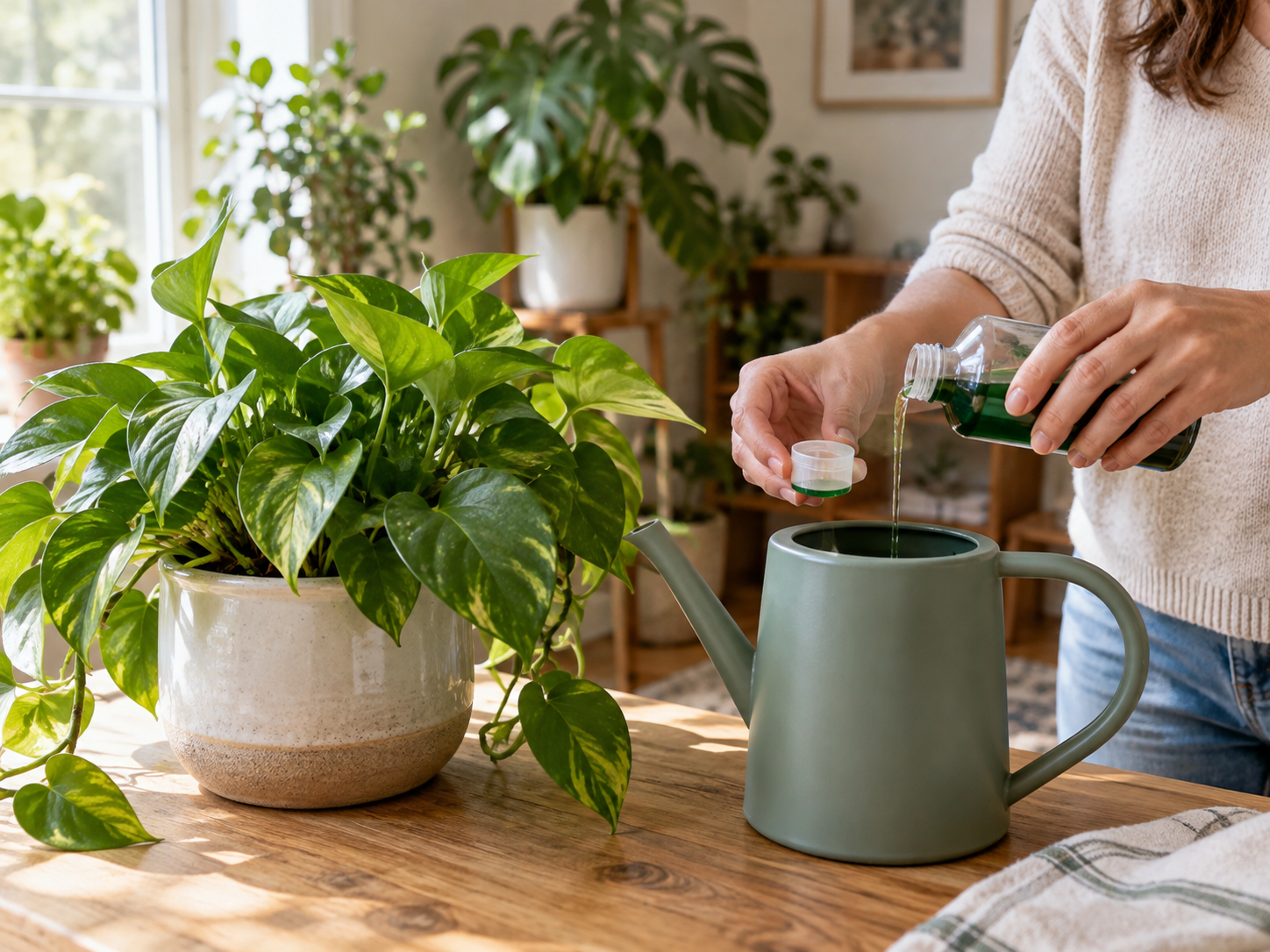
Action is useful when it is specific and measurable. In this situation, Feed only a plant that is otherwise growing reasonably well, start conservatively, and adjust according to response rather than habit. Treat that as a testable step, not as permission to overhaul the entire setup. Keep the rest of the basic environment as stable as practical so the response has a clear reference point. If the step involves a product, use the label instead of increasing concentration or frequency in an attempt to speed up the result. For this plant care topic, this is also where Why Houseplant Leaves Curl can help, because it addresses a related decision that is easy to misread in isolation. The next useful information comes from the plant’s later response, not from adding another intervention immediately.
Where Good Intentions Go Wrong
Avoid fertilizing a stressed plant, doubling doses, feeding immediately after every repot, and assuming slow winter growth is always a nutrient problem. Those habits can make the symptoms harder to interpret and may turn a manageable issue into a more complicated one. A decorative container or stand should never prevent you from seeing drainage, checking roots, or reaching the plant safely. The safest response to uncertain evidence is usually to preserve suitable basics while you collect a clearer pattern. Stable basics—appropriate light, sensible watering, drainage, and time—make it simpler to tell whether a more specific intervention is actually needed. Salt accumulation can be influenced by fertilizer, water quality, drainage, and evaporation, so browned tips should be interpreted in context. The more uncertain the diagnosis, the more valuable it is to avoid unnecessary variables.
How to Read the Response After a Change
The plant’s next response is part of the diagnosis. Over the following checks, look for a slower rate of decline, normal drying or growth patterns, and fewer new symptoms rather than judging success by one old leaf. Keep expectations realistic because damaged tissue may never look new again, even when the plant has stabilized. If several plants improve or decline together, the shared environment deserves another look. For plant-care questions, the condition of the root zone and the quality of new growth usually deserve more attention than one damaged older leaf. For this plant care topic, changing several care factors at once makes it difficult to know which adjustment helped or caused new stress. Progress becomes less difficult to judge when the same core observations are checked at similar intervals.
Use a Small Number of Reliable Checkpoints
A manageable routine can be built around one repeatable habit: connect feeding decisions to visible growth and keep a simple note of product strength and date to avoid accidental repetition. The value comes from comparing the same indicators over time, not from adding more tasks to the calendar. a maintenance pattern should tell you what to check, while the plant tells you whether any action is required. In this particular care decision, consistency is valuable because it builds a baseline, but flexibility is what allows the routine to remain appropriate as conditions change. This is also where How to Prune Houseplants for Healthier, More Balanced Growth can help, because it addresses a related decision that is easy to misread in isolation. The system should become more straightforward to maintain over time, not more complicated with every new lesson.
What Matters Most
The goal is not to control every variable. It is to recognize the factors that matter most and respond consistently. fertilizer supplies nutrients; it cannot compensate for poor light, damaged roots, chronic overwatering, or other basic growing problems. With a stable baseline, you can adjust care as the season, plant size, or growing space changes without starting from scratch each time. The result is a care system that can adapt without becoming complicated every time the season or plant size changes. You do not need perfect control; you need enough consistency to see cause and effect clearly. For plant-care questions, the condition of the root zone and the quality of new growth usually deserve more attention than one damaged older leaf. Concentration and frequency matter together; applying a strong solution less often is not automatically safer than a dilute, measured approach. Used consistently, it reduces guesswork without requiring perfect control over the plant’s immediate surroundings.