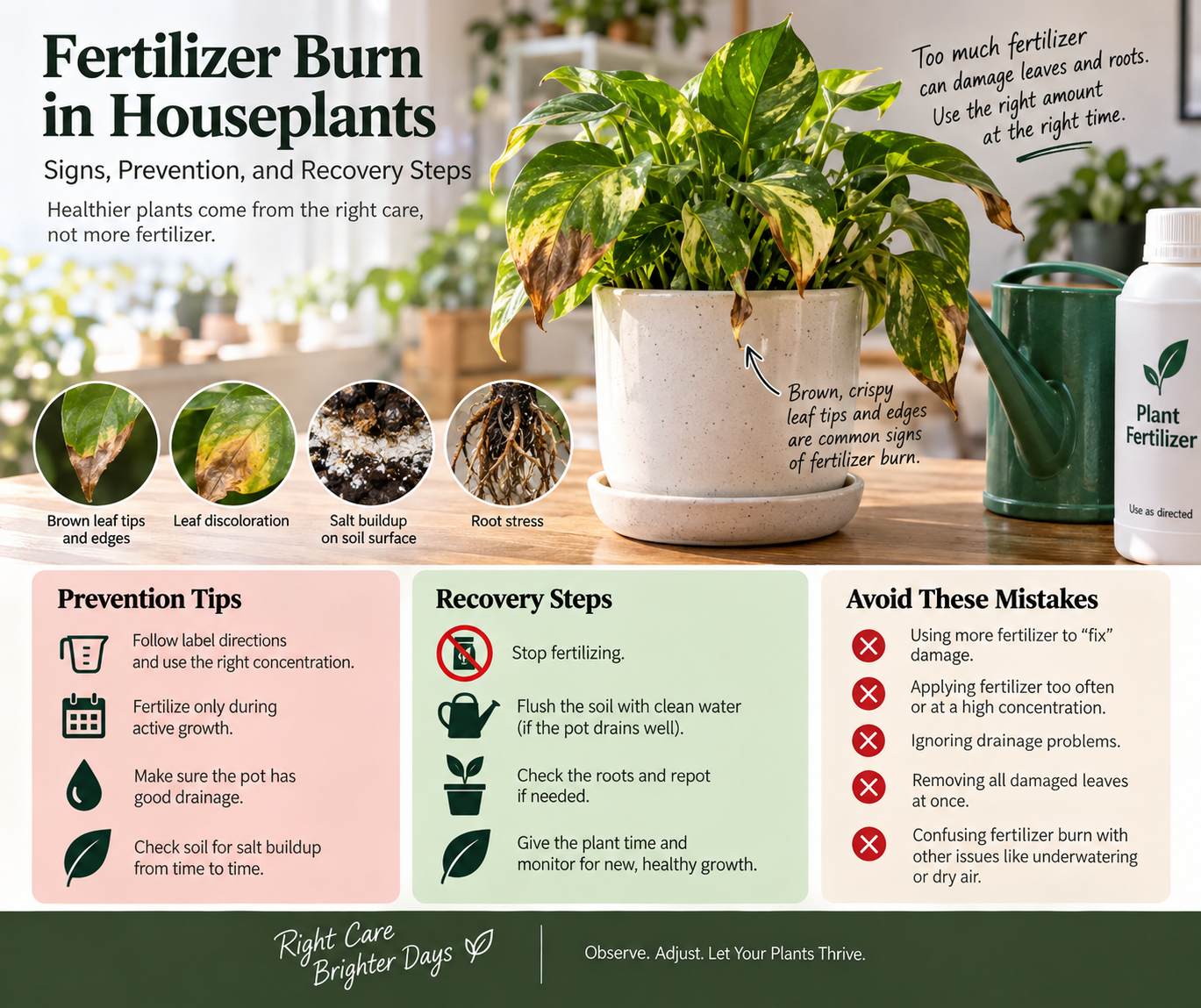
Fertilizer Burn in Houseplants: Signs, Prevention, and Recovery Steps
Successful care in real homes depends on translating general advice into observations you can make in the exact space you have. When the topic of fertilizer burn in houseplants is treated as a process instead of a fixed rule, the advice becomes easier to adapt to different plants and rooms. The central principle is that fertilizer burn usually reflects a concentration of soluble salts high enough to interfere with water uptake or damage sensitive root and leaf tissue. That matters here because symptoms can resemble dry-air or watering problems, especially when browning begins at tips and margins. The most reliable baseline is the plant’s own recent pattern: how quickly it dries, how firm the leaves feel, and what healthy new growth looks like. For plant-care questions, the condition of the root zone and the quality of new growth usually deserve more attention than one damaged older leaf. The goal is a calmer method: understand the likely process, check the strongest clues, make one change, and let the next trend provide feedback.
How the Main Factors Work Together
The most important point is that Fertilizer burn usually reflects a concentration of soluble salts high enough to interfere with water uptake or damage sensitive root and leaf tissue. That statement is useful because it describes a process, not a calendar rule, and it gives you something concrete to compare with the plant’s response. The practical advantage is that you can test the idea against what happens next rather than relying on a one-time impression. That distinction matters because a symptom can be real while the first explanation for it is still wrong. The most reliable baseline is the plant’s own recent pattern: how quickly it dries, how firm the leaves feel, and what healthy new growth looks like. Once this relationship is clear, the rest of the care decision becomes easier to keep proportionate.
What to Check First
Before changing care, collect a small set of observations: recent heavy feeding, crust on the soil or pot, tip burn across several leaves, unusually high fertilizer concentration, and root stress. These are valuable because they can be checked again later, making the next decision less dependent on memory or guesswork. When the issue involves placement, compare leaf orientation and growth with the actual light path rather than with the room’s general brightness. For the setup described here, if one clue conflicts with the others, note the disagreement instead of forcing it to fit the first diagnosis that came to mind. A houseplant often shows stress after the triggering condition has been present for days, so a symptom is best treated as evidence rather than an instant diagnosis. If the pattern is still mixed after this inspection, waiting for another check can be more useful than forcing a diagnosis.
How to Act Without Overcorrecting
Action is useful when it is specific and measurable. In this situation, Stop additional feeding, evaluate drainage and soil condition, and use a measured recovery approach rather than adding more products. Treat that as a testable step, not as permission to overhaul the entire setup. A small correction also reduces the chance that the plant has to adapt to several new stresses at the same time. A good intervention should solve a defined issue, not simply make you feel that something has been done. The best comparison is usually the plant against its own recent healthy pattern instead of simply against a perfect specimen in a photograph. Fertilizer is useful only when roots are healthy enough to use it and the plant is actively growing under adequate light. After that step, return to observation and resist the urge to improve several other things during the same adjustment.
Why Location Changes the Outcome
The method should fit the real space. Remember that symptoms can resemble dry-air or watering problems, especially when browning begins at tips and margins. That single observation is often enough to explain why a routine that worked previously no longer gives the same result. Nearby plants can shade one another, reduce airflow, or change how easy it is to water and inspect each pot. If you use a meter, thermometer, or light reading, treat it as one piece of evidence and compare it with the plant’s follow-up response. The most reliable baseline is the plant’s own recent pattern: how quickly it dries, how firm the leaves feel, and what healthy new growth looks like. The exact location should therefore be part of every follow-up check.
Use the Previous Week as Evidence
The sequence of events is often more informative than the severity of one symptom. Review what changed before the pattern appeared, including care routines, placement, room climate, and any recent disturbance. This does not prove a cause, but it helps you rank explanations instead of treating every possibility as equally likely. Changes that occurred after the symptom began are less likely to be the original cause, even if they affect what happens next. History becomes more useful when you record actions rather than impressions: note what changed, when it changed, and what the plant did afterward. For a second checkpoint, use Brown Leaf Tips on Houseplants to compare the response you see afterward with a care factor that has already been discussed on RootLuma. The clearer the sequence, the less likely you are to mistake the effect of a recent change for a separate new problem.
What Usually Makes the Situation Worse
Avoid trying to correct burn with another fertilizer, repeatedly flushing a pot that cannot drain, and removing every damaged leaf at once. Those habits can make the symptoms harder to interpret and may turn a manageable issue into a more complicated one. In this particular care decision, more water, more light, more fertilizer, or more humidity are not automatically improvements; each can become a stress when the plant does not need it. Another mistake is solving for appearance first, such as removing all damaged tissue before understanding whether the stress is still active. A houseplant often shows stress after the triggering condition has been present for days, so a symptom is best treated as evidence in place of an instant diagnosis. The more uncertain the diagnosis, the more valuable it is to avoid unnecessary variables.
A Better Way to Measure Recovery
Judge progress by the trend that develops after the change. Older marks may remain, so look for fewer new symptoms, steadier posture, more predictable moisture changes, and new growth that better matches the plant’s normal form. A photo taken from the same position once a week can make slow improvement much easier to recognize. For the setup described here, for root-zone issues, a return to more predictable drying and stable posture can be an encouraging sign even before new leaves appear. Because indoor plants grow at different rates through the year, the same action can be helpful in active growth and unnecessary during a slower period. To keep the next step grounded, cross-check this with How to Repot a Houseplant Without Stressing It before assuming the most dramatic explanation is the correct one. Progress becomes easier to judge when the same indicators are checked at similar intervals.
A Practical Maintenance Rhythm
The simplest sustainable habit is this: use consistent measuring tools, follow label directions, and periodically reassess whether the plant is actively growing enough to need feeding. Repeating that process gives you a personal baseline that becomes more useful than generic timing recommendations. A simple weekly look can include moisture, new growth, leaf undersides, stability, drainage, and changes in the surrounding space. If one plant repeatedly needs special handling, consider whether its location or container is creating unnecessary maintenance. A houseplant often shows stress after the triggering condition has been present for days, so a symptom is best treated as evidence rather than an instant diagnosis. In this particular care decision, to keep the next step grounded, cross-check this with Root Rot in Houseplants before assuming the most dramatic explanation is the correct one. The system should become simpler to maintain over time, not more complicated with every new lesson.
Bring the Pieces Together
The most reliable long-term approach is not a perfect schedule but a dependable way to decide. Remember that fertilizer burn usually reflects a concentration of soluble salts high enough to interfere with water uptake or damage sensitive root and leaf tissue. Combine that principle with the clues you can actually observe, then let the plant’s next response confirm whether the adjustment was useful. The result is a care system that can adapt without becoming complicated every time the season or plant size changes. When the space and routine are easy to understand, small problems can be addressed before they trigger a chain of unnecessary corrections. Fertilizer is useful only when roots are healthy enough to use it and the plant is actively growing under adequate light. Used consistently, it reduces guesswork without requiring perfect control over the day-to-day growing conditions.