Why Houseplants Droop: How to Diagnose Wilting Without Guessing
The goal is not to memorize another rule; it is to build a repeatable way to judge the situation before you act. To understand why houseplants droop: how to diagnose wilting without guessing, start with a clear baseline and a small number of observations you can repeat. The central principle is that drooping describes a loss of normal leaf or stem posture, but it does not identify the cause by itself. That matters here because changes in water movement, root health, temperature, or recent handling can all reduce turgor or temporarily change posture. A useful watering decision combines soil condition with pot weight and the plant’s recent behavior in place of relying on a fixed weekday. Because indoor plants grow at different rates through the year, the identical action can be helpful in active growth and unnecessary during a slower period. The goal is a calmer method: understand the likely process, check the strongest clues, make one change, and let the next trend provide feedback.
Understand the Process Before Changing Care
A sound decision begins with the fact that Drooping describes a loss of normal leaf or stem posture, but it does not identify the cause by itself. That is the part to keep constant while you evaluate the smaller variables around it. This is why a single number, date, or visual symptom rarely deserves to control the entire care decision. Understanding the mechanism gives you a reason to pause when a popular shortcut does not match the conditions you can observe. Because indoor plants grow at different rates through the year, the same action can be helpful in active growth and unnecessary during a slower period. The most reliable baseline is the plant’s own recent pattern: how quickly it dries, how firm the leaves feel, and what healthy new growth looks like. That gives you a practical reference point for the observations that follow.
What to Notice Before You Intervene
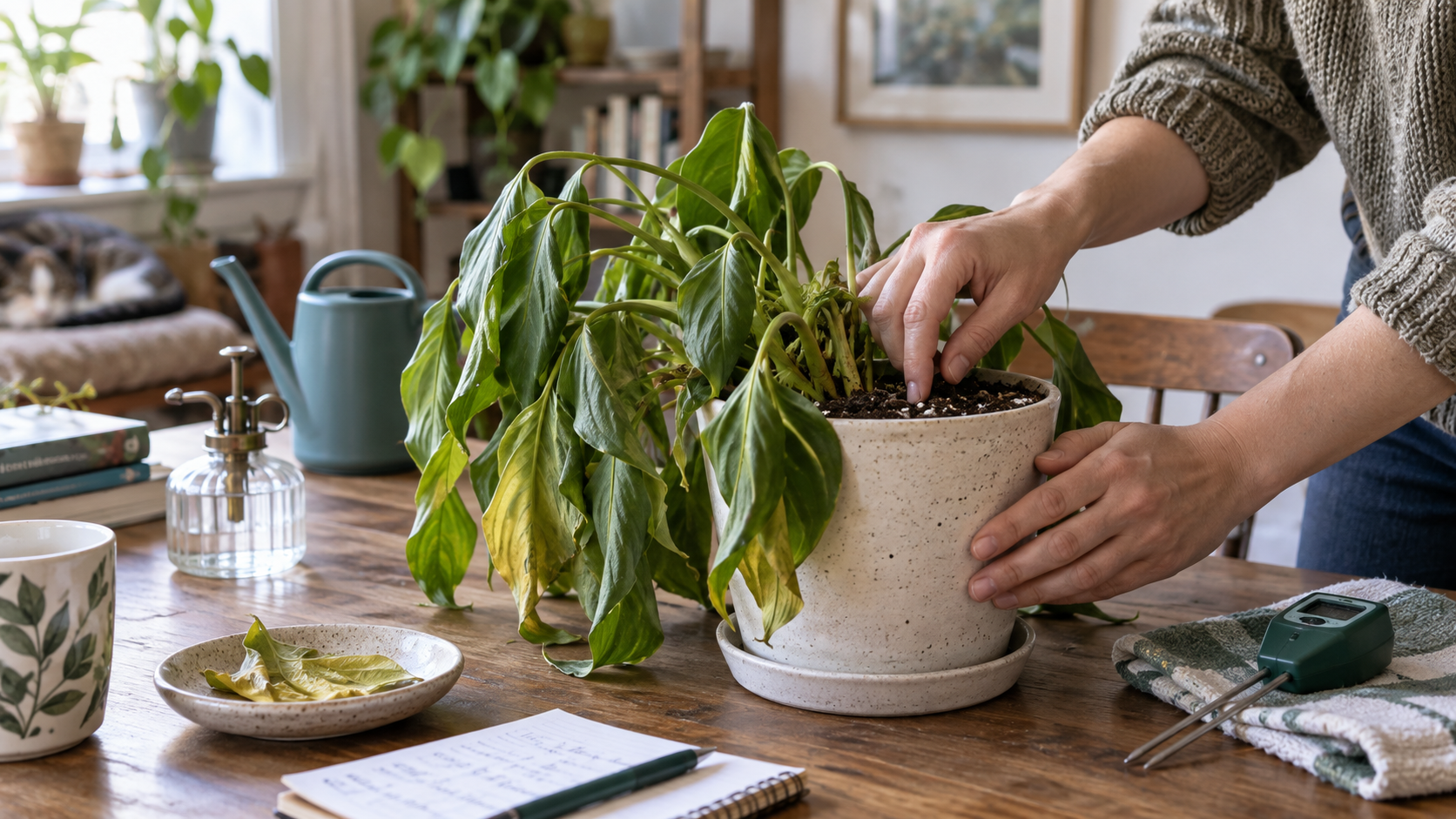
Useful evidence is spread across more than one part of the setup. Look closely at soil wetness, leaf softness, stem firmness, time of day, recent repotting, temperature, and whether the plant recovers overnight. When two or three of those details agree, you have a stronger basis for action than you would get from one dramatic symptom. The goal is not to collect every possible measurement; it is to gather enough consistent evidence to choose a reasonable next step. The plant’s newest leaves or shoots are especially valuable because they developed under the most recent conditions. The best comparison is usually the plant against its own recent healthy pattern rather than against a perfect specimen in a photograph. If the pattern is still mixed after this inspection, waiting for another check can be can be more informative than forcing a diagnosis.
Use a Step You Can Reverse or Adjust
When you are ready to act, keep the intervention proportionate: Treat drooping as a clue that starts an inspection rather than as an instruction to water immediately. Small, evidence-based changes are easier to reverse, repeat, or refine than a complete care overhaul. Write down the change if you are likely to forget it; your next inspection is more meaningful when you know exactly what was altered. If roots or soil are involved, make sure the container can drain before adding water intended to correct another problem. A houseplant often shows stress after the triggering condition has been present for days, so a symptom is best treated as evidence rather than an instant diagnosis. A focused change is easier to evaluate and usually easier on a plant that is already adapting.
Light, Heat, Airflow, and Containers Still Matter
The same technique can behave differently in another location because changes in water movement, root health, temperature, or recent handling can all reduce turgor or temporarily change posture. Light, temperature, airflow, humidity, container size, and seasonal changes can alter both the plant’s needs and the speed at which the growing medium changes. Do not assume that changing the plant means moving it far; sometimes a few inches, a sheer curtain, or a small spacing adjustment is enough. If you use a meter, thermometer, or light reading, treat it as one piece of evidence and compare it with the plant’s later response. A houseplant often shows stress after the triggering condition has been present for days, so a symptom is best treated as evidence rather than an instant diagnosis. For the setup described here, rechecking those local conditions is especially worthwhile when the season, heating, cooling, or sun angle changes.
The Sequence of Events Matters
Use a short care history as part of the diagnosis. A quick note about the previous week—water, light, temperature, products used, movement, and repotting—can reveal whether the timing supports one explanation more strongly than another. This step is particularly useful when a symptom has several common explanations that look similar at first glance. History becomes more useful when you record actions rather than impressions: note what changed, when it changed, and what the plant did afterward. Pot size, substrate texture, temperature, airflow, and root density all change how quickly a container dries. Stable basics—appropriate light, sensible watering, drainage, and time—make it easier to tell whether a more specific intervention is actually needed. For more context on the underlying care factor, read Brown Leaf Tips on Houseplants before adding another adjustment. This makes timing a practical filter in place of a guess about cause.
Common Shortcuts That Create New Problems
The situation becomes harder to read when care is driven by urgency. Common examples include watering before touching the soil, fertilizing a wilted plant, repeatedly moving the plant, and assuming every evening droop is disease. Keeping the response narrow protects both the plant and the quality of your observations. More water, more light, more fertilizer, or more humidity are not automatically improvements; each can become a stress when the plant does not need it. Trying to make every plant follow one household schedule is another common source of repeated watering and placement mistakes. A related RootLuma guide, Root Rot in Houseplants, can help you verify whether the surrounding conditions are contributing to what you see. The more uncertain the diagnosis, the more valuable it is to avoid unnecessary variables.
Let the Plant Confirm the Decision
Monitoring should answer one question: is the problem still progressing? Old yellowing, browning, scars, or stretched growth can remain visible after the cause is corrected, so give more weight to what is happening on newer tissue. Stable care needs can be a useful sign of recovery because the plant is no longer swinging between extremes. The speed of change matters: a problem that stops spreading is different from one that continues appearing on fresh tissue. Because indoor plants grow at different rates through the year, a similar action can be helpful in active growth and unnecessary during a slower period. The most reliable baseline is the plant’s own recent pattern: how quickly it dries, how firm the leaves feel, and what healthy new growth looks like. Progress becomes more straightforward to judge when that same indicators are checked at similar intervals.
A Routine That Works on Busy Weeks
For future care, check soil, temperature, recent changes, and recovery pattern before deciding whether any intervention is needed. Keep the routine short enough to repeat consistently and use it as a checkpoint rather than an automatic instruction to water, feed, move, or prune. When a routine starts creating unnecessary actions, simplify it back to observation, prioritization, and one measured response at a time. Consistency is valuable because it builds a baseline, but flexibility is what allows the checking routine to remain appropriate as conditions change. Stable basics—appropriate light, sensible watering, drainage, and time—make it easier to tell whether a more specific intervention is actually needed. You can compare this step with How to Tell When a Houseplant Needs Water when the same specimen is showing more than one clue. That is how general advice turns into a baseline that is specific to your own home.
A More Reliable Long-Term Habit
A practical routine should reduce uncertainty rather than create more rules. The key point remains that drooping describes a loss of normal leaf or stem posture, but it does not identify the cause by itself. When care is matched to the real room, container, season, and plant condition, small problems are easier to notice before they turn into repeated cycles of correction. That balance—steady basics, specific observations, and measured adjustments—is what turns general advice into useful everyday care. the outcome is a care system that can adapt without becoming complicated every time the season or plant size changes. The most reliable baseline is the plant’s own recent pattern: how quickly it dries, how firm the leaves feel, and what healthy new growth looks like. the response is a more resilient routine that can adjust as plants, seasons, and spaces change.