Springtails in Houseplant Soil: Helpful Decomposers or Pests?
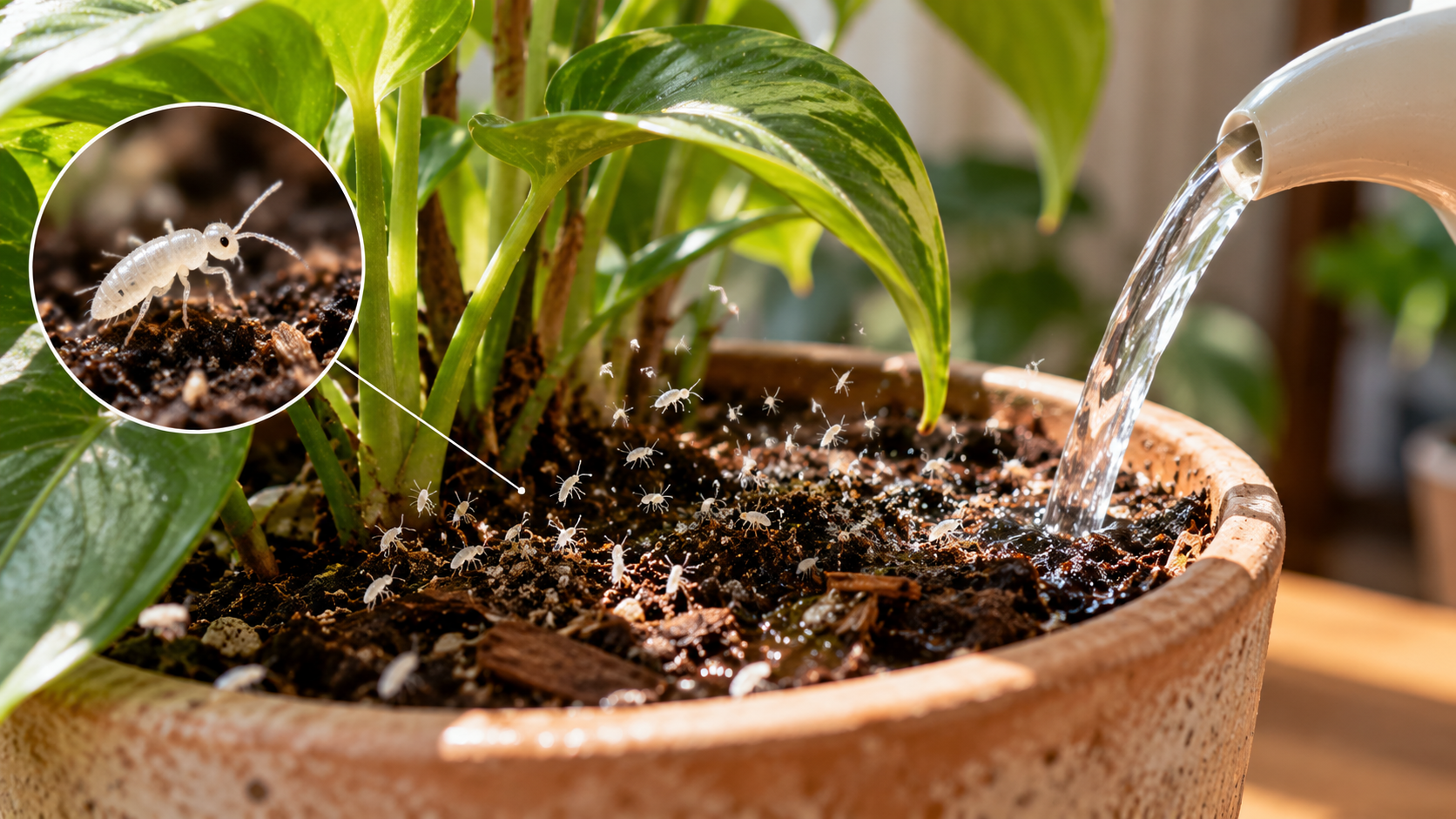
You water a houseplant, and dozens of tiny white specks suddenly bounce across the surface of the potting mix. The movement looks dramatic, especially if you were already worried about pests. But those jumping dots may be springtails: small soil-dwelling arthropods that generally feed on fungi and decaying organic material rather than attacking healthy houseplant roots.
The useful first step is not buying an insecticide. It is checking whether the creatures really are springtails, whether the plant itself shows damage, and whether the pot stays wetter than the roots need. A few springtails can be an ordinary part of a moist growing medium; a conspicuous population is often more informative as a moisture clue than as a threat.
Identify the tiny jumpers before treating anything
Springtails belong to a group of very small, wingless hexapods called Collembola. They are not flies. Many have a fork-like structure beneath the abdomen that can snap against a surface and launch the animal into the air when disturbed. This is why a pot may seem to scatter tiny grains of rice when water lands on its surface.
Colors vary. Some are pale, almost translucent, while others are gray, dark brown, or nearly black. Body shapes also differ, from narrow elongated individuals to rounder types. Size alone is not a dependable identification feature because fungus gnat larvae, mites, and other soil inhabitants can be small too.
Use a flashlight or hand lens to watch rather than crush. Springtails often hop abruptly when disturbed and land a short distance away. They lack wings, so they do not fly around the foliage. Their quick movements can appear random compared with an insect that walks steadily across a leaf.
The University of Minnesota Extension springtails guide explains their association with moisture, organic debris, and fungal growth. It also notes that they usually cause little or no meaningful injury to plants. That reference is more useful than an online claim that every crawling creature in a plant pot is a root eater.
Distinguish springtails from fungus gnats
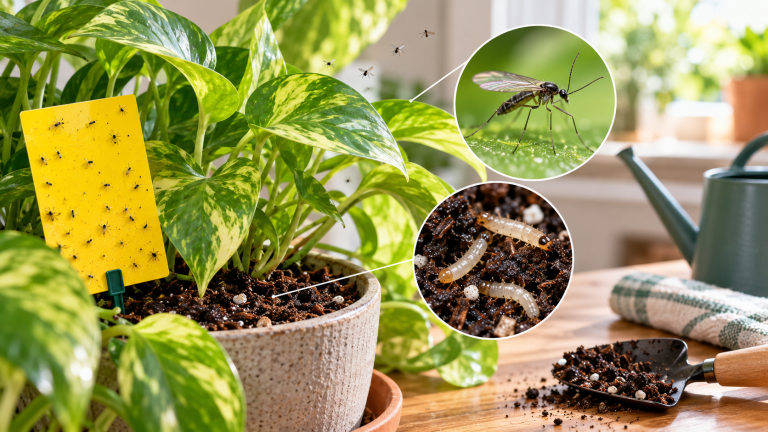
Fungus gnats are small flies. Adults move through the air, often near a window or immediately above moist potting mix; they may land on yellow monitoring cards. Their larvae live in the substrate and are worm-like, often with a darker head capsule. Springtails are generally noticeable as tiny jumping animals on the surface or around damp pot edges.
Try an observation test rather than a product test. When the pot is lightly disturbed, do the animals jump from the surface, or do tiny flies take off and circle nearby? Does the insect have wings? Does it look like a worm in the mix rather than a compact, mobile body on top? These questions help prevent misclassification.
A single pot may contain both organisms. If you see springtails, that does not prove fungus gnats are absent. If you see adult gnats, that does not convert every white jumper into a gnat larva. Identify each separately before choosing any response.
This distinction matters for management. Gnats may prompt monitoring of adults and attention to the moisture conditions supporting larvae. Springtails normally call for restraint and, when necessary, correction of overly damp conditions. A spray marketed for flying insects is not a logical solution to a harmless surface-dwelling decomposer.
What springtails do in potting mix
Many springtails feed on fungi, algae, bacteria, and decomposing organic matter. They help process tiny pieces of plant material in soil ecosystems, and their presence does not mean a pot is dirty or poorly maintained. Commercial substrates containing bark, peat, coir, composted matter, or other organic ingredients can offer food and habitat when moisture is available.
Their role is not a guarantee of perfect soil health. A large population can indicate a persistently damp environment where algae or decomposing matter is abundant. That same condition may or may not be appropriate for the plant growing in the pot. A fern that prefers more even moisture has different needs from a jade plant that tolerates the medium drying substantially.
There are springtail species that occasionally feed on tender living tissues, and uncommon damage can occur under particular conditions. But that possibility should not be used to label all springtails dangerous. On typical indoor ornamental plants, damage severe enough to justify treatment is unusual, according to Extension guidance.
When leaves are yellowing, ask whether overwatering, inadequate light, old roots, temperature, or a separate pest explains the symptoms better. The animals may be responding to the conditions created by a root problem rather than causing the root problem themselves. Correlation is not proof of plant injury.
Why they appear immediately after watering
Adding water changes the surface environment in several ways. It fills some pores, pushes air through others, and may displace small animals toward the top or edge of the pot. Dampness can also make them easier to see against dark media. A sudden appearance after watering does not necessarily mean the population multiplied overnight.
Observe the pot before, during, and after the next irrigation. Check whether jumpers gather along the water line, drainage tray, or moist rim. A white saucer makes them easier to spot, but keep the saucer drained so the roots do not stand in water unnecessarily. The goal is to identify where and when they are visible, not to count every individual.
A glazed cachepot can retain water out of sight. Lift the inner grow pot after watering and check the outer container. A pot that looks dry at the surface can have a very wet lower root zone. Conversely, a few springtails on the surface of a well-draining, appropriately watered plant may not require any adjustment.
If springtails are showing up beyond the pot, inspect nearby damp surfaces. A condensation-prone windowsill, leaking container, or wet organic debris may offer additional habitat. Indoor nuisance management often begins with correcting sources of persistent moisture rather than treating the animals themselves.
When a small population should be left alone
If your plant is healthy, its medium drains properly, and you see only a few springtails after watering, there is usually no reason to act. They do not bite or sting people, and the University of Minnesota identifies them as generally harmless to households. Routine chemical treatment can cause more practical disruption than the organisms warrant.
A plant owner may still dislike seeing tiny animals indoors. That preference is understandable, but nuisance management should remain proportionate. Remove spilled wet media, clean saucers, and keep adjacent surfaces dry. You can physically remove visible individuals from a sink or windowsill without turning the pot into a chemical treatment project.
Remember that many houseplants thrive with a biologically active substrate. An indoor pot is not a sterile laboratory container, even when the plant looks clean and well maintained. Seeking total elimination of every microscopic or tiny soil organism is neither a realistic nor necessary care goal.
Adjust moisture without stressing the plant
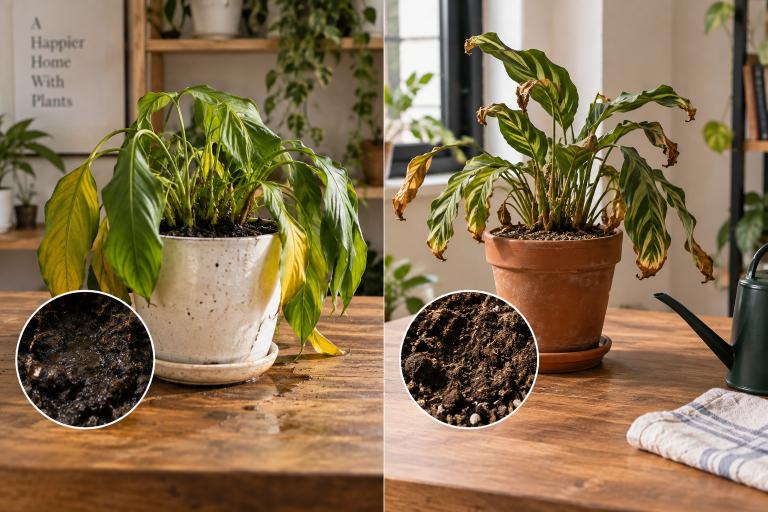
If the population is unusually large and the medium stays saturated, review the watering routine. Let the upper portion of the mix dry to a degree suitable for the species, and water thoroughly when the plant actually needs it. Ensure drainage holes are open and empty catch trays after excess water has drained.
Do not let a moisture-loving species collapse in an attempt to eradicate springtails. There is no universal instruction such as “keep the soil dry for two weeks.” The appropriate drying period depends on plant type, pot size, temperature, and rooting condition. A small pot near a sunny window may dry fast, while a dense mix in a cool room may stay wet much longer.
If a pot is chronically soggy despite careful watering, examine why. The container might be excessively large for its root mass. A decorative pot might have no drainage outlet. The mix may have collapsed into a fine, compacted texture. The plant may be losing roots to disease and therefore using less water. Each cause suggests a different correction.
Repotting is not the default answer to springtails. Disturbing a healthy root ball to replace every grain of mix could be unnecessary and stressful. Reserve a major media change for a demonstrable substrate or root problem, not merely because tiny organisms are present.
What not to do: chemical shortcuts and harsh soil treatments
Do not apply household disinfectant, bleach, concentrated soap, or alcohol to potting mix. Products designed for surfaces or hands can injure roots and disrupt growing media. Nor should you use a pesticide merely because a seller lists “soil bugs” as a target. Insecticides used inside a home must be legal for the site and pest, carefully labeled, and actually warranted.
University of Minnesota Extension notes that pesticides generally are not effective against springtails and should not be used as the indoor solution. Moisture control is the more relevant strategy for nuisance populations. If a plant is genuinely damaged, identify the actual cause instead of escalating a treatment that addresses the wrong animal.
Also avoid sealing a root zone to exclude springtails. Some online suggestions recommend covering the entire soil surface with impermeable materials. That can change gas exchange, evaporation, and water monitoring in ways that are not necessarily suitable for the roots. Solve the conditions that support excessive moisture rather than hiding them.
There is no need to discard an otherwise healthy pot because a few jumpers appear. Disposal becomes more reasonable when the medium is contaminated, the plant has extensive root rot, or another specific problem demands it—not because Collembola were observed.
A practical scenario: white dots after every watering
Imagine a small pothos in a nursery pot placed inside a decorative ceramic cachepot. Its leaves are green and new growth is steady, but every Saturday watering brings dozens of springtails to the surface. The pot feels surprisingly heavy several days afterward.
The owner lifts the inner pot and finds water pooled in the cachepot. That stagnant water is corrected first. Subsequent irrigations are done over a sink; the plant drains completely before returning to its container. The owner checks moisture in the root zone rather than following a fixed weekly schedule. Wet leaf litter on the surface is removed gently.
Over time, the number of visible springtails may decline as persistent moisture decreases. If a few remain, the owner does not treat the plant because it continues to grow well. The intervention succeeded by improving conditions for the roots and reducing nuisance numbers without pretending to sterilize the soil.
Now imagine the same jumpers in a fern kept evenly moist in an airy mix. A different drying regimen might damage that plant. Instead, its owner removes standing water and keeps the pot tidy while accepting some soil fauna. The observation is the same; the sensible care decision is species-specific.
When leaf damage requires another diagnosis
Springtails deserve a second look when you find fresh holes in tender seedling tissue and can rule out other causes, but severe damage on an established houseplant is much more likely to have another explanation. Search for chewing insects, sap-feeding pests, disease lesions, sunburn, and mechanical injury according to the symptom pattern.
For yellow leaves, inspect roots and watering history. For tiny stippled spots, check foliage for mites. For flying insects, distinguish gnats and other small flies from nonflying springtails. A magnified photograph can help, but images without a description of the plant and its conditions can be misleading.
If the identity remains uncertain and damage is progressing, contact a local horticultural Extension or diagnostic service with clear photos and details about the plant and growing environment. This is more reliable than repeating broad pesticide applications until something appears to change.
A five-minute monitoring routine
At the next watering, inspect the surface for jumping versus flying movement. Confirm that the pot drains. Check whether the plant’s leaves are firm and new growth looks healthy. Empty the saucer or cachepot. Return a week later and compare observations rather than reacting to the total number of animals that happen to be visible immediately after water is added.
You do not need sticky traps to count springtails; traps aimed at flying pests are not a meaningful measure of soil jumpers. Nor do you need a complex soil-testing regime unless other plant problems justify it. The routine should be simple enough to repeat without making houseplant care feel like pest surveillance.
The key judgment is whether the plant is suffering. If it is not, springtails are usually organisms to understand and tolerate. If the root zone is overly wet, correct that condition for the plant’s sake. If real damage appears, identify its cause rather than blaming the most conspicuous tiny creature.
References
University of Minnesota Extension — Springtails
University of Minnesota Extension — Managing insects on indoor plants