Scale Insects on Indoor Plants: Brown Bumps, Honeydew, and Control
A brown dot on a ficus stem might be normal bark texture, a healed scar, or an insect feeding beneath a protective covering. Scale is especially easy to miss because many individuals barely move once they settle. You may notice the sticky shelf below the plant before you notice the insects themselves. A quick spray over the leaves can leave the real population untouched along stems and veins.
Scale insects are a diverse group rather than one pest with one universal treatment. Soft scales commonly produce honeydew; armored scales typically have a harder shield and do not produce honeydew in the same way. Knowing which signs you have—and where the insects are attached—allows a measured response instead of treating every harmless bump as an infestation.
Decide whether the bumps are insects
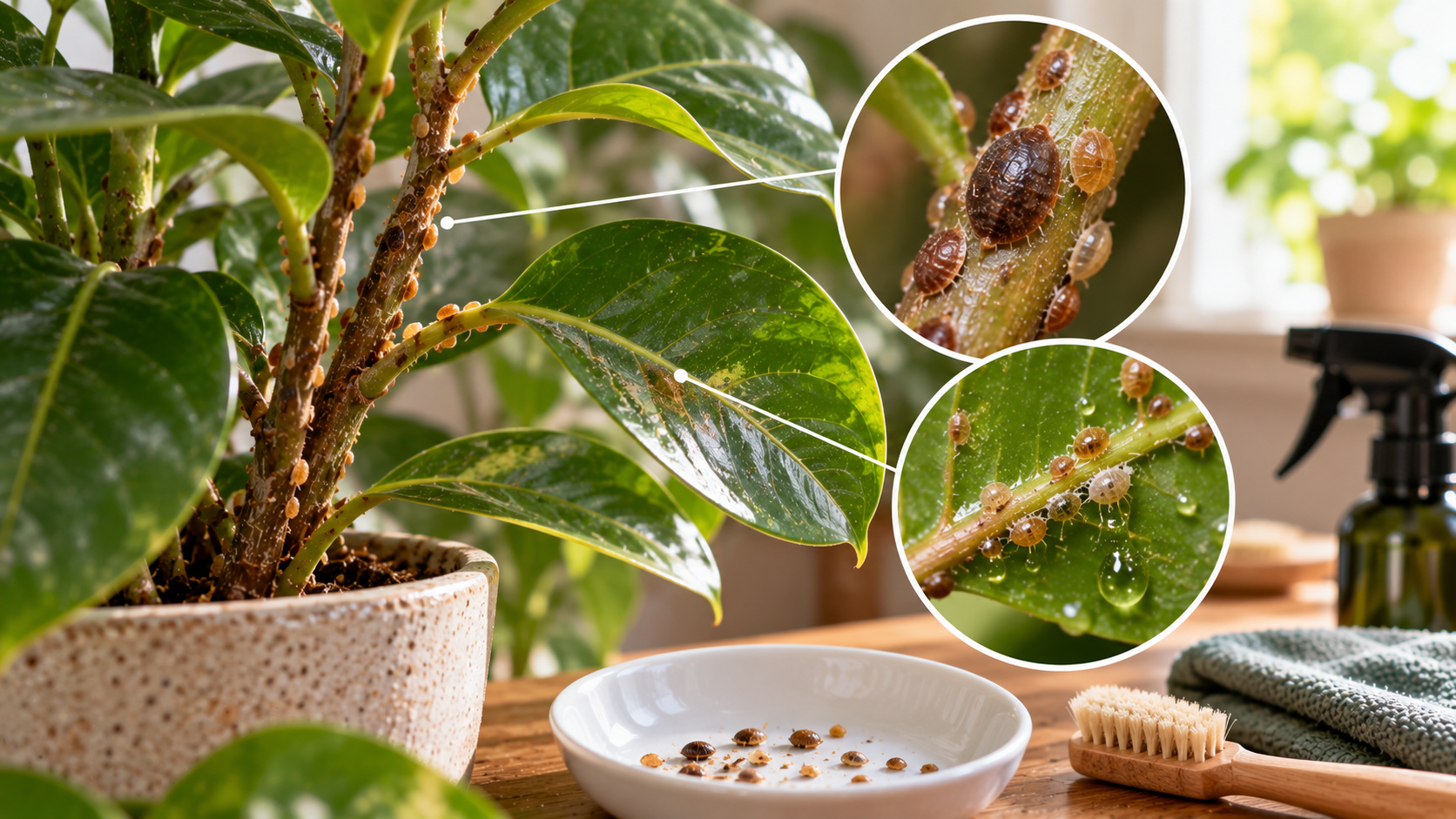
Inspect stems where they meet leaves, along the midrib, and around newer twigs. Scale may appear as tan, brown, gray, or pale raised discs or domes. The shapes differ by group and species. Some look like small shells glued to the plant; others are soft and more rounded. An important clue is repetition: several similar bumps clustered along living veins or shoots warrant closer examination than a single irregular scar.
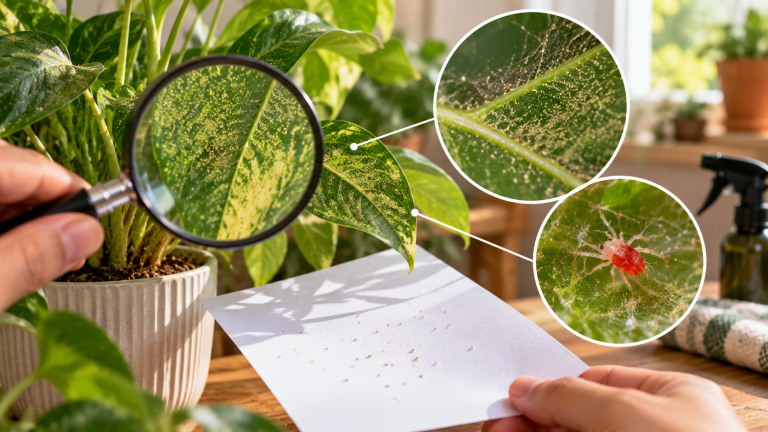
Take an enlarged photograph, then examine the suspected bump with a hand lens. Do not scrape a large section of tender bark to check your theory. Where the plant is sturdy, you may gently lift one suspect individual with a small wooden tool to see whether it separates as an organism rather than part of the stem. Avoid damaging the epidermis, and stop if the plant tissue itself begins to tear.
Some plants naturally develop corking, lenticels, aerial root initials, or textured nodes. These may be mistaken for pests. Normal structural features often follow predictable patterns as stems mature; scale populations can appear irregularly and cluster where sap is accessible. Compare young and old stems of the same plant and inspect an unaffected specimen if possible.
What honeydew tells you—and what it does not
Sticky droplets on leaves, floors, or furniture may be honeydew from sap-feeding insects. Soft scales can produce it, and black sooty mold may grow on the sugary residue. However, a sticky leaf does not identify which sap feeder is responsible; mealybugs and aphids can also cause it. Inspect carefully before selecting a treatment.
Armored scales may not leave this obvious sticky clue. A plant can carry many armored scales while the surrounding surface remains clean. Conversely, a plant with slightly sticky foliage from nectar secretion or residue from a product may not have scale at all. Combining visual inspection with the location of bumps is more reliable than choosing a diagnosis from a single symptom.
Damage often accumulates slowly: loss of vigor, mottled yellowing, reduced growth, and twig dieback in severe cases. Because these symptoms overlap with environmental stress, record actual living scale before blaming the pest for every brown leaf tip. Confirmed insects and new feeding damage provide a stronger basis for action.
Map the infestation before choosing a method
Divide the plant into a few zones: upper stems, lower stems, leaf undersides, new growth, and the pot rim. Count affected zones rather than attempting an exact insect census. A ficus with two localized clusters on a sturdy branch is different from a palm with numerous scales hidden along overlapping fronds. The most proportionate response depends on that distribution.
Isolate the plant where its basic light and temperature remain acceptable, and check adjacent plants for similar bumps. Scale crawlers—the mobile young stage—can spread before settling. Clean pruners and avoid brushing an infested stem against healthy foliage during handling. The RootLuma quarantine guide gives a practical approach to separation that can be adapted to a confirmed infestation.
If the population is limited, physically remove individual scales with a soft brush or damp cloth where plant tissue permits. Work gently and contain debris. Some scales remain attached after death, so a brown shell alone is not definitive proof of an active population later. Fresh crawlers, new settled individuals, and the condition of developing tissue are more informative.
Why coverage and timing matter
Scale insects can be challenging because a shield or waxy covering protects some life stages. Adults that remain fixed may be difficult to reach with contact products, while newly emerged crawlers are usually more exposed. This biological difference is why a treatment that works against visible exposed insects may not affect protected adults equally.
Insecticidal soap, horticultural oils, and other registered products may be options, but efficacy depends on the type of scale, the host plant, exposure, and the label. Some oils can injure sensitive foliage, particularly under heat or intense light. Never assume a product permitted on a garden tree is approved for use on an indoor plant. Read every restriction, including whether the pest is listed and how applications should be timed.
You may see recommendations for rubbing alcohol on individual insects. Although careful spot removal can be helpful on some plants, alcohol can also damage foliage and should not be sprayed indiscriminately. Avoid mixtures of cooking oil and detergent as replacements for formulated products; untested concentrations can be phytotoxic and difficult to remove from leaf crevices.
The goal is to interrupt surviving individuals and new settlers, not merely to make the plant look clean for a day. After an initial removal or labeled treatment, keep inspecting the same stems and a previously clean branch. If new bumps continue to appear, reassess coverage, species identification, and whether nearby plants are a source.
A decision table for common situations
What you find What it may mean Sensible next step
Rough texture present uniformly on old stems Natural corking or bark change Compare with healthy growth before scraping
Several similar raised discs on veins or twigs Possible settled scale insects Examine closely with magnification and map affected areas
Brown domes plus sticky residue Soft-scale infestation is plausible Inspect for living insects and check neighboring plants
Dry hard shields but little or no honeydew Armored scale is possible Confirm identification; do not rely on honeydew as a test
Shells remain but no new insects appear Dead individuals or abandoned covers may persist Monitor new growth and new crawler activity
Branch decline without confirmed insects Another cause may be involved Evaluate roots, water, light, and plant health separately
A decision table is useful only when observations are good. If you cannot determine whether the bumps are insects, show photographs to a local extension service or experienced horticulturist before repeated pesticide applications.
Keep the plant stable during recovery
A scale-infested plant still needs appropriate growing conditions. Do not fertilize heavily to replace lost vigor while feeding insects remain. Excess water or an oversized pot may add root stress, making recovery harder to interpret. Set the plant where you can inspect every affected stem without repeatedly scraping it against surrounding furniture.
After insect activity is controlled, sticky honeydew and associated sooty mold may remain. Remove residue with an appropriate gentle cleaning method rather than confusing it with a new wave of pests. For smooth foliage, the RootLuma leaf-cleaning article provides a cautious approach that avoids unnecessary leaf-shine products. If soot returns on freshly cleaned leaves, look for continued honeydew production.
Damaged foliage may not recover its original color. The healthier signal is renewed normal growth, fewer new insects, and reduced fresh residue. A plant with an extensive old infestation may need many weeks to show improved vigor, particularly in low-light seasons. Avoid interpreting slow growth as a need for daily interventions.
A realistic case: sticky floor under a rubber plant
Suppose a rubber plant near a bright doorway develops a tacky patch on the floor beneath one branch. A quick inspection of the topmost leaves shows nothing obvious, but the underside of the leaf midribs carries several rounded tan bumps. Rather than washing the entire room with insecticide, photograph the bumps, isolate the pot if practical, and check whether they are living scales. If the population is localized, careful removal may be feasible.
After removing accessible insects, clean the floor and a few affected leaves so future honeydew can be recognized. Observe the same branch and nearby plants over subsequent weeks. Fresh sticky deposits or new insects indicate that the underlying source remains. If activity persists, select a control labeled for the confirmed pest and indoor use, following the manufacturer or local extension guidance.
The example illustrates why environmental cleanup and insect control are different jobs. Removing old honeydew improves hygiene and visibility, but it does not remove scales hidden on the branches. Conversely, effective pest reduction may leave dead shells attached. Evidence of current activity should guide the next action.
Common errors to avoid
Treating ordinary stem texture. Overzealous scraping can damage living bark. Confirm whether an individual insect body is present before making removal the priority.
Assuming all scales leave honeydew. The absence of sticky leaves does not rule out armored scale. Match the observation to the type of scale rather than expecting one symptom from every species.
Spraying only leaf tops. Many individuals shelter along stems and veins. Incomplete coverage leaves protected areas untouched even when the plant looks freshly washed.
Repeating a product without checking the label. Some pesticides used for other insects are unsuitable or ineffective for scale. Species, growth stage, plant sensitivity, and indoor approvals matter.
Throwing away a healthy plant immediately. Localized infestation is often manageable. The decision to discard should reflect severity, accessibility, plant condition, and risk to the rest of the collection.
When a heavily infested plant needs a harder decision
Not every plant is equally practical to treat. A smooth-leaved rubber plant with clusters concentrated on accessible stems may allow effective manual removal and repeated inspection. A dense palm with many thin leaflets can conceal hundreds of insects, making complete coverage difficult. The difference is not simply the number of visible scales; it is how well you can reach the places where young stages settle.
Consider the plant’s condition and the rest of the collection. If the infested specimen is inexpensive to replace, nearly leafless, and surrounded by valuable healthy plants, disposal in a sealed bag may be a reasonable protective choice. That is not a moral failure or proof that scale always wins. It is an allocation of effort and risk. On the other hand, a vigorous sentimental plant with a modest infestation may justify a longer course of careful monitoring.
Keep disposal material contained so insects do not fall onto neighboring foliage as you carry it through the room. Clean the shelf and tools afterward, then check nearby plants over time. Discarding the obvious source reduces risk but does not prove that all crawlers have disappeared from the collection.
A note on biological controls
Predatory insects and parasitoids may be used against some scale insects in commercial production or specialized greenhouse settings. Indoor household use is more complicated: the predator must match the pest, survive the environment, and be practical to release in a living space. It is not responsible to suggest buying a random container of ladybirds as a universal scale treatment. If biological control interests you, consult a local professional who can identify the scale species and evaluate an appropriate program.
Frequently asked questions
Are brown bumps always scale insects? No. Corking, scars, and natural stem features may resemble scale. Examine distribution and look for individual bodies.
Can scale return after removal? Yes. Hidden individuals or emerging crawlers may establish new populations. Continue checking the affected stems and neighboring plants.
Does soap work on every type of scale? No universal claim is justified. Contact products differ in effectiveness by type and life stage and must be used according to their approved labels.
Should I strip the leaves? Removing most foliage can weaken the plant. Prune only severely affected parts when that is a proportionate choice.
Why does sooty mold remain after insects disappear? The fungus grows on leftover honeydew deposits. Cleaning the residue is separate from stopping its production.
The lasting fix is better observation
Scale control is easier when you know what is alive, what is old residue, and where a new generation might appear. Begin with identification, map affected plant surfaces, remove manageable clusters, and use labeled control options only where warranted. Revisit the same locations over time. That approach respects both the biology of the pest and the health of the plant it is feeding on.
References
University of Maryland Extension — Scale insects indoor plants
University of Minnesota Extension — Insects on indoor plants