Houseplant Potting Mix Ingredients: Perlite, Bark, Coir, and More
A bag labeled “houseplant potting mix” describes a product category, not a universal growing environment. Two mixes may both look dark and fluffy while behaving very differently after watering. One stays saturated around the roots for days; another drains rapidly and demands frequent attention. Understanding the ingredients helps you predict those differences rather than following a recipe because it appeared in a popular video.
The central question is not which single ingredient is best. It is what combination of water storage, drainage, air-filled pore space, physical stability, and plant compatibility a container needs in your actual home. A small plant under modest winter light uses water differently from a vigorously growing plant near a bright summer window. Pot shape, watering practices, and root mass change the outcome too.
What growing media need to do
Roots require water and oxygen. A functional potting medium makes both available after excess water has drained away. Very fine particles can fill large pores, slowing gas exchange and water movement. Very coarse components may leave a medium that dries too quickly for a small-rooted tropical plant in warm indoor air. Stability matters because organic ingredients break down over time, and the structure of a once-airy mixture can change.
Most container mixes are intentionally different from garden soil. Mineral soil from outside can compact heavily in a small pot, may carry pests, and is not automatically suited to drainage in a container. A soilless mix uses components selected for physical properties rather than relying on backyard topsoil. University Extension guidance on potting media emphasizes that component selection and handling influence the final performance.
Drainage holes remain necessary even when the mix is coarse. Water does not disappear simply because bark or perlite is present; it has to leave the pot, and a decorative cachepot can trap what drains. Conversely, a light mix does not justify watering every day regardless of plant demand. Ingredients help set the potential behavior; the growing setup determines the actual behavior.
Perlite: air spaces without much weight
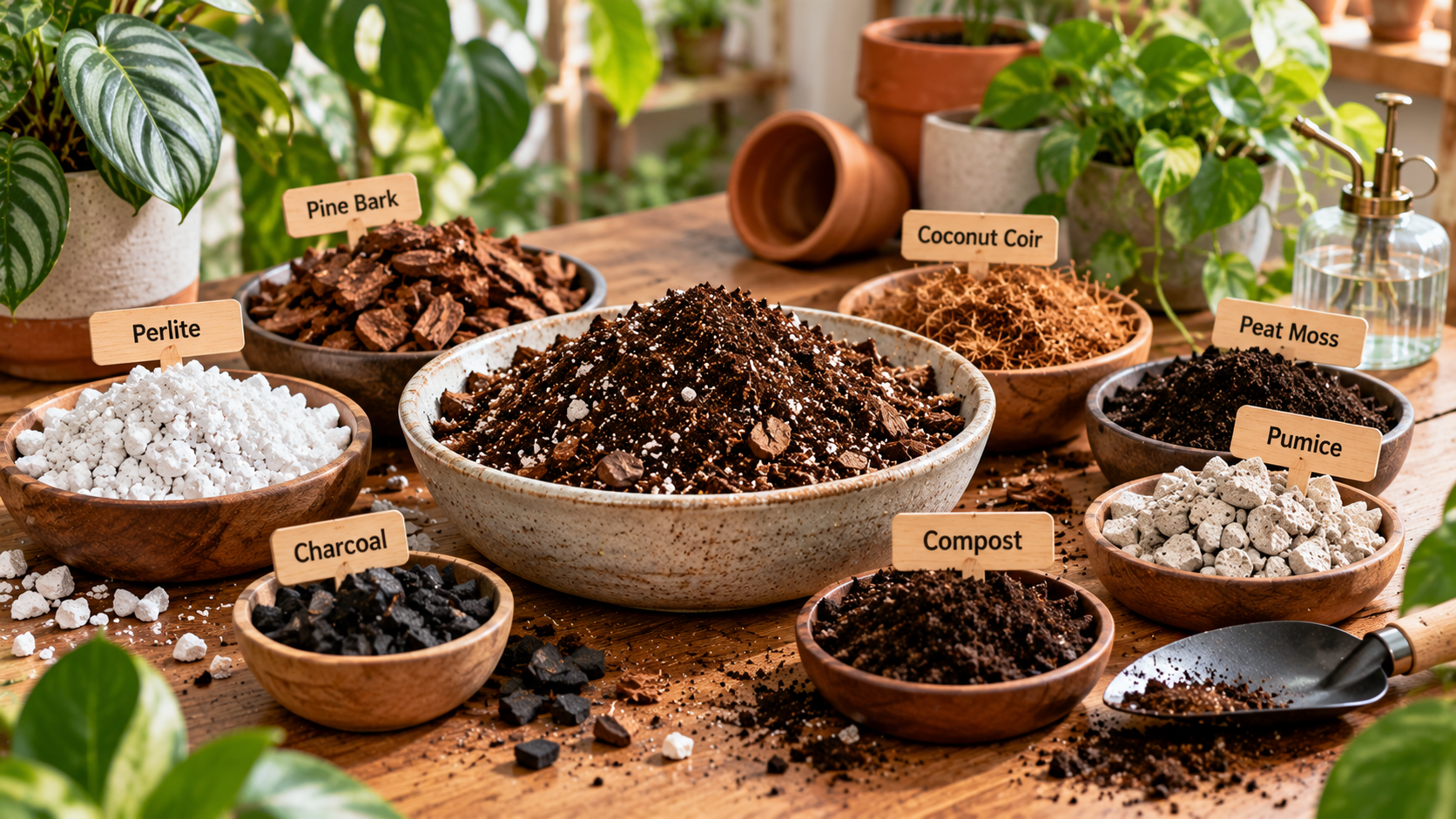
Perlite is a heat-expanded volcanic material often recognizable as white, lightweight particles. Its main value in container mixes is physical: it helps keep the medium open and reduces density. It can improve aeration when blended appropriately with finer components. The particles do not act like a sponge capable of storing unlimited water, and adding perlite cannot rescue a pot with no drainage or a root system already badly damaged.
The drawback is that perlite can float or migrate toward the surface during watering, especially in very loose mixes. Fine perlite dust may irritate the eyes or respiratory system when poured dry. Moisten it and work in ventilation rather than shaking dusty bags in an enclosed room. Perlite also does not provide the bulk of a plant’s nutrients, so it should not be mistaken for fertilizer.
Pine bark and other coarse organic pieces
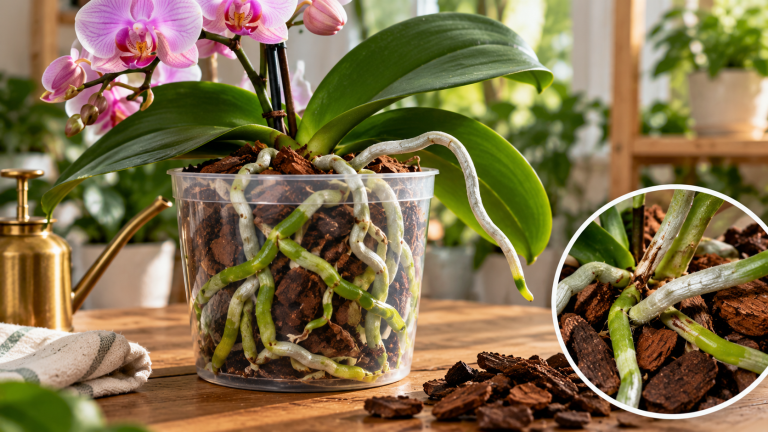
Bark introduces relatively large particles that can help maintain structure, especially in epiphytic or aroid mixes that benefit from substantial air spaces. The useful size depends on the plant and pot. Huge chunks around fine seedlings may provide too little continuous root contact, while small particles that break down rapidly may not maintain openness in the long term.
Bark is an organic material and changes as it decomposes. Over months or years it can become finer and alter moisture behavior. A plant that was comfortable in a bark-heavy mix when potted may eventually need fresh material because the old medium has settled. Do not respond by pushing a stick aggressively through the roots every week; instead, assess drainage, root condition, and the age of the mix.
Some products sold as “orchid bark” contain blends or sizes intended for specific uses. Inspect the actual particles rather than assuming all bark bags are equivalent. For epiphytic orchids, pot structure and moisture management are particularly important; for ordinary foliage plants, bark may be one ingredient among several rather than the entire medium.
Coconut coir: water retention and handling differences
Coir comes from coconut husks and is sold as fibers, pith, chips, or compressed blocks. The forms behave differently. Fine coir pith can retain substantial moisture, while larger chips contribute more coarse structure. Coir is not automatically a one-for-one replacement for every component in every recipe, although it can serve as part of a balanced growing medium.
Product quality matters. Processing and washing influence soluble salts, so choose materials intended for horticultural use and follow preparation directions. If a compressed block requires rehydration, expand it fully before measuring by volume. A dry compressed brick and a loose hydrated mix do not represent the same usable quantity. Coir provides structure and water-holding capacity, not a complete nutrient supply.
Because it can hold water, increasing coir proportion may be helpful in fast-drying pots but unhelpful in a large container that already stays wet for days. Judge it by root-zone conditions rather than assuming its plant-based origin guarantees better results.
Peat, compost, pumice, and mineral ingredients
Peat moss is widely used for moisture retention and fine structure. It can be difficult to rewet when thoroughly dried, depending on formulation, and sourcing raises environmental questions connected to peatland ecosystems. Choosing a lower-peat or peat-free product can be a reasonable preference, but performance still matters; a poorly matched peat-free mix may not serve the plant simply because of its label.
Pumice is a porous volcanic rock that can maintain relatively durable air spaces and adds more weight than perlite. This may suit top-heavy plants, but it also makes a large container harder to lift. Horticultural grit or coarse sand can increase mineral fraction when correctly sized, whereas fine construction sand may reduce large pore space and make a mix heavier without improving aeration. Do not assume all sand produces drainage.
Compost can contribute nutrients and water-holding capacity but varies enormously in maturity, salts, particle size, and biological activity. Too much fine compost in a small indoor pot may create dense, persistently moist conditions. Use mature, suitable products and think of compost as one component, not proof that a potting medium will feed any plant indefinitely.
Compare common ingredients by function
Ingredient Main contribution Main tradeoff
Perlite Lightweight air-filled structure Dust, floating particles, little nutrition
Coarse bark Open texture and structural chunks Breaks down and sizes vary
Coir pith Water retention and bulk Salt quality and overly wet blends
Peat moss Moisture-holding fine component Rewetting behavior and sourcing concerns
Pumice Durable porous mineral particles Weight and local availability
Compost Organic matter and some nutrients Variable maturity, salts, and fineness
Coarse grit Weight and mineral structure Fine grades may compact a mix
These are typical tendencies, not guaranteed outcomes. Actual particle size, the ratio among ingredients, compaction during filling, and the pot’s drainage arrangement can change performance dramatically.
Match the mix to the plant rather than a trend
Aroids that climb in nature may benefit from a structured medium that retains some moisture while leaving ample air spaces. Succulents generally need more rapid dry-down in ordinary indoor conditions, especially when light is limited. Ferns often require more consistent moisture than drought-tolerant plants, but they still need oxygen around their roots. The labels “chunky” and “moisture-retentive” describe properties, not complete recipes.
For a small seedling, a fine, uniform propagation medium may give better root contact than a container of large bark pieces. For a large mature climbing plant, some coarse structure may remain useful longer than a pure fine-textured medium. These examples illustrate why a ratio such as one part perlite to one part bark to one part coir should be treated as an experiment, not a law.
The RootLuma article on root rot explains why prolonged poor root-zone conditions matter. Ingredients are relevant because they influence how much water and air remain available after watering. But root disease has multiple possible contributors; changing one ingredient does not guarantee immunity.
Test a candidate blend before repotting everything
Prepare a small sample using the same ingredients and proportions you intend to use. Fill a spare draining pot to the depth you expect, water thoroughly, and allow excess to drain. Note how the surface looks immediately, after a day, and over the following several days. Lift the container to understand its weight change. If you can, compare with the mix currently used for a healthy plant in a similar room.
A pot of medium without roots does not perfectly predict water use once planted; it is a physical demonstration, not a calibrated scientific test. Still, it can reveal an obviously dense mixture, persistent standing water in a cachepot, or components that segregate when watered. It also helps you practice adding water evenly rather than dumping it into one spot.
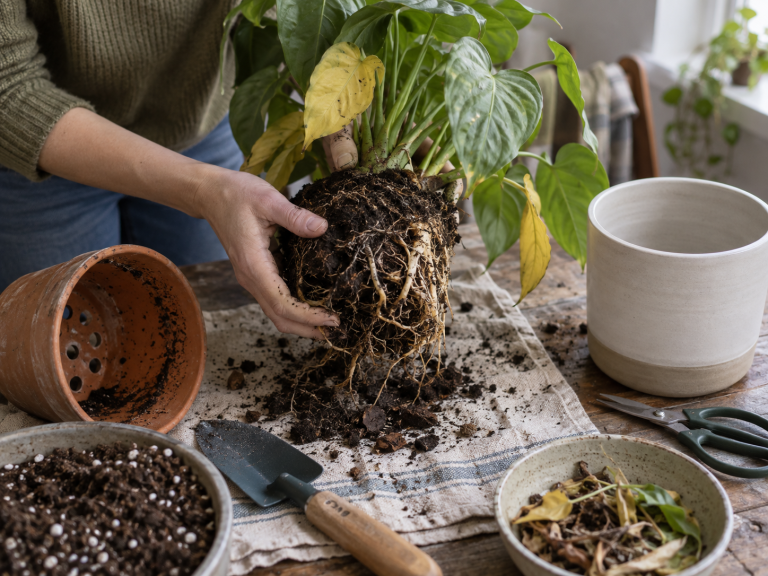
When repotting, fill around the root ball gently so roots make contact with the medium without crushing its pore spaces. Avoid packing each handful as firmly as concrete. The RootLuma repotting guide provides the broader handling steps. Once the plant is settled, observe its water use under current light and temperature rather than copying your old schedule automatically.
Troubleshooting a mix that does not behave
The surface dries but the bottom remains wet. This may reflect pot depth, particle distribution, inadequate drainage, low root water use, or a large container. Check below the crust and empty standing water. Do not solve the problem by adding a decorative dry top layer and assuming everything underneath is fine.
Water runs through instantly and the plant wilts. A dried-out mix may have become water-repellent or coarse components may hold insufficient moisture for that plant. Apply water gradually to rewet appropriately and assess whether the blend suits the species; soaking or repeated small applications should be used with attention to drainage and root condition.
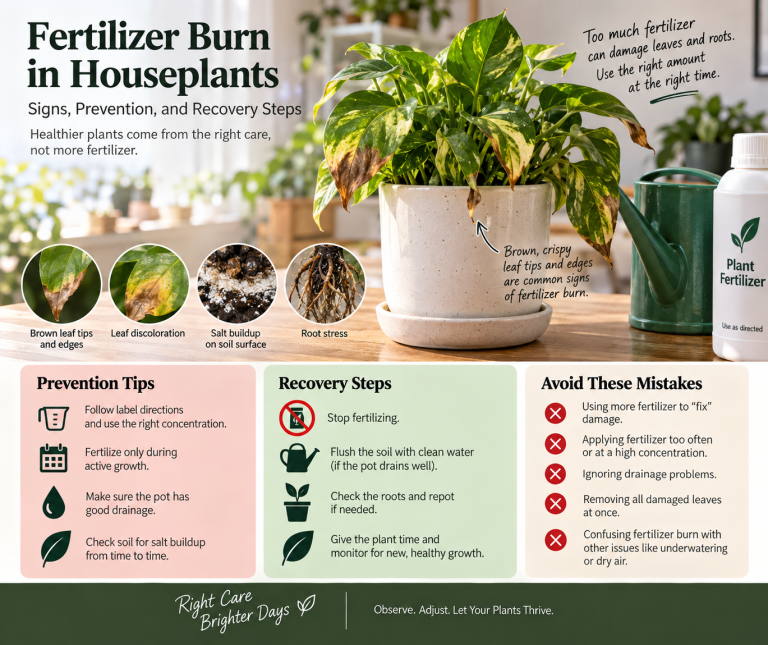
White deposits appear on the surface. They may be mineral salts, fertilizer residue, or biological growth. Observe texture and distribution instead of calling every pale patch mold. Review water quality, fertilizer use, and medium conditions as appropriate.
The mix sinks noticeably after months. Some settling is normal, but rapid collapse suggests that fine material is filling pores or organic pieces are breaking down. Investigate drainage and root vigor before deciding to replace medium.
The plant seems root-bound despite fresh mix. The issue may be container size and root growth rather than ingredients alone. Adjust pot size modestly when the root system warrants it, not simply because the mixture looks different from an online photograph.
Handling and storage change what goes into the pot
Even a well-chosen medium can behave badly if the ingredients are stored poorly. Keep dry bags protected from rain and prevent fine dust or garden debris from being introduced during mixing. If you measure by volume, compare ingredients in a consistent moisture state: a compressed dry block of coir expands substantially when hydrated, and a bucket of damp bark contains more water than the same bucket of dry bark.
Do not blend fertilizer granules into a homemade mixture without understanding the product’s labeled rate and how the finished pot will be watered. Nutrient strength can be harder to estimate when several commercial mixes already contain fertilizers. For a useful first test, start with a simple base medium and change one physical component at a time. Record what you mixed; otherwise, even a successful pot will be hard to reproduce.
Wear appropriate protection for dusty dry materials and wash hands after handling. Moistening perlite and other light particles before pouring can reduce airborne dust. A tidy work surface is not only convenient—it helps prevent unplanned changes to the medium that you are trying to evaluate.
Choose the next adjustment from what the pot actually does
A mix cannot be judged by the ingredient list alone. If it stays wet for an unusually long time, check drainage holes, pot size, plant water use, and the particle size of the blend before adding more coarse material. If it dries rapidly while roots remain healthy, examine the amount and condition of moisture-retaining material rather than assuming that the plant always needs daily watering.
Perlite is an option for added structure, not a universal requirement. Orchid bark by itself does not meet every terrestrial houseplant’s needs, and the environmental footprint of coir or peat depends on sourcing and processing. Commercial mixes may contain starter fertilizer, but that varies by product and does not replace ongoing observation.
For a useful comparison, pot two similar plants in small test batches, keep other conditions as consistent as possible, and record watering intervals, new root growth, and leaf condition. Change only one major component at a time.
Better mixes are judged in use
A successful potting mix keeps roots supplied with both water and oxygen for the way the plant lives in your home. Learn what each component contributes, notice how particle size changes texture, and run modest trials before repotting an entire collection. The most useful mix is not the one with the longest ingredient list. It is the one you can water predictably while the plant continues making healthy roots and leaves.
References
Iowa State University Extension — Potting media components and handling
University of Maryland Extension — Growing media potting soil containers