Edema on Houseplant Leaves: Why Corky Blisters Appear
A houseplant leaf develops little raised bumps. Some are translucent at first; others feel rough and look tan or brown. The marks may be concentrated on the underside of a few leaves, making it tempting to assume scale insects, a fungal infection, or a mysterious biting pest. One possibility often overlooked is edema, also spelled oedema: a noninfectious physiological disorder associated with an imbalance between water taken up by roots and water lost through leaves.
The most important part of this diagnosis is what not to do. A plant with edema does not benefit from an insecticide aimed at imagined insects, and its old corky patches will not smooth out after a change in watering. The useful task is to identify the disorder reliably enough, adjust the conditions that encourage it, and look for healthier new growth.
Understand edema as a water-balance problem
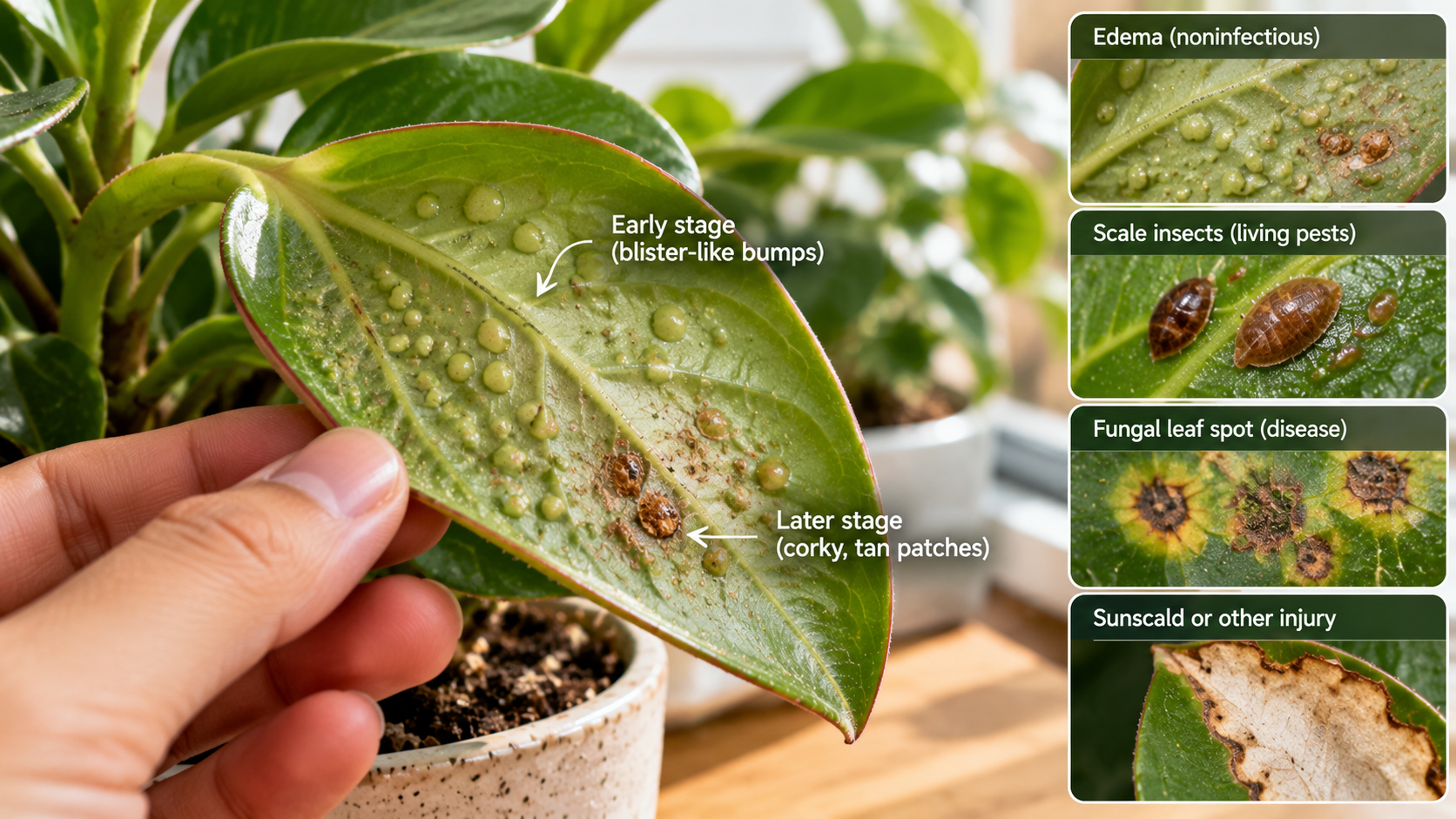
Roots absorb water and transport it into stems and leaves. Leaves release water vapor through transpiration, a process influenced by air movement, humidity, temperature, light, and the plant’s physiology. When roots supply water more rapidly than tissues can use or release it, pressure can damage some leaf cells. The affected areas initially form small water-soaked blisters or raised spots; with time those spots can become rough, dry, corky scars.
This is different from infection. Edema is not a microorganism moving from one plant to another, and a scarred leaf does not spread the condition by touching a healthy one. Several houseplants can develop edema, including jade plants, schefflera, ivy, and African violets, though their symptoms may not look identical. Some varieties are more susceptible than others under the same growing conditions.
The University of Maryland Extension article on edema in indoor plants describes bumps or blisters on lower leaf surfaces that later become brown and are sometimes mistaken for insect or disease damage. The UC Integrated Pest Management guidance likewise emphasizes that edema is noninfectious and that damaged tissue does not regenerate into perfect leaf surface.
How an early blister turns into a persistent scar
The earliest visible spots may resemble tiny translucent pinheads or slightly swollen areas. On many plants they are easier to see from an oblique angle or on the underside of the leaf, where the light catches the raised tissue. As cells rupture and dry, the bumps change color and feel rougher. Clusters may merge into uneven patches. Some affected leaves develop yellowing or eventually fall, especially when damage is severe or the plant is already stressed.
Once the tissue is corky it cannot reverse its structure merely because you water less next week. That is why photos of old spots provide a poor measurement of recovery. A better measure is the appearance of leaves that expand after growing conditions become more stable.
The pattern can also vary by plant. A succulent may have bumps that look like small warts, while a thin-leaved ornamental may show larger scabbed patches. New leaves that were developing during the stressful period may display injury only after they open fully. Give this delay consideration before concluding that your adjustment failed immediately.
Distinguish edema from scale insects
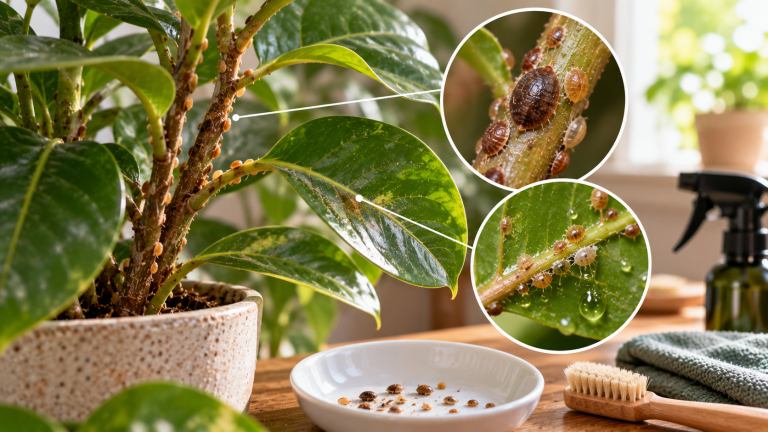
Scale insects are living organisms. Some appear as raised brown shells or soft bumps attached to stems and leaves. They may cluster along veins or nodes, and certain species produce honeydew that makes nearby surfaces sticky. Edema bumps are part of the plant tissue itself; there is no insect body to lift away intact.
Inspect the exact location with a hand lens and a strong side light. Look for different sizes and stages of insects, cottony or waxy material, honeydew, and newly expanding colonies. Do not scrape a suspected spot aggressively. Scraping can destroy leaf tissue and still fail to prove what was present. If you can lift a small structure from a leaf without tearing the epidermis, inspect it carefully; some scale insects detach but old plant scars do not behave the same way.
Also compare the plant’s history. Scale can arrive on a new plant and spread to other hosts, whereas edema often follows a change in environmental conditions. A cluster of similarly affected leaves after several cool, cloudy days and heavy watering is consistent with edema. It is not a laboratory diagnosis, but it may guide what to check next.
Consider other leaf diseases and injuries
Fungal and bacterial diseases can cause brown lesions, sometimes with halos, water-soaked margins, or spreading patches. Those conditions differ in biology and control. Sunscald can bleach tissue exposed to sudden direct sunlight, while salt injury may produce browning along tips or margins. Thrips can leave silver feeding scars, and mites may produce fine stippling. One image taken with a phone rarely distinguishes all these causes reliably.
Look at the location, texture, age, and distribution of the marks. Are the bumps truly raised from within the leaf? Are they mainly on undersides or particular leaves? Is the surrounding tissue otherwise firm and green? Are there live insects, soft decay, sticky residue, or expanding water-soaked lesions? If several observations point in different directions, consult a plant diagnostic clinic before using a pesticide or discarding a valuable plant.
A single leaf can also have more than one issue. For example, a plant may carry residual edema scars and separately develop spider mites weeks later. Diagnosing edema today does not mean you should ignore new symptoms tomorrow.
Check the pot and watering history
Edema often occurs when the growing medium holds abundant moisture while the leaves lose water slowly. Begin by checking whether the pot drains freely and whether water remains inside a decorative outer pot. A pot with drainage holes can still stay saturated if it sits in standing water. Dense media, a large container for a small root system, or a compacted root zone may keep moisture available much longer than expected.
Instead of asking whether you watered the plant “on schedule,” ask how the pot behaved after the last watering. Did it become noticeably lighter over several days? Was the center of the mix still wet when you watered again? Did the plant sit in a cool corner during a cloudy week? Did you switch from a porous nursery pot to a larger, less ventilated decorative container?
Assess moisture below the surface when possible. On small pots, carefully lifting the container may tell you more than the appearance of the top layer. Larger containers may need a wooden probe or careful evaluation of the medium at root depth. A dry crust on top can coexist with a saturated middle; conversely, a dark-looking surface does not automatically mean roots are waterlogged.
Do not take “edema means overwatering” as a command to let the root ball become bone dry. Many tropical houseplants still need even moisture. What matters is correcting a mismatch between water availability and the plant’s current capacity to use it.
Look beyond water: light, air, humidity, and temperature
Water is only half the story. A sudden run of dark, cloudy days reduces light available for growth and can slow transpiration. Air that stays humid and still around crowded foliage also slows moisture loss. Cool air temperatures may contribute to the imbalance even when potting mix retains warmth and moisture.
Place the plant where it receives light appropriate to its species. Do not move a shade-adapted plant directly into intense midday sun as a supposed cure; abrupt exposure can cause an entirely different kind of leaf damage. If the plant is tucked among tightly packed pots, create breathing room without exposing it to a cold draft. A gentle increase in room air circulation is often more sensible than aiming a strong fan at leaves.
Observe the environment at the actual plant position. The top of a shelf can have a different temperature, airflow, and brightness from the lower corner. A pot beside a heating vent may dry rapidly while another on the same shelf stays wet. A humidifier aimed at a dense group of plants can create an unusual local microclimate even when a room hygrometer elsewhere reads moderately.
Season matters. A watering interval that worked in bright summer weather may provide too much water during a darker season. Changes in weather are not under your control, but matching watering to the pot and plant’s present needs is.
Make a conservative correction plan
First, let the existing medium approach the appropriate next-watering point rather than adding water on a fixed date. Empty standing runoff and check that drainage holes are not blocked. Improve the plant’s access to suitable light and airflow. Separate crowded plants enough to allow ordinary inspection. If the plant is otherwise healthy, these adjustments may be all that is necessary.
Avoid making five drastic changes on the same day. Repotting a mildly affected plant into a different mix, moving it to direct sun, cutting half the foliage, and applying pest spray will make it impossible to identify which action helped or hurt. Reserve repotting for convincing evidence of persistent saturation, unsuitable medium, root problems, or a badly oversized pot.
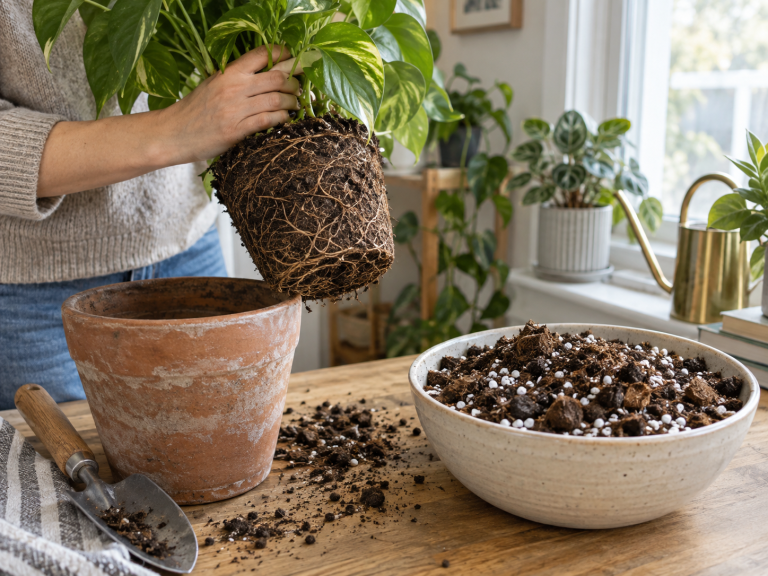
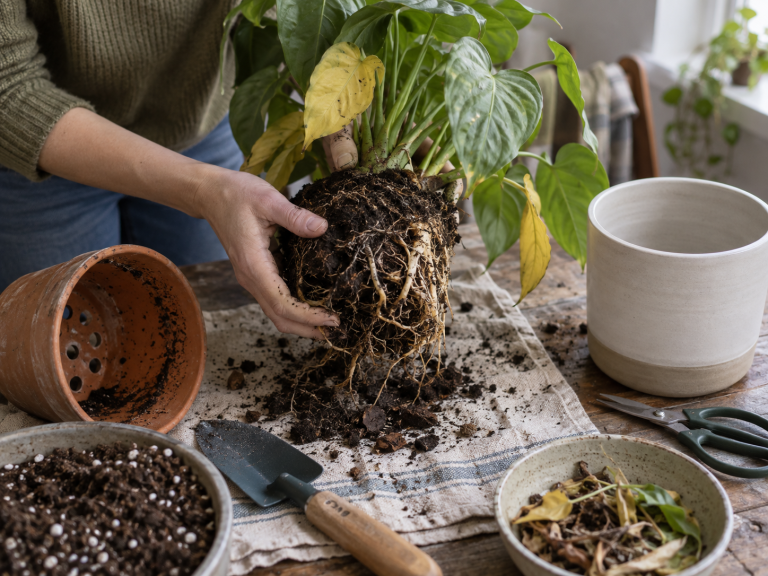
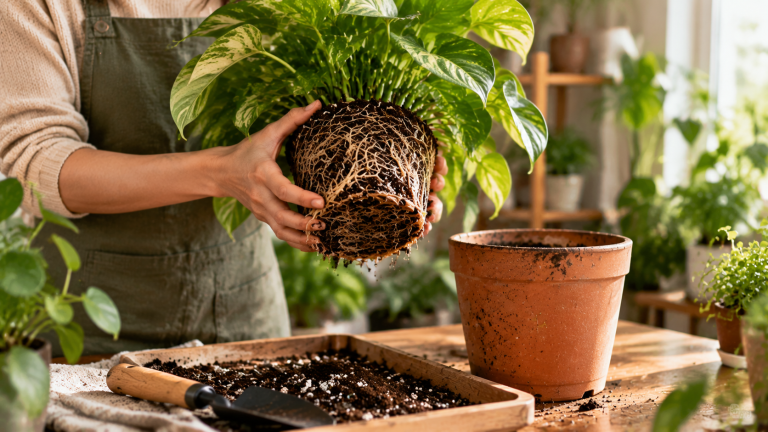
If repotting is justified, use a container sized for the root system and a medium that balances air and water for that species. Be gentle with roots. Choose a time when the plant can recover, and expect a temporary change in growth while it settles. Root disturbance is not necessary simply because some older leaves look corky.
Do not remove all scarred leaves. They may remain photosynthetically useful, and stripping them can weaken the plant. Remove a leaf only if it is mostly dead, decaying, obstructing air movement, or otherwise no longer beneficial. Cosmetic perfection is not worth sacrificing a healthy canopy.
A real-world example: a jade plant after rainy weather
Imagine a jade plant near a window during a week of cool, overcast weather. The soil stays moist longer than usual, but you water again because it is the usual weekend. Several older leaves develop tiny rough brown bumps along their undersides. You cannot find insects or sticky residue, and the leaf surfaces are otherwise firm.
Instead of treating for scale immediately, you document the raised spots, check drainage, and compare the watering history with the change in daylight. You skip the automatic weekend watering, check the pot’s weight over the next few days, and move it to an appropriately brighter position without exposing it suddenly to harsh sun. You avoid the urge to repot a healthy root system just to eliminate old blemishes.
A month later the original bumpy leaves are still bumpy, but new growth is smooth. That is consistent with an improved environment. If new lesions continue or symptoms spread in unexpected ways, you revisit the diagnosis. The case is an illustration of reasoning, not a promise that every plant will respond in exactly a month.
Use a simple observation log
Record the date, approximate pot moisture, last watering, recent weather or light change, and whether new leaves show spots. You do not need a specialized app. A few notes next to photos are enough, especially if you keep photos at similar angles. The most useful distinction is “existing lesions unchanged” versus “new lesions on newly expanded leaves.”
Review the log after several new leaves have grown, not after only a few days. Some plants are slow growers; a jade plant in a dim winter position may provide little new foliage for weeks. In that case, steady firmness and the absence of expanding fresh damage are useful interim signs. On a faster growing plant you may be able to judge sooner.
Keep observing for signs that do not fit edema: live insects, sticky deposits, soft rotting tissue, rapid lesion expansion, or widespread collapse. Those signs deserve additional investigation rather than another reduction in watering.
When to ask for diagnostic help
Seek advice if bumps appear rapidly on many species under different conditions, if the plant develops wet rot or extensive leaf drop, or if the evidence cannot distinguish edema from insects or disease. Provide photos of both leaf surfaces, a picture of the whole plant, pot and drainage information, and a brief timeline of watering and light. This is more useful than supplying a close-up without context.
Edema does not usually call for dramatic treatment. It calls for understanding the relationship between root-zone moisture and the conditions surrounding leaves. Confirm the pattern, make modest improvements, and judge the result on healthier new growth rather than trying to erase scars that are already part of the leaf.
References
University of Maryland Extension — Edema of Indoor Plants
University of California IPM — Edema
Royal Horticultural Society — Oedema