How to Tell If a Houseplant Is Root-Bound and What to Do Next
The goal is not to memorize another rule; it is to build a repeatable way to judge the situation before you act. This guide focuses on how to tell if a houseplant is root-bound and what to do next, with an emphasis on observations that can be made in an ordinary home rather than an ideal greenhouse setup. The central principle is that a root-bound plant has filled much of its available pot volume with roots, but some plants can remain healthy in a snug container for a considerable time. That matters here because roots at a drainage hole or near the surface are clues, not automatic proof that immediate repotting is required. Root-zone problems are often hidden until the leaves respond, which makes drainage behavior and soil condition useful clues. Because indoor plants grow at different rates through the year, a similar action can be helpful in active growth and unnecessary during a slower period. The goal is a calmer method: understand the likely process, check the strongest clues, make one change, and let the next trend provide feedback.
Look for Agreement Between the Clues
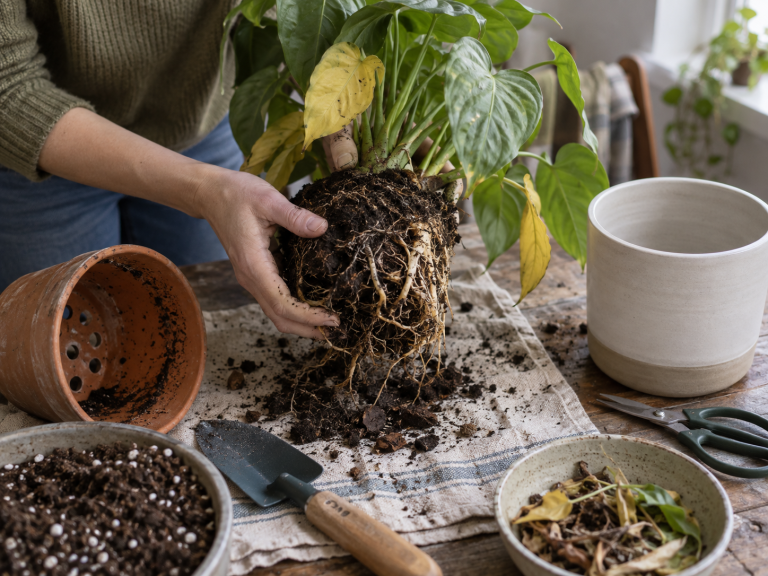
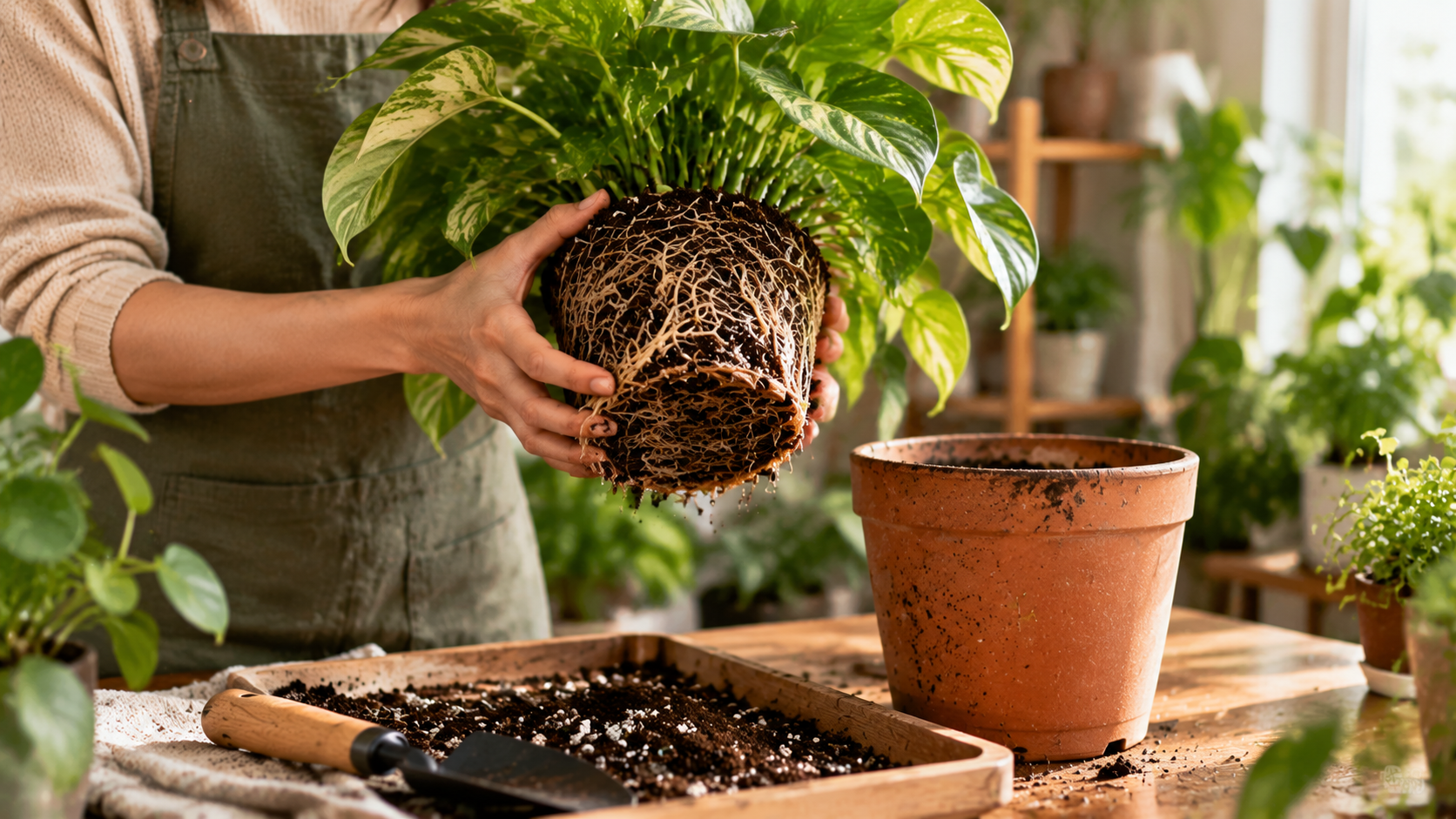
Before changing care, collect a small set of observations: rapid drying, water passing through unusually fast, circling roots, slowed growth despite good conditions, pot distortion, and a dense root ball. These are valuable because they can be checked again later, making the next decision less dependent on memory or guesswork. The best clues are usually the ones you can observe again after the adjustment, because they give you a built-in way to judge the result. In this particular care decision, photos taken several days apart are often more useful than constant checking because gradual changes become easier to see. Stable basics—appropriate light, sensible watering, drainage, and time—make it less difficult to tell whether a more specific intervention is actually needed. The purpose of the check is to build enough agreement between clues that the next step is defensible and easy to evaluate.
Understand the Process Before Changing Care
The most important point is that A root-bound plant has filled much of its available pot volume with roots, but some plants can remain healthy in a snug container for a considerable time. That statement is useful because it describes a process, not a calendar rule, and it gives you something concrete to compare with the plant’s response. This is why a single number, date, or visual symptom rarely deserves to control the entire care decision. A clear mechanism also makes later troubleshooting faster because you know which variables are capable of producing the pattern you are seeing. Stable basics—appropriate light, sensible watering, drainage, and time—make it easier to tell whether a more specific intervention is actually needed. That gives you a practical reference point for the observations that follow.
Why Season and Position Belong in the Decision
Microclimates matter here: roots at a drainage hole or near the surface are clues, not automatic proof that immediate repotting is required. Recheck the situation after seasonal changes, furniture moves, heating or cooling changes, or anything else that alters the plant’s immediate environment. Revisit placement after seasonal changes instead of assuming a successful summer location will behave the same way all year. The more stable the surrounding conditions are, the easier it becomes to tell whether the specific care change was helpful. A related RootLuma guide, Why Potting Soil Becomes Compacted and How to Improve Root-Zone Airflow, can help you verify whether the surrounding conditions are contributing to what you see. Rechecking those local conditions is especially worthwhile when the season, heating, cooling, or sun angle changes.
Recent Changes Can Explain More Than One Symptom
A simple timeline turns vague concern into usable evidence. Note the last major care change, the first day the symptom was noticed, and what happened afterward. That sequence is often enough to rule out at least one tempting explanation. A short history can also reveal whether the plant has experienced that same pattern before under similar seasonal conditions. If you recently made a correction, give it enough time to be evaluated before layering another one over it. A houseplant often shows stress after the triggering condition has been present for days, so a symptom is best treated as evidence instead of simply an instant diagnosis. The most reliable baseline is the plant’s own recent pattern: how quickly it dries, how firm the leaves feel, and what healthy new growth looks like. Treat the timeline as supporting evidence, then compare it with what the plant is showing now.
Use a Step You Can Reverse or Adjust
Turn the diagnosis into one clear move: Repot when restricted root space is affecting care or growth, not simply because one root is visible. The purpose is not to force instant improvement but to create conditions in which the plant can show whether the reasoning was sound. Keep the rest of the basic environment as stable as practical so the response has a clear reference point. A small correction also reduces the chance that the plant has to adapt to several new stresses all at once. In this particular care decision, for plant-care questions, the condition of the root zone and the quality of new growth usually deserve more attention than one damaged older leaf. The next useful information comes from the plant’s response, not from adding another intervention immediately.
Do Less When the Evidence Is Weak
The situation becomes harder to read when care is driven by urgency. Common examples include jumping several pot sizes, teasing apart every root, repotting during unrelated stress, and confusing poor soil with root binding. Keeping the response narrow protects both the plant and the quality of your observations. If a pest or disease is suspected, confirm the evidence as far as practical before applying broad treatments to every plant nearby. For this plant care topic, avoid treating one online photo as a diagnosis because many unrelated problems produce similar-looking leaves. A houseplant often shows stress after the triggering condition has been present for days, so a symptom is best treated as evidence rather than an instant diagnosis. For this plant care topic, good troubleshooting protects the clarity of the next observation as much as it protects the plant.
Old Damage Is Not the Same as Ongoing Damage
Measure improvement with repeatable observations. Compare photos, pot condition, new growth, leaf firmness, or other relevant signs at similar times rather than checking constantly and reacting to small day-to-day fluctuations. New growth is particularly useful because it reflects conditions after the adjustment rather than before it. In this particular care decision, if the same symptom continues on new growth, revisit the diagnosis instead of repeating the original correction automatically. Changing several care factors at once makes it difficult to know which adjustment helped or caused new stress. This is also where Root Rot in Houseplants can help, because it addresses a related decision that is easy to misread in isolation. In this particular care decision, use the direction of the trend to decide whether to continue, refine, or reconsider the original approach.
Make Observation Part of Normal Care
For future care, inspect the root ball only when other signs support the suspicion, then choose the smallest appropriate increase in pot size. Keep the routine short enough to repeat consistently and use it as a checkpoint rather than an automatic instruction to water, feed, move, or prune. Consistency is valuable because it builds a baseline, but flexibility is what allows the maintenance routine to remain appropriate as conditions change. When a simple routine starts creating unnecessary actions, simplify it back to observation, prioritization, and one measured response at a time. In this particular care decision, for more context on the underlying care factor, read How to Tell When a Houseplant Needs Water before adding another adjustment. The system should become simpler to maintain as the weeks pass, not more complicated with every new lesson.
The Practical Takeaway
Use this topic as a model for future decisions: a root-bound plant has filled much of its available pot volume with roots, but some plants can remain healthy in a snug container for a considerable time. The combination of observation, context, measured action, and follow-up is more useful than any one shortcut because it keeps the plant’s actual response at the center of the process. When the space and routine are easy to understand, small problems can be addressed before they trigger a chain of unnecessary corrections. The result is a care system that can adapt without becoming complicated every time the season or plant size changes. The most reliable baseline is the plant’s own recent pattern: how quickly it dries, how firm the leaves feel, and what healthy new growth looks like. Used consistently, it reduces guesswork without requiring perfect control over the local growing conditions.