Growing Carrots in Containers: Root Depth, Thinning, and Harvest
Carrots look like an ideal small-space crop: no sprawling vines, no heavy trellis, and a harvest hidden neatly under the soil. Yet a shallow decorative bowl may produce a lush tuft of leaves above a cluster of forked or undersized roots. Successful container carrots require enough uninterrupted depth, a loose medium, and careful seedling spacing long before orange shoulders appear.
The practical way to plan a carrot pot is to work backward from the root shape you want to harvest. Choose a cultivar suited to the container’s usable depth, sow directly rather than transplanting ordinary seedlings, and thin decisively before the roots crowd one another. Water evenly without keeping the pot waterlogged, and harvest based on variety and visible development rather than assuming every carrot follows the same calendar.
Match the variety to the usable depth
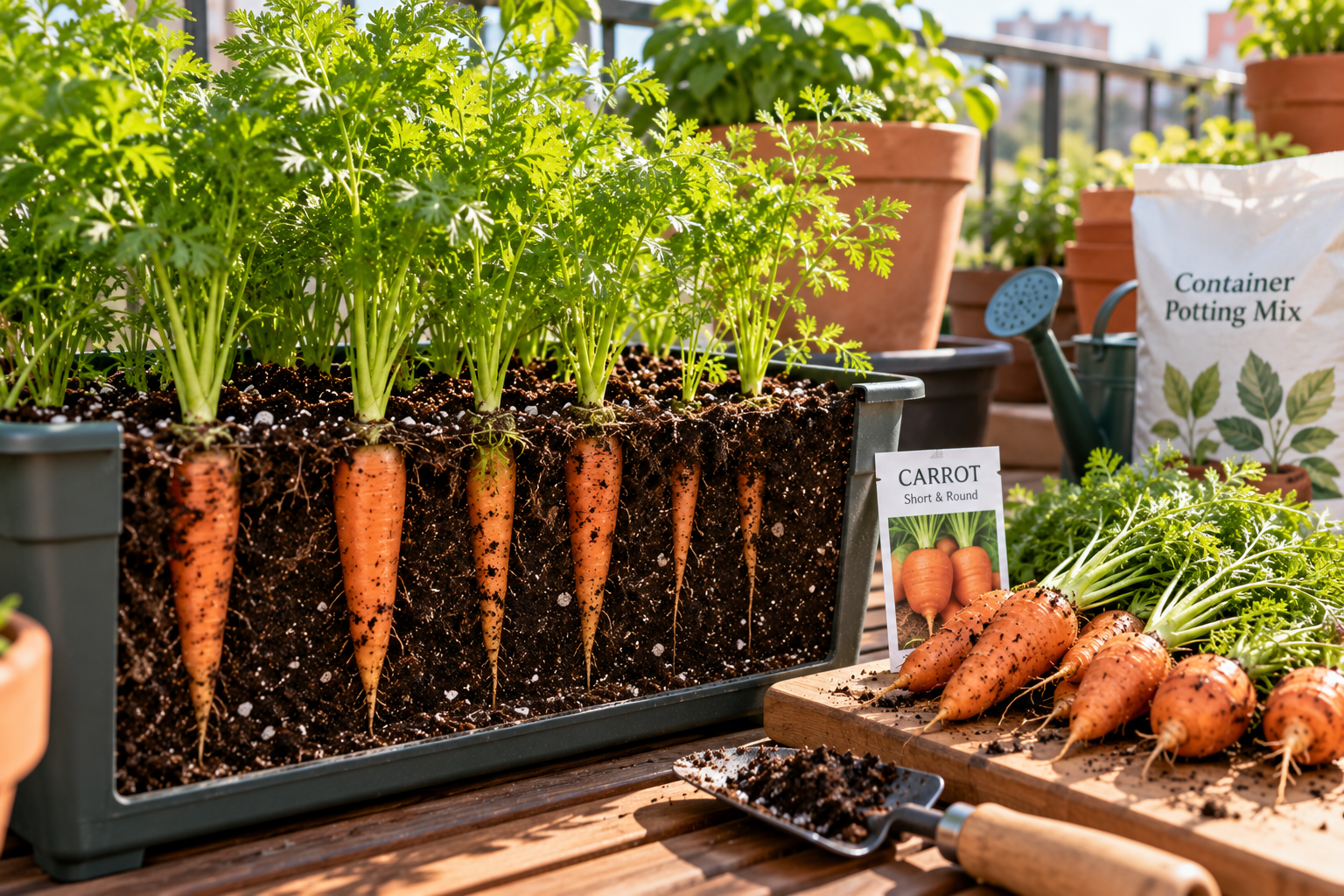
Carrot cultivars differ substantially in mature length and shape. Some are long and tapered; others are shorter, cylindrical, or nearly round. A compact cultivar designed for shallow soils makes more sense in a modest balcony planter than a long-rooted storage carrot that needs considerably deeper undisturbed growing medium.
Read the cultivar description for expected root length and allow additional usable depth for root development and drainage. The nominal height of a container is not always its usable depth; a thick false bottom, stones, or a raised insert may reduce the volume available to roots. Measure from the settled medium surface to the effective base of the growing zone.
A large container is not automatically better for every planting, but it gives you more flexibility. University of Maryland Extension lists carrots among crops suitable for containers and emphasizes matching container dimensions to plant needs. The exact cultivar, available light, and spacing still matter more than a single gallon figure in a broad chart.
For a windowsill with limited vertical space, very short or round-rooted carrots may be a realistic experiment. For a deep terrace pot, more conventional shapes may be possible. Avoid promising a particular carrot length without knowing the variety and root-zone depth.
Choose a medium that will not obstruct root expansion
Carrots grow best when the developing storage root can enlarge without repeatedly striking hard clumps, stones, or compressed layers. An appropriate container growing mix should be loose, reasonably uniform, and well draining while retaining enough moisture for germination and growth.
Do not fill a balcony pot with dense garden soil just because carrots are “root vegetables.” Soil taken from the ground may compact heavily in a container and hold water differently from a formulated potting medium. Screening out large stones, wood chunks, and hard debris can reduce obvious physical obstacles, though it does not guarantee perfectly straight roots.
Excessively rich fresh manure is not a shortcut to sweet carrots and can contribute to undesirable root forms under some conditions. Use an appropriate prepared potting mix with a balanced fertility plan rather than packing the root zone with undecomposed organic waste. Some branching is normal variation; not every fork is caused by a single identifiable mistake.
Water the filled pot before sowing to settle the medium, then top up if it sinks significantly. A compacted hard layer at the bottom defeats the purpose of an otherwise fluffy upper layer. Confirm that water exits through drainage holes and does not remain trapped in an ornamental outer container.
Sow directly and keep the surface consistently moist
Most carrots do not enjoy ordinary transplanting because disturbing the developing taproot can lead to irregular root shape or poor establishment. Direct sowing is the practical method for a container crop. Place seed at the depth recommended by the packet, firm the surface gently for contact, and label the cultivar and date.
Carrot seeds are small. Broadcasting a thick carpet may appear efficient, but it creates work and root competition later. Aim for reasonably even distribution, understanding that some thinning will probably be required. If a packet offers pelleted seed, follow its instructions; those coatings can change water needs during germination.
Moisture during germination is especially important. The very top layer can dry rapidly on a sunny balcony, just where shallow-sown seeds are trying to sprout. Water with a gentle rose or fine stream so seeds are not displaced. A suitable temporary cover can reduce evaporation if used safely, but remove it at the appropriate time to avoid overheating or restricting emerging seedlings.
Germination time varies with soil temperature and seed age. Do not dig through the medium every day to check progress. Instead, maintain conditions appropriate to the crop, note the date, and wait within the expected range for that variety and weather.
Thin early without disturbing the survivors
Thinning is the moment when a container carrot crop often succeeds or fails. Each mature root needs its own growing space. If dozens of seedlings remain tightly packed because they all look healthy, their storage roots may compete and remain small or distorted.
Follow spacing guidance for the cultivar rather than applying an identical number of centimeters to every round or long carrot. Some growers thin in stages: first removing obviously crowded seedlings, then setting final distances as leaves become large enough to assess. The key is not postponing the final decision until roots are already intertwined.
When seedlings are delicate and densely grown, snipping unwanted tops at soil level can reduce disturbance to nearby roots. Pulling may also be workable in a loose mix with appropriate care. Choose the method that least disrupts the plants you intend to keep.
Do not assume every removed seedling will transplant into a perfect carrot elsewhere. Carrot taproots are sensitive to disturbance, and transplanted material may develop irregularly. If you want additional carrots, direct sow fresh seed in another suitable container instead.
Provide light and water for steady root growth
Carrots generally perform best with a substantial amount of light, though growing conditions vary with climate and season. A balcony with morning sun and some protection from extreme afternoon heat may be suitable in hot areas, while a cooler region may require a sunnier location for reliable growth. Observe the actual hours and intensity, not just the compass direction of the balcony.
Containers dry differently from garden beds. A thin planter on a windy railing can lose moisture much faster than a large pot beside a sheltered wall. Check the medium in the root zone and water thoroughly when needed, letting excess drain. Avoid repeated cycles of severe drought followed by saturation; uneven growth conditions can affect root quality and cause stress.
Do not keep the pot permanently saturated to guarantee straight carrots. Roots need oxygen as well as water. If foliage yellows while the mix stays wet, investigate drainage, crowding, and other causes rather than simply giving more water.
Heat can complicate sowing and root development. In very warm climates, choose a suitable cooler growing window or provide protection based on local advice. In colder climates, wait until the seedbed is within an appropriate temperature range; forcing a crop into unsuitable weather may lead to poor germination and slow growth.
Feed for roots, not just leaves
A carrot is harvested for its enlarged storage root, so a plant with enormous foliage is not necessarily delivering an excellent crop. Excess nitrogen can favor leafy growth, but nutrient deficiencies also reduce overall vigor. Start with a balanced container mix and follow crop-specific feeding guidance rather than adding concentrated fertilizer every time the tops look green.
If your potting mix already contains slow-release nutrients, account for them before applying more. Overfertilization can increase salts in a small container. When water evaporates or is taken up, mineral residues may remain. Rinsing the pot continually is not a substitute for applying fertilizer at a sensible rate.
Carrots also need adequate room below the surface. A deeply rooted cultivar placed in a shallow pot cannot solve that space limitation by receiving extra fertilizer. Treat container design and seedling spacing as first-order factors, then refine fertility if growth suggests a genuine need.
Read the shoulders before harvest
The listed days to maturity provide a useful estimate, not an exact deadline. Temperature, light, variety, and growing conditions affect how quickly a storage root develops. As the crop approaches the expected window, gently uncover a small area around a few root shoulders to judge diameter and development.
Do not expose large sections of the roots for extended periods merely to inspect them. Cover the shoulders again after checking, particularly if light exposure risks discoloration. Pull a sample carrot when it looks appropriate for the variety and examine its size and texture. Some compact carrots are delicious when harvested small; others need longer to develop their intended form.
For a container, harvesting individual roots can create extra room for remaining plants. But if the crop is densely packed and many roots have intertwined, selective pulling may disturb neighbors. Harvest carefully and water the remaining plants appropriately afterward.
Freshly pulled carrots should be handled as food. Remove excess dirt and wash produce before eating according to normal food-safety guidance. Do not consume roots from containers known to be contaminated with unsafe chemicals, animal waste, or polluted runoff.
A balcony example: short roots in a deep planter
A beginner owns a rectangular planter that looks spacious from above but is only modestly deep. The first attempt uses a long-rooted carrot cultivar, sown thickly. The tops become lush, yet the harvest contains short forked roots. The gardener blames watering and decides to fertilize more next time.
A better diagnosis considers container depth and crowding. For the second sowing, the gardener selects a shorter cultivar suitable for the available depth, fills the planter with a looser clean mix, and sows more evenly. Emerging plants are thinned to the packet’s recommended spacing. The gardener checks moisture during germination and adjusts watering to the balcony’s wind and sun.
At harvest, the roots may still vary in shape, because biological systems are not identical. But they have more room and fewer physical obstructions than before. That is a reasonable, testable improvement rather than a promise of uniform supermarket carrots.
If a deeper container becomes available, the gardener can experiment with a different cultivar in a separate batch. Comparing two well-labeled sowings teaches more than changing seed type, pot, soil, and fertilizer simultaneously without keeping notes.
What causes forked or small carrots?
Hard obstacles and compressed layers. Stones, debris, or compacted medium can redirect a growing root. Improve substrate uniformity and usable depth.
Crowding. Too many plants compete for the same volume. Thin early according to variety.
Transplant disturbance. Handling young taproots can change root form. Direct sow for ordinary container production.
Unsuitable temperature or inconsistent moisture. Stress can interrupt steady development. Choose a favorable season and monitor the root zone.
Variety mismatch. A long-rooted cultivar may never achieve its intended form in a shallow planter. Select a compatible type.
Premature harvest. Some carrots simply need more time. Use maturity guidance and a small sample to judge readiness.
No single appearance identifies the cause with certainty. A forked root is still often edible when healthy and grown in safe conditions; cosmetic irregularity alone does not imply spoilage.
Plan the next sowing from actual results
Record the cultivar, usable pot depth, sowing date, thinning date, sun exposure, and harvest observations. You do not need complex charts. A brief note that a short cultivar performed well in a windy balcony planter is valuable when choosing seed next season.
For a continuous supply, consider modest staggered sowings when climate and container capacity permit, rather than placing every seed into one pot on a single day. Keep pots stable and ensure drainage water does not fall onto neighbors. Follow local rules for balcony loading and placement.
The strongest container-carrot strategy is simple but not effortless: start with the right root shape for the available depth, establish seedlings without disturbance, thin while they are small, and water consistently through a suitable growing period. Get those four decisions right and the crop has a much better chance than it does with extra fertilizer applied to an overcrowded shallow bowl.
References
University of Maryland Extension — Growing Vegetables in Containers and Salad Tables
University of Maryland Extension — Growing Vegetables in Containers