How to Measure Grow-Light PPFD Without Guessing
A grow light can be described as “full spectrum,” “high output,” or “100 watts” without telling you how much plant-usable light actually reaches a leaf. Two plants placed under the same fixture may experience very different intensity simply because one stands closer to the center and another sits near the edge. Measuring that difference helps you set up an indoor shelf more intelligently. If fixture positioning is new to you, first review grow-light brightness, distance and duration before interpreting the readings.
Photosynthetic photon flux density, or PPFD, is a useful measurement, but it is also easy to misuse. You need an appropriate instrument or a clearly stated estimate, readings taken at actual canopy positions, and a distinction between instantaneous intensity and the amount of light received across a day. This guide explains how to measure carefully, interpret results, and avoid the claim that one PPFD target suits every houseplant.
Understand what the number measures
Plants use light across a photosynthetically active range to power photosynthesis. Photosynthetic photon flux (PPF) describes the rate at which a source emits photons within a defined plant-relevant spectral range. PPFD describes the number of those photons that arrive on a particular surface area each second. Its common unit is micromoles per square meter per second, written µmol m⁻² s⁻¹.
This is why a bulb’s wattage is not its PPFD. Watts describe electrical power consumed, not how efficiently the fixture converts electricity into useful photons or how those photons are distributed. A high-wattage fixture mounted too far from a plant can deliver less light to that canopy than a well-placed efficient lower-wattage lamp.
Lumens and lux are weighted for human visual perception. They can be useful for ordinary room lighting but do not directly represent the plant-relevant photon count across different spectra. The University of Minnesota Extension guide to indoor plant lighting explains these differences and why distance from a fixture matters.
A PPFD reading is also local. It describes one point in space at one moment, not the whole plant, the entire shelf, or the full day. If you move a sensor ten centimeters sideways, the reading may change significantly under a directional LED fixture.
Choose a measurement method that matches the decision
A calibrated quantum sensor designed to measure photosynthetic photons is the most defensible option for accurate readings across different horticultural light sources. Professional meters can be expensive, so not every hobby gardener needs one. If you own one, follow its calibration, leveling, spectral, and operating instructions.
Some phone applications estimate PPFD using a camera or light sensor. Their accuracy depends on the phone model, sensor response, application assumptions, and the lamp’s spectrum. A generic lux-meter application is particularly unreliable when converted by a universal multiplier across very different red-blue and white LED sources. Treat phone results as rough comparisons only unless a particular application and device have been validated for the spectrum being used.
Manufacturer PPFD maps can be helpful, but examine the test conditions. A chart should state hanging height and ideally the size of the measured coverage area. A center reading from a bare fixture does not tell you how much light the corners of a planted shelf receive. Pay attention to whether the measurements were made in a reflective tent or an open room.
The best method depends on the question. If you need to optimize a small shelf and already have a credible manufacturer map, careful placement and observation may suffice. If you grow sensitive plants under complex lighting and need reliable comparisons, a calibrated quantum meter provides stronger evidence.
Measure where leaves actually grow
Turn on the fixture and let it operate under normal conditions. Place the sensor at the height of the leaf canopy, keeping its collecting surface level and oriented according to the instrument instructions. Do not measure at the bare shelf surface when the plant’s leaves sit twenty centimeters above it; the result may not represent what the plant receives.
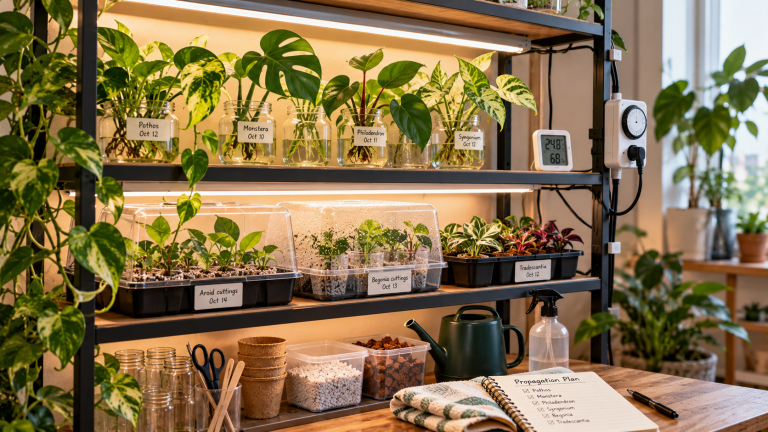
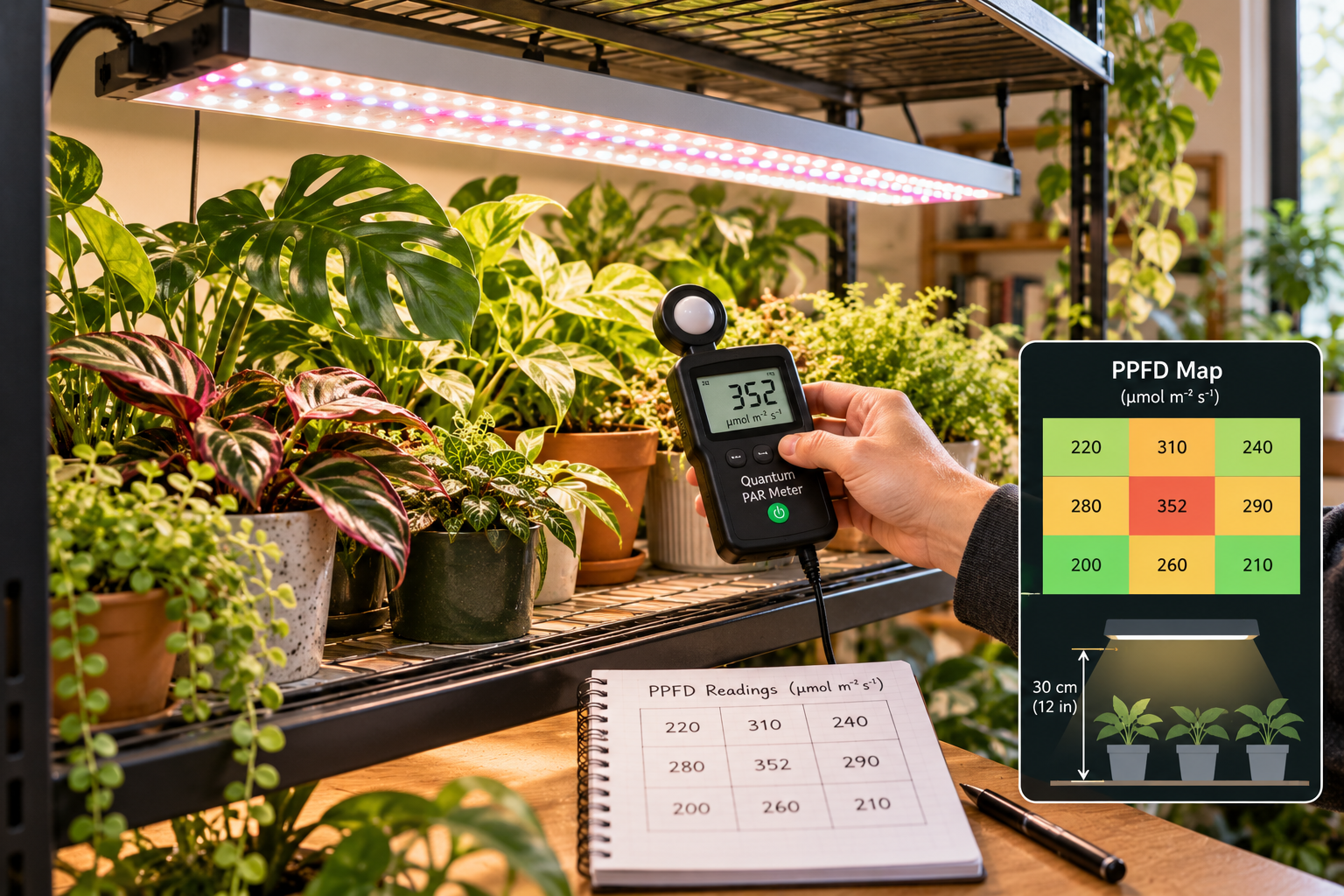
Take a reading under the center of the fixture, then at several points toward the edges of the actual planted area. A simple three-by-three grid often reveals whether the center is substantially brighter than corners. For a long narrow shelf, a row of evenly spaced readings may be more appropriate. The goal is not to produce an impressive single number but to understand the distribution.
Avoid letting your body shade the sensor. A head, hand, or clipboard can change the reading more than the adjustment you are trying to measure. Position the sensor consistently and repeat a questionable result before moving the lamp.
If natural daylight also enters the shelf, measure it separately when useful. A daytime reading with sunlight included cannot be interpreted as the grow light’s output alone. You can compare lamp-off and lamp-on measurements at a similar moment, recognizing that changing daylight complicates precise subtraction.
Distance changes the result, but not always by a simple formula
As a fixture moves closer to the canopy, delivered light generally increases. Yet real LED panels and bars are extended light sources with lenses, reflectors, and multiple diodes. The inverse-square rule for a point source is not a precise prediction for every short-distance horticultural fixture.
Use measured or credible mapped results at practical heights. Lowering a fixture can improve intensity at the center while making coverage more uneven or increasing heat near leaves. Raising it can soften hotspots and broaden coverage but reduce average intensity. Choose an arrangement that fits all the plants on the shelf, not just the one leaf directly below the brightest diode.
Check leaf temperatures and fixture clearances. PPFD does not measure leaf heating directly, and manufacturers specify safe distances for reasons beyond photon intensity. Keep water away from non-waterproof electrical parts, and do not use a fixture in a confined enclosure unless ventilation and mounting are appropriate.
A hanging plant or climbing vine has multiple leaf heights. Measure representative upper and lower canopy points if the distribution matters. A single number near the pot rim cannot characterize all its foliage.
Convert intensity into a daily light estimate
Daily light integral, or DLI, adds the photosynthetic photons received across a day. It is commonly expressed in moles per square meter per day. PPFD is a rate; DLI is an accumulated quantity. To estimate DLI under a constant artificial light intensity, multiply PPFD by the number of seconds the light runs, then divide by one million to convert micromoles to moles.
The simplified relationship is: DLI = PPFD × lighting hours × 3,600 ÷ 1,000,000. For example, a constant PPFD of 200 µmol m⁻² s⁻¹ for 12 hours gives 200 × 12 × 3,600 ÷ 1,000,000 = 8.64 mol m⁻² day⁻¹. That result is arithmetic, not a recommendation that every plant should receive exactly 8.64 DLI.
If the light intensity varies substantially through the day, the constant-intensity formula is only an estimate. Sunlight from a window can change minute by minute because of clouds, orientation, and building shade. A proper daily measurement integrates readings through time, or approximates them from intervals fine enough for the purpose.
The Purdue Extension guide to daily light integral discusses the integration concept in a greenhouse context. Its foot-candle conversions are dependent on the light source, reinforcing why a universal lux-to-PPFD shortcut should be treated skeptically.
Understand why photoperiod alone can mislead
One plant receiving very low PPFD for sixteen hours can accumulate less light than another receiving suitable intensity for a shorter period. Extending the photoperiod cannot always compensate for severely inadequate intensity, and excessively long light periods can conflict with biological responses to day length or a plant’s normal night cycle.
Seedlings need enough photons to grow stockily after emergence. Some flowering plants also respond to the length of uninterrupted darkness, so simply leaving lights on all night can interfere with flowering cues. The correct daily schedule depends on species and growth stage, not just the total DLI calculation.
If you change fixture height and hours on the same day, it becomes harder to know which change improved or harmed the plant. Make a measured adjustment, monitor new growth, and revise gradually. Old stretched internodes will not shorten even if subsequent growth becomes compact.
For a mixed indoor collection, group species by broad light requirements where possible. A high-light succulent and a shade-adapted foliage plant may not thrive at the same exposure. Put plants at positions on the shelf that match their needs rather than trying to find one center PPFD target for all of them.
A practical shelf-mapping example
Consider a meter-long shelf lit by a bar fixture. At the height of the highest leaves, a grower records approximately 260 at the center, 190 halfway to either end, and 110 µmol m⁻² s⁻¹ at the far corners. Those are illustrative readings, not measurements of a specific product.
The grower initially planned to put a high-light herb at one end simply because it fit the container arrangement. The map shows that the center delivers substantially more light. Instead of purchasing another fixture immediately, the grower rearranges plants by need and checks whether foliage receives adequate coverage without touching the lamp.
After moving the bar slightly higher, the center reading falls but edge readings become more even. The grower compares both the new distribution and the required exposure of the intended plants. The best setting is not necessarily the one with the largest number; it is the one producing suitable and reasonably even light over the useful area.
The grower repeats readings as plants grow taller. A shelf arrangement that was appropriate for seedlings may become uneven once broad leaves shade lower plants. This is why measuring canopy height, rather than a permanent point on the shelf, gives actionable information.
Don’t turn broad published ranges into universal rules
Extension references sometimes describe low-, medium-, and high-light plant groups with illustrative PPFD ranges. Such values are context for comparing needs, not exact thresholds that every cultivar must cross. Species, leaf acclimation, photoperiod, temperature, water, and nutrition all affect how a plant uses light.
For a flowering succulent, a measured exposure that keeps a shade plant healthy may still be too low to support dense growth. A shade plant exposed to a level suitable for a sun-adapted herb may bleach or scorch. Avoid declaring a plant “overlit” or “underlit” based on one reading without observing its growth and history.
Be especially careful when comparing product claims. Different brands may publish values at different mounting heights or crop areas. If a chart omits test conditions, the number is not suitable for a fair direct comparison. A responsible article should make readers aware of that limitation rather than presenting a ranking of fixtures from incomparable specifications.
Instrument and measurement mistakes worth avoiding
Measuring at the wrong height. A reading at the floor or empty shelf does not describe the leaves above it. Record canopy height along with the number.
Blocking the light with your hand or body. Repeat measurements with the sensor unobstructed and properly oriented.
Treating phone lux as calibrated PPFD. Spectral assumptions can create substantial uncertainty. State the estimate and validate it if precision matters.
Recording only the center hotspot. Map enough positions to reveal edge falloff and shading.
Ignoring photoperiod when discussing DLI. One instantaneous reading cannot tell you the daily total without a time assumption.
Using watts as a direct plant-light score. Electrical input is not equivalent to photon delivery to a leaf.
Comparing manufacturer maps without test conditions. Height, beam pattern, and measurement environment influence results.
Turn the measurement into an indoor-care decision
Once you have a rough or measured map, decide which problem you are solving. Is a seedling stretching because the fixture is too far away? Is a leaf bleaching under an intense hotspot? Is a vine shading neighboring pots? Improve position or duration cautiously, then watch newly developing tissues.
Keep a simple record: date, fixture model, hanging height, readings across the canopy, lighting hours, and the plants in each position. For a single home shelf, this is enough to make future adjustments interpretable. Recheck after a fixture replacement, a substantial plant growth change, or a seasonal change in incoming daylight.
The point of PPFD measurement is not to pursue the highest possible number. It is to understand what light your leaves actually receive and to match that exposure to the plants you grow. A repeatable modest measurement, interpreted alongside growth and photoperiod, is more valuable than a dazzling product specification with no context.
References
University of Minnesota Extension — Lighting for indoor plants and starting seeds
Purdue Extension — Measuring Daily Light Integral in a Greenhouse