Seed-Starting Heat Mats: Reading Soil Temperature Safely
A seed-starting tray on a cold windowsill may germinate unevenly even when the room feels comfortable. The air beside a person’s chair and the moist mix surrounding a seed can be several degrees apart. A seedling heat mat can help warm that root-zone environment, but it works only if the temperature it produces is suitable for the crop and the equipment is used safely.
The common mistake is to buy a heat mat, place every tray on it, and assume warmth is always helpful. Some seeds prefer cooler conditions, many need warmth mainly during germination, and tender emerged seedlings can become weak if high temperatures continue alongside inadequate light. A thermometer and a crop-specific plan are more useful than treating the mat as a permanent fixture.
Measure the medium rather than guessing from room temperature
A room thermostat measures air where its sensor is located. It does not measure the moist potting mix at the center of a seed tray. Cold windows, stone countertops, floor drafts, and evaporating water can all change the temperature around seeds. The University of Minnesota Extension guide to starting seeds indoors notes that indoor potting media can be cooler than the surrounding air, helping explain why some trays germinate slowly in otherwise comfortable rooms.
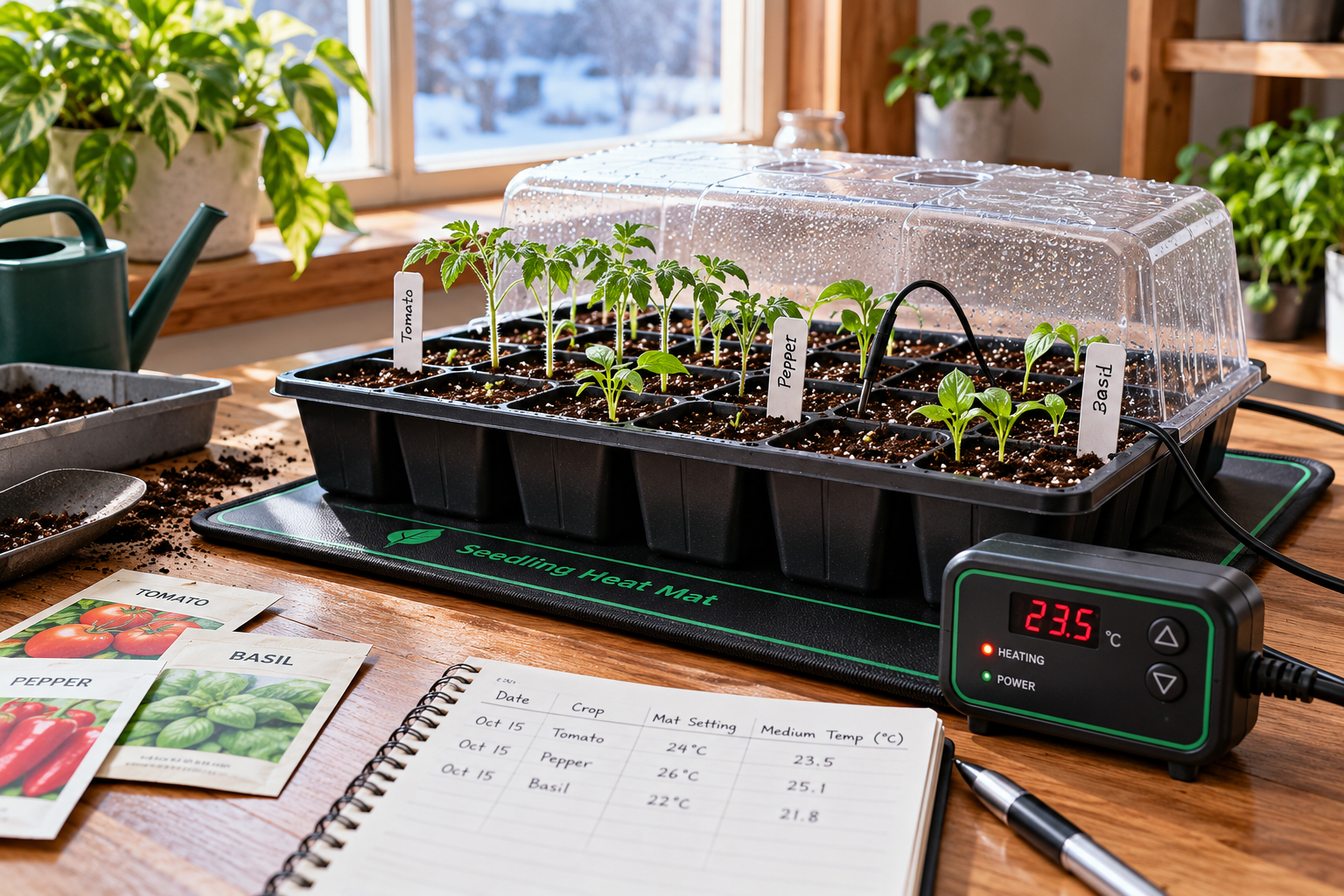
Use a clean probe thermometer suitable for the task. Insert it into an empty or representative cell at approximately seed depth where practical, rather than pressing the probe against the hot mat surface. The temperature at the mat’s underside is not the same as the temperature experienced by the seed. Measure again after the system has had time to stabilize.
Record the crop, room conditions, mat setting if adjustable, and medium reading. A difference of a few degrees may matter for sensitive germination. You do not need a complicated scientific log, but one meaningful measurement is better than the assumption that all mats deliver the temperature printed on the packaging.
Identify what each seed actually needs
Different species have different germination temperature preferences. Warm-season crops such as peppers and tomatoes often germinate faster in relatively warm media, whereas some cool-season crops germinate adequately or more reliably at lower temperatures. The correct target is not a universal “seedling temperature”; it is the recommended medium range for the seed variety you are sowing.
Read the seed packet and, where available, consult a local University Extension germination chart. Consider both the range and the context. A crop may germinate across a broad span but emerge faster at a narrower optimum. Seeds that are pushed too hot can be injured or fail to germinate, while a tray that is too cool may sit wet for longer, increasing opportunities for disease.
Do not raise a mat to the highest advertised setting to compensate for old seed or poor medium. Seed viability, planting depth, oxygen, and water also influence germination. Heat cannot restore dead seed, and faster emergence is not a meaningful benefit if the seedlings are subsequently overheated.
Choose a mat and controller designed for seed starting
Use equipment intended for horticultural seed starting and suited to the electrical standard in your location. Inspect the cable, plug, and protective surface before installation. A damaged or pinched power cord is a reason to stop, not to conceal the problem under a tray. Keep electrical connectors clear of water and follow the manufacturer’s requirements for placement, stacking, and cleaning.
A thermostatic controller can improve consistency when it senses medium temperature and switches the mat according to a setpoint. Place the probe according to the controller instructions, ideally in a representative tray cell that experiences similar conditions to the seeds. If the probe is left hanging in air or touching the mat surface, the controller may regulate the wrong temperature.
The Penn State Extension guide to sowing annual seeds recommends thermostatically controlled germination mats and cautions against using unprotected household heating pads because of shock or fire risks. A standard bed-warmer, blanket, or improvised electrical heater is not an acceptable substitute just because it feels warm to the hand.
Do not cover ventilation openings or place mats near flammable clutter. Keep cords arranged so that watering the trays does not lead runoff across plugs. If you cannot safely protect the electrical setup from splashing, change the location before sowing.
Position the trays without trapping excessive heat
Place the mat on a stable, level surface consistent with the manufacturer’s instructions. Keep it free of folds and pinches; a flexible mat is not necessarily designed to be bent into a curved shelf. Set the seed tray above it with adequate drainage, and ensure water can be managed without leaving the electrical surface wet.
A propagation dome can raise humidity, but it can also trap heat, especially if strong light hits it. Do not assume the combined warmth of a mat, sunlit window, and closed plastic lid is safe because each component is common in gardening. Check the actual medium temperature under the full setup.
Keep trays away from strong cold drafts that cause repeated temperature fluctuations. Equally, do not place them directly against a radiator to “help” the mat. You are trying to maintain a controlled root-zone environment, not create the hottest microclimate in the room.
Label trays clearly. When several crops share a shelf, a single mat setpoint may not be ideal for all of them. Group seeds with similar requirements together, or use the mat only for the warm-germinating crop while cool-season seeds remain elsewhere.
Know when the heat mat has finished its main job
Warmth is often most useful while seeds are germinating. Once seedlings emerge, continued high root-zone temperature may not be beneficial, particularly if air is warm and light is inadequate. Young plants need conditions for balanced growth, not just rapid sprouting.
The University of Maryland Extension seed-starting guide explains that a heat mat can speed germination and that seedlings often benefit from cooler conditions afterward. Treat that as a reason to evaluate when to reduce or discontinue bottom heat, not as an instruction to switch off every mat on the same day regardless of crop and room conditions.
Monitor the first emerged seedlings closely. If a tray contains a mixture of germinated and ungerminated cells, decide whether the remaining seeds are worth keeping warm while the emerged seedlings need different treatment. Separate trays or remove emerged cells to a brighter, cooler growing position where practical.
Do not run the heat mat on the same timer as grow lights by default. Seeds may need a relatively stable medium temperature through the night, while seedlings require a light-dark cycle. Minnesota Extension specifically cautions against plugging the mat into a timer intended for lighting.
Water management changes when the mix is warm
Warm growing media can dry more rapidly, especially at the surface. A germinating seed may be harmed if it begins absorbing water and is then allowed to dry abruptly. On the other hand, a closed wet tray that never drains can deprive developing roots of oxygen and favor disease organisms.
Check moisture within the cells, not just the appearance of the tray lid. Condensation on a dome does not prove that all the mix below is evenly moist. Lift a representative cell or gently test the medium at seed depth. Add water with enough control to keep the mix suitably moist but not waterlogged.
Bottom watering can reduce displacement of tiny seeds in appropriately designed seed trays, but drain the tray once adequate moisture has been taken up. Continuous standing water plus warmth is not a simple cure for slow germination. The aim is oxygen and moisture in the right balance.
If algae becomes conspicuous, the surface stays shiny-wet, or seedlings collapse near the soil line, do not automatically increase the mat temperature. Investigate sanitation, drainage, ventilation, and disease symptoms. Heat alone does not correct a poorly managed seed-starting environment.
Example: peppers and lettuce on the same windowsill
A gardener starts pepper and lettuce seeds in neighboring trays in a cool apartment. The pepper packet suggests warm germination conditions, while the lettuce seeds are comfortable at lower temperatures. The gardener originally places both trays on the same mat and finds that one group emerges poorly.
Rather than buying a stronger heater, the gardener measures actual medium temperature with a probe. The pepper tray is moved onto a properly controlled mat, and the lettuce remains on the cooler shelf where its seed-specific recommendation can be met. Both trays get appropriate moisture and attention to light after emergence.
The gardener also notes that the mat under a dry tray warms differently from one under a saturated tray, so measurements are repeated after watering and under ordinary operating conditions. When the peppers begin emerging, the gardener reassesses whether continued warmth is useful, avoiding a situation where small sprouts stretch under too little light.
This example illustrates why the mat is not the central ingredient. The relevant decision is matching the root-zone environment to the seed and its developmental stage. One well-placed tray may benefit; a neighboring tray may not need any heat at all.
Read a temperature discrepancy carefully
Suppose the controller says 25°C, but a separate probe in the seed cell reads substantially lower. First check where the controller probe is positioned. Is it touching plastic or outside the medium? Is the sensor buried at a different depth? Is the room drafty? Is the tray unusually thick or elevated above the mat?
Do not immediately raise the setting by the full numerical difference. That can overheat areas closer to the mat. Reposition the probes correctly, wait for the system to settle, and measure more than one representative cell. The objective is to understand uneven heating before adjusting the control.
If the surface warms too much while deeper medium remains cool, inspect tray design and whether the mat is compatible with it. An improvised pile of insulating materials is not a safe fix unless the product instructions explicitly allow it. The simplest solution may be a different tray or a warmer room location.
When comparing Fahrenheit and Celsius recommendations, use one unit consistently in your notes to avoid errors. A temperature chart for one crop is not an instruction for all seed varieties. If you are unsure about a setting, prioritize the seed packet and reliable local advice rather than an influencer’s photograph of a thermostat display.
Prevent damping-off while supporting germination
Young seedlings are vulnerable to damping-off diseases, which can be favored by poor drainage and slow growth in unsuitable conditions. Warmth that helps seeds emerge at an appropriate rate can be one useful component of prevention, but it does not sanitize dirty trays or cure infected seedlings.
Use clean seed-starting materials, fresh suitable mix, drainage holes, and measured moisture. Provide adequate light promptly after emergence. In the Minnesota Extension damping-off guide, warm growing media are discussed alongside sanitation, drainage, and good seedling care—an integrated approach rather than a guarantee from one device.
If seedlings collapse with narrowed, water-soaked stems, remove affected plants and investigate the whole setup. A hotter mat is not a rescue treatment for diseased tissue. Clean and replace materials where indicated before starting the next batch.
Electrical and household safety checklist
Use only a mat rated for the location and power supply. Keep outlets, plugs, and extension connections away from watering paths. Do not leave cords where a pet can chew them or a person can trip. Inspect the device for damage each time it is set up after storage and unplug it before cleaning.
Follow instructions for continuous operation, allowable surfaces, thermostat use, and water exposure. Never assume that an unmarked heating pad designed for human use is safe underneath wet seed trays. Do not sandwich the mat between insulating layers unless the manufacturer explicitly permits it; overheating equipment is a more serious problem than slow seed germination.
If a tray requires frequent lifting, arrange the cord so that moving it does not strain the plug. If the setup is in a communal space, make it obvious which cables belong to the mat and which to the light fixture. Small organizational choices reduce mistakes during daily watering.
A four-step routine for the next sowing
First, look up the germination temperatures of the actual crop. Second, measure medium temperature in the location without heat. Third, if bottom heat is justified, install a purpose-built mat and controller according to instructions, then verify the temperature inside a representative cell. Fourth, reassess warmth as soon as seedlings begin to emerge.
The value of a heat mat is predictability, not maximum heat. Used carefully, it can help warm-season seeds germinate in a cool home. Used without measurement, it may dry trays, encourage excessive warmth, or distract from more basic requirements such as clean medium and adequate light. Trust the thermometer, the crop guidance, and the seedlings—not the marketing promise on the packaging.
References
University of Minnesota Extension — Starting seeds indoors
Penn State Extension — Sowing Annual Seeds
University of Maryland Extension — Starting Vegetable Seeds Indoors
University of Minnesota Extension — How to prevent seedling damping off