Phalaenopsis Orchid Roots: Healthy, Dry, or Rotten?
Clear orchid pots can make every root look like a diagnosis waiting to happen. Some roots are silver, others turn green after watering, and a few disappear into coarse bark. One root may curl out of the container entirely. Beginners often interpret these changes as a sign that something has gone wrong, but root color alone is not a reliable test of health.
Phalaenopsis, commonly called moth orchids, grows differently from many foliage houseplants. In nature, many species are epiphytes that attach to trees rather than rooting in dense garden soil. Their roots have a specialized outer layer called velamen, which helps with water uptake and storage. Understanding that structure makes it easier to distinguish normal roots from desiccation or rot—and to avoid overwatering in an effort to make every root stay green.
Learn what healthy orchid roots look and feel like
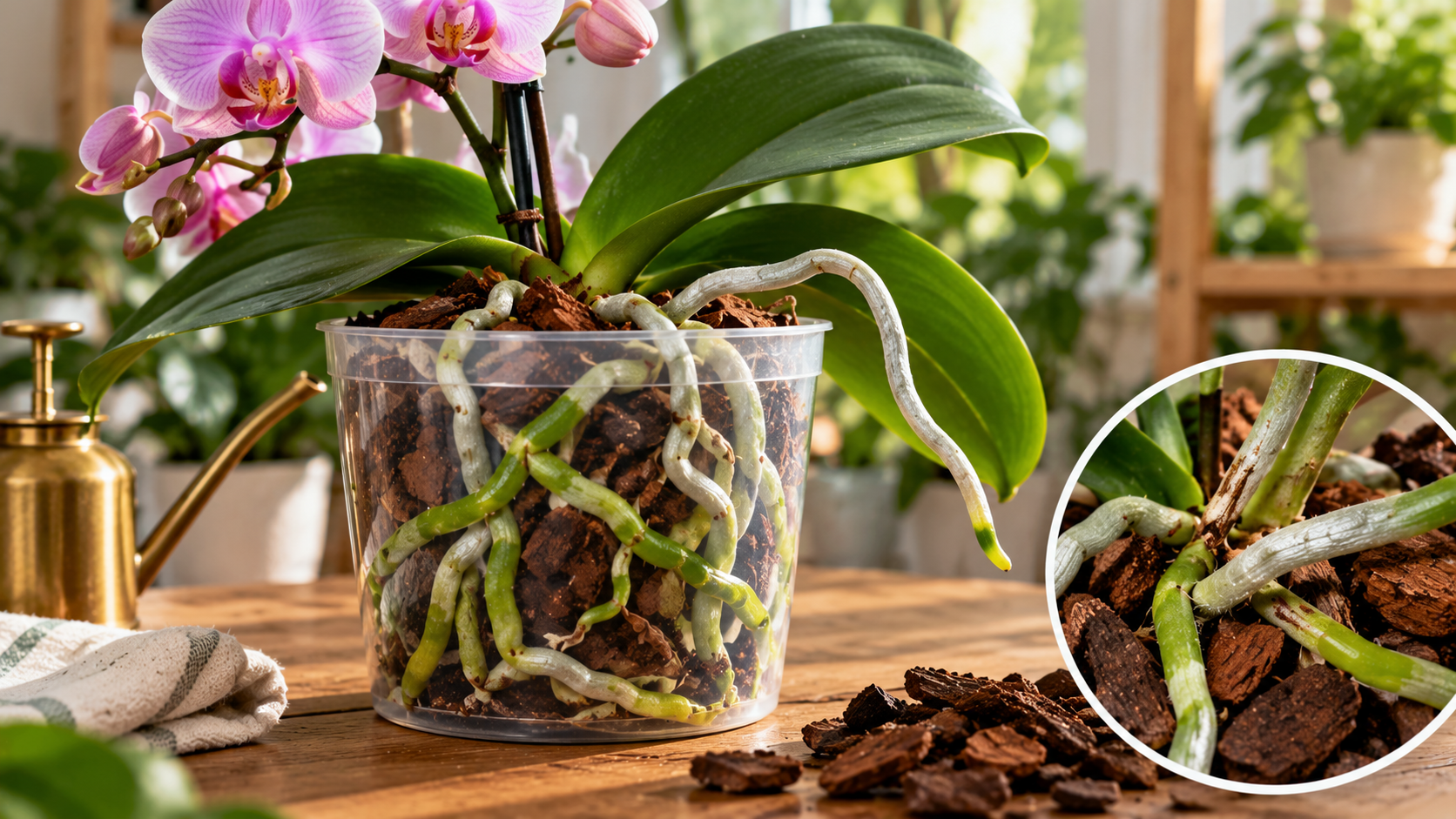
Healthy phalaenopsis roots are usually firm. Depending on hydration and light exposure, they may look silvery-white, green, or even yellowish when shaded inside the medium. Roots in a transparent pot often turn greener when wet because hydrated velamen becomes more translucent, revealing tissue beneath. That visible shift is useful but not a complete watering meter.
An aerial root extending over the pot rim is not automatically thirsty, diseased, or trying to escape. Orchids naturally produce roots outside their pots, and these may grow toward humid air or support surfaces. Do not cut a firm living root simply because it interferes with a neat silhouette. Equally, a pale root inside bark is not dead just because it is not green at that moment.
Touch is informative when inspection is safe. A viable root generally has substance; a rotten root may feel mushy, slimy, or hollow, sometimes leaving a stringlike core after the outer tissue slips away. A thoroughly desiccated root may be papery or brittle. Even these traits require context—one dry tip does not mean the entire root system has failed.
Why transparency helps but does not answer everything
A clear pot allows you to observe some roots and condensation, but the middle of the pot may behave differently. Fresh bark and decomposed bark also hold moisture differently. A pot can look dry near the outside while the center remains wet, especially if a dense nursery plug remains around the original roots. Conversely, no visible condensation does not automatically mean the plant must be watered immediately.
Use the pot’s weight, the condition of bark or other media, and the firmness of roots together. Learn how the same pot feels after drainage and later in its drying cycle. Avoid a rigid watering day, because indoor light, season, humidity, and airflow change how quickly roots and media lose water.
Recognize actual root rot
Rot frequently involves loss of root structure rather than mere discoloration. Soft, collapsing roots; foul or persistently sour medium; and deterioration spreading from the root tip or crown deserve attention. A severely compromised root system may no longer supply enough water despite a wet pot, so leaves become limp or wrinkled even as the grower responds with additional irrigation.
This is a crucial diagnostic trap: wilt can occur when roots are too dry or when roots have rotted and cannot absorb water. If a phalaenopsis has limp leaves but the pot remains saturated for days, watering again is not a safe default. Inspect moisture and root condition before deciding. The RootLuma guide to early root-rot signs covers the underlying problem broadly; orchids add the complication of exposed velamen and coarse media.
There may be dead roots buried in an otherwise healthy pot, especially on an older plant. A few failed roots can be removed during a justified repot without declaring the orchid beyond saving. The question is how much functional root system remains, whether decay is ongoing, and whether the potting medium still permits air movement.
Distinguish dry roots from dead roots
An aerial root may appear pale and wrinkled in dry room air yet remain viable. A brief change in hydration can alter its appearance, but do not repeatedly soak the crown or mist everything indiscriminately to force a green color. Some roots are naturally older and may lose function over time. Test firmness gently and look for active green or pale growing tips rather than condemning the whole plant from one brown section.
Dead roots are often hollow, papery, brittle, or collapsed. Rot is usually wetter and softer, though a root can pass through several stages as it declines. In both cases, pruning is justified when tissue is clearly dead during a repot, but there is little reason to trim firm roots for cosmetic reasons. Removing viable roots reduces the plant’s capacity to support leaves and future flowers.
Do not peel off velamen simply to see what lies beneath. It is functional root tissue, not disposable packaging. Rough handling during inspection can create exactly the damage you hoped to diagnose.
Decide when repotting is warranted
Phalaenopsis often grows in coarse bark or other specialized orchid media. Over time, organic particles degrade, become finer, and retain water differently. When the medium smells stale, stays wet unusually long, or has visibly collapsed, repotting into a suitable fresh material may be more useful than changing the watering schedule alone.
Repot if roots need to be inspected after clear decline, the original nursery plug is restricting even moisture management, or the container and medium no longer suit the root system. Otherwise, avoid uprooting a vigorous orchid every time you see a brown root through the wall. A plant in active flower can sometimes be repotted if necessary, but unnecessary disturbance may shorten the display or slow establishment.
Choose a draining orchid pot sized for the viable root mass, not an enormous decorative container based on leaf width. Carefully free decomposed media without tearing healthy roots. Sterilize cutting tools and trim only clearly dead or rotten tissue. Set the orchid so the crown remains above the medium and water cannot pool persistently between its leaves. The RootLuma repotting guide offers general handling principles, but remember orchids may require specialized media and different depth decisions.
Bark, sphagnum, and their tradeoffs
Coarse bark allows substantial air space but may dry quickly in warm, airy rooms. Sphagnum moss can hold much more water and may suit some production methods or very dry settings, but tightly packed moss can stay too wet around vulnerable roots. Neither medium is universally better. Growers should understand the actual material, pot size, and watering pattern rather than copying a schedule from an orchid grown in a completely different substrate.
When transitioning from tightly packed moss to bark, the pot may dry differently and require closer observation. A plant with few roots also uses less water than a vigorous specimen with many active tips. The successful medium is the one that supports roots you can inspect and water appropriately under your home conditions.
Protect the crown while watering
Water the root medium thoroughly when it needs moisture, then let excess drain. Avoid leaving the inner pot standing in a decorative cachepot of water. If water accumulates in the leaf crown, especially in cool low-airflow conditions, remove it gently rather than allowing prolonged pooling. Crown rot is a separate serious risk from ordinary root discoloration.
Good humidity does not require constantly wet leaf bases. A bright position without harsh midday sun, comfortable temperature, and suitable air movement will usually do more for an orchid than frequent surface misting. If you use a humidifier, avoid persistent condensation against leaves, shelves, or nearby walls.
Three common scenarios
Observation More likely explanation Better response
Roots turn silver between waterings but remain firm Normal dry velamen Review overall pot moisture before watering
One aerial root grows over the rim Normal epiphytic growth Leave it intact unless clearly dead
Many roots are soft inside stale wet media Possible root rot Inspect, remove dead tissue, refresh media when needed
Limp leaves with a saturated pot Roots may not be functioning Stop automatic watering and investigate
Firm roots, fresh tips, and steady leaf growth Plant is likely functioning Maintain consistent care rather than repotting compulsively
A useful monthly check
Once a month, photograph a couple of visible roots, check for fresh tips, and lift the pot to compare moisture behavior with the previous month. If a root shifts from firm to soft, inspect that area further. If an older leaf gradually yellows while healthy roots and new growth remain, do not assume root disease is the only explanation.
After repotting, avoid checking underground roots by unpotting every few days. Look for stabilization of leaf firmness, gradual root activity, and the absence of spreading decay. Root recovery is not instant. The plant may pause flower production while investing energy in rebuilding its support system.
Mistakes to avoid
Cutting all silver roots. Dry-looking velamen may be normal. Cutting removes functional tissue and increases recovery demands.
Keeping roots constantly bright green. That can mean leaving the medium too wet for too long. Root color is not a target in itself.
Burying the crown. Moisture held against leaf bases can cause serious problems. Keep the crown positioned appropriately above the medium.
Using ordinary dense garden soil. Many phalaenopsis orchids need airy specialized media rather than fine compacting soil.
Fertilizing to repair rot. Fertilizer does not replace dead roots. Establish root function and stable growing conditions before increasing feeding.
Repotting into an oversized pot. More medium around a small root system can hold unnecessary moisture, even if the new pot looks better aesthetically.
How to inspect an orchid without turning inspection into injury
Transparent orchid pots are useful because you can monitor some roots in place. Before deciding to remove the plant, look through the sides and bottom of the pot, noting which roots are firm, which have active tips, and whether the medium is decomposing. A single dead root visible against plastic is not evidence that every concealed root must be exposed. Combine what you see with leaf firmness, water uptake, and the plant’s recent growth.
If a repot is justified, plan your workspace first. Have appropriate fresh media, a clean container, and sanitized cutting tools ready so roots are not left exposed while you search for supplies. Moisten or prepare media according to its instructions. Work slowly to release roots attached to bark or plastic; tearing a healthy velamen layer can create new damage.
After repotting, position the orchid consistently and resist pulling it out to examine progress after only a few days. Watch for new root tips and stable leaves instead. Some plants replace lost roots slowly, particularly in less favorable seasons. Avoid adding concentrated fertilizer to “stimulate” root regeneration while the remaining tissue is recovering.
Why the nursery plug deserves a look
Some orchids are sold with a dense central plug from an earlier production stage surrounded by bark. The plug may hold water longer than the visible outer particles. A grower may water based on dry bark near the pot wall while the center remains damp. This is not proof that every plug must be removed immediately, but uneven moisture behavior and root decline can justify checking it during an appropriate repot.
Treat each substrate layer as part of the water-management system. When you change it, your old watering interval may no longer apply. Test the new pot’s drying pattern before returning to the schedule used with the nursery medium.
Frequently asked questions
Should I mist aerial roots every day? Not automatically. It may be unnecessary and can increase unwanted moisture on leaves or furniture. Evaluate humidity and root condition instead.
Are yellow roots always dead? No. Roots shaded from light may be pale or yellowish while remaining firm and functional.
Can an orchid grow with only aerial roots? Phalaenopsis can produce functional aerial roots, but recovery prospects depend on how much viable root area remains and whether conditions support it.
Should I trim a brown root tip? Only when tissue is clearly dead or rotten and trimming is justified. A colored tip alone is not proof.
When will the orchid bloom again? Root health supports future growth, but flowering depends on maturity, temperature, light, cultivar, and season. Repotting is not a guaranteed bloom trigger.
Read the roots as living structures
A healthy orchid root does not have to look like a bright green plastic straw at every moment. Learn the range of normal velamen colors, check firmness and the condition of the medium, and reserve invasive work for evidence of genuine decline. By caring for the roots as an aerated, living system, you give the orchid a better chance to produce strong leaves and—when conditions favor it—another flower spike.
References
Royal Horticultural Society — Growing guide
American Orchid Society — Pseudobulb and root problems