How to Divide a Snake Plant and Keep Its Leaf Pattern
A snake plant that has filled its pot with upright leaves can often be multiplied without taking leaf cuttings. Division separates established shoots and their underground rhizomes into smaller groups, giving each new plant part of an existing root system. That makes it an especially useful method when you want to preserve a particular appearance, such as the yellow margins of a variegated cultivar.
Not every snake plant is ready to divide. A small specimen with only two leaves may benefit from another growing season; a large crowded clump with several distinct fans is a much better candidate. The aim is to create independent pieces that have viable rhizomes, leaves, and roots—not simply to cut the plant into as many fragments as possible.
Why division matters for variegated plants
Snake plants are commonly classified under Dracaena trifasciata, although older guides and plant labels still use Sansevieria trifasciata. Named cultivars can show bands, margins, or unusual leaf shape. Some striped or yellow-edged selections do not reproduce their distinctive pattern reliably through leaf cuttings because the variegation may not be preserved in plants regenerated from leaf tissue.
Division maintains an existing growing point with its established pattern. That is the practical reason to choose offsets or rhizome sections when the appearance of a cultivar matters. It is not a guarantee that every new leaf will be visually identical—the plant’s environment and natural variation still influence appearance—but division generally preserves the named plant more faithfully than leaf-section propagation in cultivars prone to reversion.
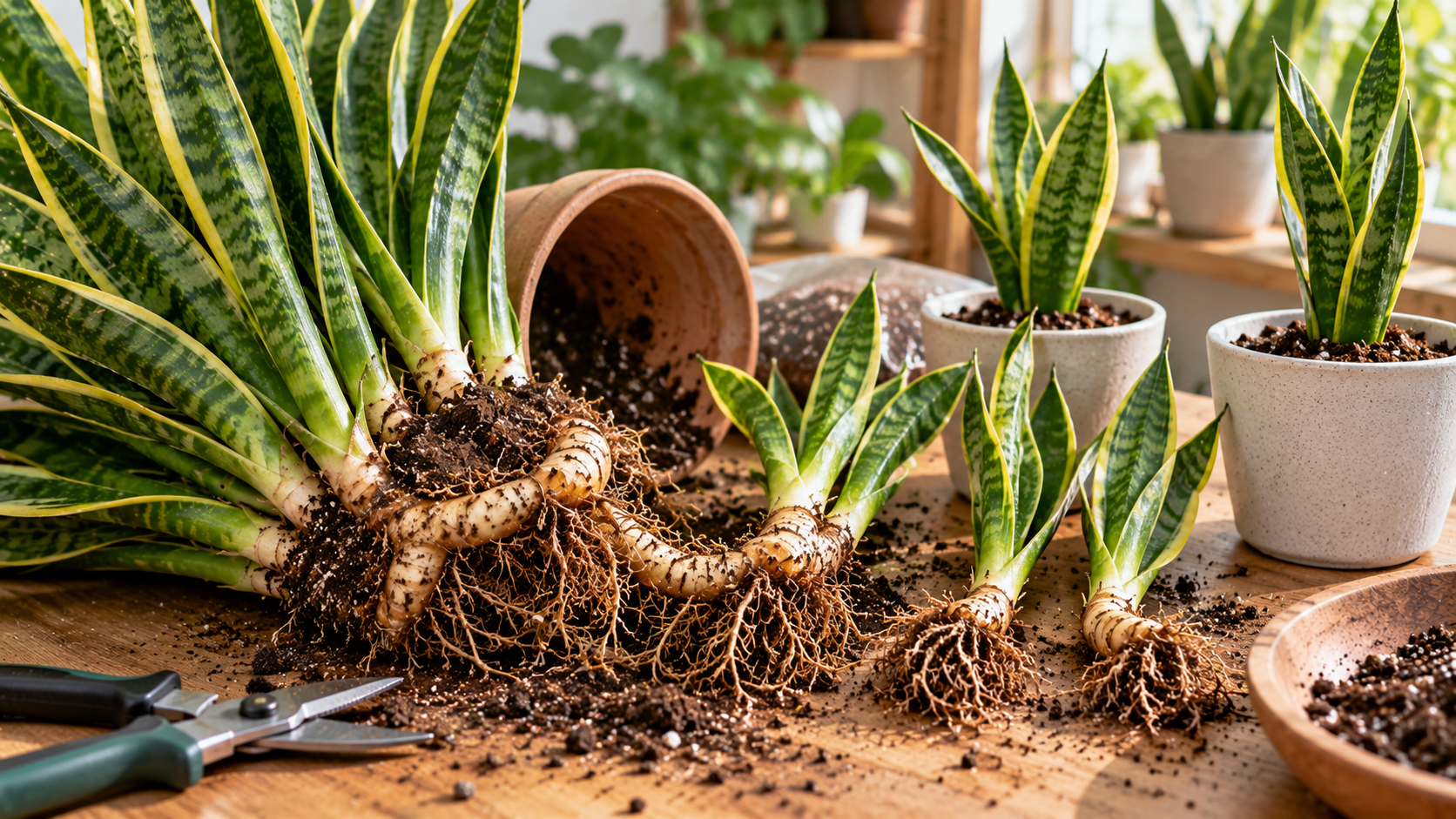
Look at where individual shoots emerge. A crowded pot may contain several rosettes or fans connected by thick horizontal rhizomes beneath the mix. Each viable piece should ideally retain a healthy growth point and enough roots to support it. A leaf with no rhizome or crown is not the same as a division, even if it looks substantial above the surface.
Choose the right plant and season
Division is easiest when the plant is healthy and actively growing, often during warmer, brighter months. It can be done at other times with suitable indoor conditions, but a plant under severe drought stress, root disease, or cold exposure should be stabilized first. Division is an intervention, and a recently declining plant has fewer reserves for rebuilding damaged roots.
Indicators that division is sensible include distinct offsets, a pot visibly crowded with rhizomes, and roots that can be separated into natural sections. A pot that is simply full of leaves is not necessarily suffering; snake plants can tolerate a relatively snug container. Divide because you want another plant or because rhizomes are distorting or cracking a pot, not merely because a universal schedule says it is time.
Set up a work surface with a washable tray, clean knife or pruners, spare draining pots, and fresh airy potting medium. Use gloves if the leaf edges or tools make handling uncomfortable. Keep pets away from loose plant material; snake plants are not a safe snack for cats or dogs.
Remove the clump without tearing the leaves
Water management before division should make the medium workable without turning the root ball into mud. If the pot is extremely dry and roots are brittle, a little moisture can help. If it is soaked, wait until it can be handled without collapsing into an unmanageable slurry. Squeeze a flexible nursery pot gently and tip it sideways while supporting the base of the plant. Do not pull hard on individual leaves.
Brush away enough loose medium to reveal how the fans join underground. Identify each thick rhizome and the finer roots attached to it. Sometimes a large clump separates naturally into offsets with minimal cutting. When rhizomes are firmly connected, use a clean sharp blade and make a decisive cut between growing points. Avoid repeatedly sawing through the same tissue with dirty or blunt tools.
Aim for fewer, stronger pieces. A substantial offset with several healthy leaves and roots is generally easier to establish than tiny rhizome fragments. Where a cut surface is exposed, keep it reasonably clean and avoid burying damaged tissue in waterlogged medium. Do not leave exposed roots drying for days; the goal is to prevent unnecessary moisture stress while allowing the cut area to settle appropriately.
Recognize healthy and unhealthy roots
Healthy snake plant roots may vary in color but should feel reasonably firm for their type. Rotten roots often become soft, dark, or easily separated from their outer tissue. A dry brown root is not automatically rot, particularly if it remains structurally intact. Evaluate texture, odor, and the overall vigor of the plant rather than judging from color alone.
If the original pot contains substantial rotten tissue, address that as a root-health problem. Divide only sections that still have viable rhizomes and growing points, and use a fresh draining medium. Cutting a compromised rhizome into many pieces does not transform it into multiple healthy plants. An extensive decline may require a more conservative salvage attempt.
Pot the divisions at an appropriate depth
Choose pots that fit the remaining roots rather than the tallest leaves. An oversized container holds a greater volume of medium that the reduced root system cannot use promptly. Provide drainage holes and a mix that balances structure and modest water retention. Snake plants generally prefer a medium that does not stay saturated for long periods indoors.
Plant the rhizome and crown near the same depth at which they previously grew. Burying the bases of leaves deeply can encourage unwanted moisture around sensitive tissue. Firm the medium enough to support each upright fan, but do not compress all air spaces. Tall divisions may need temporary support until new roots anchor them.
The RootLuma repotting guide covers the broader tradeoffs of container choice and root handling. For division specifically, remember that each new pot contains a reduced root system despite having mature-looking leaves. Its water use may be lower than before separation, and your old watering schedule may now be excessive.
Aftercare is not a race
Place divisions in bright indirect light appropriate to the cultivar rather than immediate harsh sun. Maintain warmth and avoid cold drafts. Do not compensate for root disturbance with frequent heavy watering. Allow the medium to approach the normal watering point for a snake plant, taking into account pot size, season, and how much root mass remains.
An offset may look unchanged for several weeks before it produces visible growth. The first important job is root establishment, which is hidden below the medium. Firm leaves and no progressing collapse are useful signs. Older leaves may remain stable long before a new spear emerges. Avoid unpotting repeatedly just to measure root growth; that resets the recovery process.
Likewise, fertilizer is not a substitute for a functional root system. Wait for evidence of established growth before returning to a modest feeding routine. Fresh potting mixes may already contain nutrients, and high salt levels can burden stressed roots. Patience is particularly important during a cool, low-light season when water use is slow.
A division plan for a crowded pot
Imagine a snake plant with five clear fans in one container. Two are large and robust, one sits on a long rhizome near the rim, and two are smaller offsets. You might make two substantial groups rather than trying to create five tiny pots. Keep the smallest offset attached to one larger section until it has a stronger root system. After inspecting the rhizomes, make only the cuts needed to separate the groups.
Label the pots if one fan has different variegation. Photograph the original arrangement before dividing so you can remember which piece came from where. If one group temporarily leans, stake it instead of planting the rhizome too deeply. Over the next month, note leaf firmness and changes in pot moisture before deciding when each division needs water.
This example does not prescribe an exact ratio of leaves to roots. It illustrates a decision rule: preserve viable growth points and enough roots, minimize wounds, and match pot volume to the new root systems. Those principles travel better between cultivars than a rigid “one leaf per pot” formula.
Observation after division Likely meaning Response
Leaves remain firm but no new growth Establishment may still be underway Maintain stable light and conservative care
Pot stays wet unusually long Root system is small relative to medium or conditions are cool Reassess watering and drainage
Leaf base turns soft and collapses Possible rot or damaged crown Inspect promptly; remove irrecoverable tissue
Division tips over Roots have not anchored or pot is unbalanced Add gentle support, not extra depth
New spear emerges Growth has resumed Continue normal species-appropriate care
Common mistakes and their consequences
Cutting through every rhizome at once creates needless wounds and tiny weak pieces. Pulling a plant by one leaf risks tearing the shoot away from its roots. Putting a one-fan division into a huge decorative planter may keep the medium wet too long. Deep burial can trap moisture against leaf bases. None of those shortcuts makes the resulting plant establish faster.
Another mistake is confusing a variegated leaf cutting with a division. You may propagate some snake plants from leaves, but if keeping a cultivar’s distinctive marginal color is the objective, separate an offset with its growth point instead. This is a horticultural choice connected to plant genetics, not a cosmetic preference imposed after rooting.
When division is not the right propagation method
A healthy snake plant with one compact fan and no visible offsets may not have anything meaningful to divide yet. Splitting it simply to create more pots risks damaging the sole growing point. Continue ordinary care and wait for natural offsets to develop. When a plant has multiple fans but they share a very short, tightly fused rhizome, separate only where viable rooted sections can be preserved without crushing the tissue.
Leaf cuttings remain an option for some snake plants when producing more plants matters more than preserving variegation. But the result can be slow, and cultivars with distinctive marginal patterns may not reproduce true to type. A careful grower treats those propagation choices as different outcomes rather than interchangeable techniques. If the name of the cultivar matters, document it and choose division where possible.
Avoiding accidental water stress after splitting
Two divisions from the same original pot may have very different root masses. A large fan with many intact roots may resume normal water use faster than a smaller offset with a severed rhizome. Do not water them on identical dates merely because they were potted together. Lift each pot and check the medium at the depth appropriate to the species.
If a division looks temporarily less upright, determine whether the stem is physically unstable or tissue is genuinely becoming soft. A supportive stake helps the first; more water can worsen the second when the medium is already wet. Separating a mechanical problem from a root-health problem prevents an avoidable second injury.
Keeping varieties correctly labeled
The older name Sansevieria remains common in shops. Include the cultivar name on the label alongside the modern genus Dracaena when known. A new plant with yellow-edged leaves may look identical to its parent while small, but future growers appreciate knowing exactly what was divided rather than receiving an unverified generic “snake plant.”
A division-day check before you make a cut
Locate each growing point. Identify a recognizable fan or offset with viable roots or a realistic rooting prospect. A loose leaf without a growing point is not equivalent to a division.
Protect the variegation. If preserving a marginal leaf pattern matters, select an established offset that already displays it rather than relying on leaf-cutting propagation.
Use the right moisture response. When a newly separated section has few roots, do not water repeatedly simply because it has not produced a new leaf. Check that the medium can dry appropriately and that the division remains firm.
Allow seasonal variability. Recovery and new growth depend on warmth, light, and root establishment; a winter division may progress more slowly.
Record the date, the number of viable root sections, and any soft tissue removed. If the parent clump is healthy but too weak to produce reliable divisions, defer cutting instead of forcing a smaller plant into several unstable pieces.
Better divisions come from better boundaries
A successful division looks less like chopping one plant into many pieces and more like separating natural growing units. Preserve strong shoots, rooted rhizomes, and the original pattern of the cultivar. Then give each new piece a suitably sized pot and time to establish. The reward is not only another snake plant—it is a propagation method that respects how this plant grows.
References
Iowa State University Extension — How propagate houseplants division and offsets
Iowa State University Extension — How propagate houseplants leaf section cuttings