Can You Reuse Old Potting Mix? Screening, Refreshing, and Disposal
At the end of a growing season, a balcony gardener may be left with several large pots of used potting mix. Throwing everything away feels wasteful, especially when the material still looks loose and clean. Yet filling next season’s containers directly with old mix can create problems if the previous plants suffered root disease, the particles have broken down, or salts have accumulated.
Reusing potting mix is a conditional decision, not a blanket rule. The right approach begins with a record of what grew in it, what happened to that plant, and how the mix now behaves. Healthy history and good physical structure make reuse more plausible; suspected disease and severe compaction are reasons to start fresh. Refreshing a tired medium cannot guarantee that an unknown pathogen or salt problem has disappeared.
Review the previous plant before judging the mix
The most useful question is not “Does this soil look brown?” but “Why is it available?” A container emptied after a vigorous annual herb finishes its season is different from one holding the remains of a tomato that died from a suspected vascular wilt. In the second case, the mix may carry an avoidable risk into the next planting.
Record whether the old plant was healthy until normal harvest or seasonal decline. Did it show progressive wilting despite adequate moisture, rot near the crown, or roots that were black and mushy? Was there a serious pest problem in the pot? Were herbicides or other chemicals applied that could affect future crops? Those details matter more than the surface color of the medium.
Maryland Extension’s advice on reusing potting mix supports refreshing material from containers without known root or wilt diseases while advising replacement when such diseases were suspected. It also cautions that home attempts at complete sterilization are impractical and that exposed media will be recolonized by ordinary microorganisms.
Avoid interpreting that advice as a warranty of safety. A healthy-looking plant can sometimes carry low-level disease, and a casual home inspection cannot test the medium for every pathogen. For vulnerable seedlings, high-value plants, or a crop with a history of serious problems, new suitable mix may be the more sensible low-risk choice.
Examine texture, drainage, and water behavior
Potting mix is a blend of materials whose particles change over time. Bark decomposes, some fibrous components fragment, and repeated wetting and drying can change how the mix holds water. A once-airy material may become fine, dense, or unevenly wet, especially after a long season of roots filling the pot.
Squeeze a handful of lightly moist mix. It should not resemble heavy mud or stay in a dense block if the intended plants need a well-aerated root zone. Notice whether water pools on the surface or flows rapidly through one channel while the rest stays dry. Check for a sour smell, extensive slime, or a compacted lower layer.
Do not expect an old medium to behave like the fresh bag it came from. A container that took two days to dry last season might stay wet much longer when refilled with the same broken-down mix. The physical behavior, not simply the age, determines whether refreshing will be useful.
Large quantities of undecomposed roots may also obstruct drainage or create localized pockets of decomposing matter. Remove substantial root masses and other debris. Small fine roots can often be screened or mixed into a compost stream, but do not assume visibly decaying diseased roots belong back beside new sensitive transplants.
Screen useful material without overprocessing it
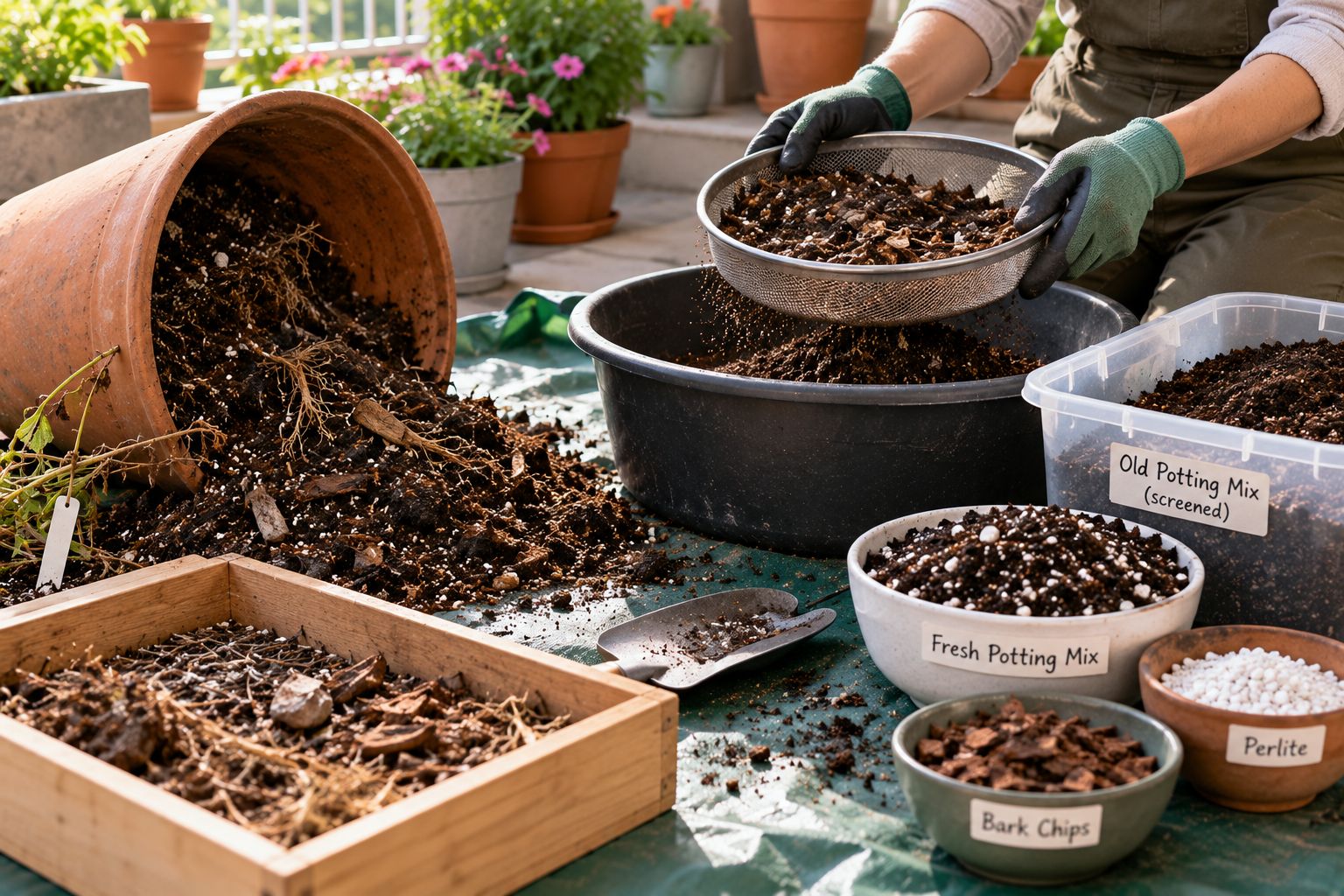
Spread the old mix on a clean tarp or into a wide container. Remove labels, ties, sharp fragments, large roots, and any non-compostable material. A coarse sieve can help separate large debris while leaving the smaller useful components. Work where dust will not blow into living spaces, and consider a mask if dry particles become airborne.
Do not try to remove every microscopic root fiber or sterilize every grain. Screening is a mechanical cleaning step, not a medical procedure for soil. Its value is restoring consistency, removing obstruction, and giving you a chance to inspect what you plan to reuse.
If you find obvious pest larvae or a concentration of surviving weed seeds, think about the next crop and your tolerance for risk. A large bucket of contaminated media may be better diverted to an appropriate composting or non-sensitive outdoor use, where local rules allow, than used for a tray of delicate indoor seedlings.
Handle any old fertilizers or slow-release granules cautiously. You may not know how much nutrient remains in the mix. Do not automatically double the next fertilizer dose because the medium is “old.” A poor balance of soluble nutrients can damage roots even when the texture is otherwise acceptable.
Refresh pore structure rather than merely adding food
Used mix may need better aeration as much as it needs nutrients. Add fresh suitable potting mix or amendments based on the original recipe and the intended plant. For example, a fine, compacted blend may benefit from replacing a substantial portion with a fresh, more open-textured substrate, whereas a still-structured mix may need only modest refreshing.
Maryland Extension notes that incorporating new potting mix or finished compost can help restore usable structure in suitable old media. Compost quality matters: it should be mature, appropriate for container use, and not overly salty. Heavy, wet compost added indiscriminately may make some indoor succulent or seedling mixes worse rather than better.
A useful practice is to begin with a small test batch. Mix some screened old substrate with fresh material, fill one representative pot, water it thoroughly, and observe drainage and drying. Adjust the blend before committing a dozen containers. There is no single ratio suitable for every starting mix and every plant species.
For a succulent, you may prioritize rapid drainage and enough air-filled pores. For a large leafy herb in an outdoor container, moisture retention and stability may be more important, though waterlogging remains undesirable. Avoid using one “recycled soil recipe” for all plants just because it uses up available material.
Manage fertility without assuming old mix is empty
Plants remove nutrients, and irrigation can leach some elements through the pot. However, old mix can also retain residual fertilizer salts or partially released slow-release granules. It is possible for a medium to be short of some nutrients while having an undesirable concentration of others. That is why “add a large scoop of fertilizer” is not a careful diagnosis.
If the previous plant received frequent liquid feeding, inspect for white crusts on the pot rim or surface and consider whether salts built up. A crust is not conclusive proof, but it is a prompt to examine the fertilizer history and water source. For valuable or large-scale reuse, a horticultural media test can provide more information than guessing.
When you establish new plants, follow a sensible feeding program for the crop and the refreshed medium rather than trying to replace a full season’s nutrients in one dose. Observe new growth and root condition. If plants decline despite an apparently suitable mix, reconsider whether the reused material is part of the problem.
Do not claim that a small amount of compost turns depleted mix into an indefinitely self-fertilizing medium. Containers have limited nutrient stores and different rates of leaching. Reusing a substrate and maintaining fertility are related but separate tasks.
Disease history changes the recommendation
If the previous plant declined, RootLuma’s guide to early root-rot signs can help frame what to inspect before deciding on reuse. Root rots, some wilt diseases, and certain soilborne pests can persist in media or debris. The risk depends on the organism and crop, which is why a casual boiling-water treatment cannot be advertised as a reliable reset. Even a medium that has been heated may become contaminated again through equipment, water, or new plants.
The Maryland Extension discussion of container media reuse identifies disease carryover, salt accumulation, and loss of structure as reasons for caution. When a plant died from a suspected serious root or wilt problem, discarding the mix and cleaning the container is generally a safer home approach than trying to rescue it for another susceptible crop.
Separate the disposal of medium from the reuse of the pot. A durable plastic or ceramic pot can often be cleaned effectively even when the substrate should not be retained. Remove all old roots and dirt, wash thoroughly, and follow appropriate disinfecting instructions if the previous occupant was diseased. Do not mix cleaners or leave harmful residues for a new plant.
If the old crop developed only a leaf condition such as a mild non-systemic problem, the risk calculation may differ. But without a confident diagnosis, avoid promising that reuse is harmless. Where the cost of fresh seed-starting mix is modest, there is little benefit in gambling valuable seeds on a questionable substrate.
Why seed-starting trays deserve a separate rule
Very young seedlings are more susceptible to damping-off organisms than established plants. For that reason, a mixture that seems acceptable for a vigorous mature houseplant may be a poor choice for germinating hundreds of delicate seedlings. Fresh, clean seed-starting media are generally recommended for this high-risk stage.
Do not sieve old balcony mix to a fine texture and assume it has become a sterile propagation product. Fine particles can impede aeration, and screening does not remove pathogens. If you want to reuse well-screened material, reserve it for lower-risk established container plants where appropriate, not sensitive seedling trays.
This is a practical distinction, not a statement that old mix is always toxic. The cost of failed seedlings includes time, seeds, and lost planting windows, so using clean fresh media can be the more economical decision even for a gardener who wants to reduce waste elsewhere.
Storage matters between seasons
Dry or slightly moist useful mix can be held in a clean, covered container that protects it from contamination and excessive rain. Avoid sealing a wet bucket in a warm cupboard where anaerobic odors or unwanted growth develop. Keep containers labeled with their source and whether a disease problem was suspected.
Do not place a bag of used mix directly beside newly opened seed-starting materials. Separate clean and questionable inputs. Before reusing, inspect it again: storage conditions can change the texture, moisture, and smell, and pests may have entered an open container.
For outdoor storage, protect the material from repeated saturation and contamination by animal waste. Some weed seeds may survive storage. Composting or disposal may be a better destination for heavily contaminated media, but not every home compost system reaches temperatures sufficient to destroy particular pathogens or weed seeds.
Example: three pots after a balcony harvest
A gardener has three containers: one grew healthy basil until it flowered, another held a tomato that wilted progressively while the substrate stayed wet, and a third grew lettuce that was harvested normally. The basil and lettuce media remain reasonably airy; the tomato mix has a sour smell and decomposing roots.
The gardener screens the basil and lettuce material separately and removes large roots. Some is blended with fresh appropriate mix, watered in a test pot, and observed before being reused for an established herb. Nutrient addition is based on the new crop rather than an assumption that the old mix contains nothing useful.
The tomato medium is not reused for a new tomato. Because a root or wilt disease is suspected, the old mix is discarded or directed to a safe disposal route, and the container is cleaned before reuse. No effort is spent heating the questionable mix in a kitchen oven.
This decision saves material without pretending that every pot is equally safe. It also preserves a clear record: if a new plant struggles, the gardener knows which reused batch it came from and can stop using the remainder.
When not to reuse potting mix
Do not reuse media from containers with a suspected serious root or vascular disease, unknown chemical contamination, severe pest problems, or badly collapsed structure for sensitive plants. Do not use obviously waterlogged, foul-smelling, or contaminated material simply because it seems wasteful to throw it away.
Avoid reusing old potting mix for starting delicate seedlings unless a reputable, crop-specific procedure explicitly supports it. Avoid mixing suspect media into all your healthy pots; that would spread one uncertain batch across the collection. And do not market a home-screened medium as sterile—it is not.
If disposal options are limited, check municipal composting and waste guidance. Some green-waste services restrict diseased plant material or potting substrate. Do not dump potting mix into natural areas, waterways, or shared gardens without permission.
A decision path for a low-waste garden
First, review the previous crop’s health. Second, test texture and drainage. Third, remove debris and consider the next plant’s needs. Fourth, refresh only suitable material with a compatible new mix or amendments. Fifth, check fertility, water behavior, and plant response after repotting. Keep suspect media separate and choose fresh mix when the risk is meaningful.
Reuse is successful when the next plant grows well in an adequately aerated, clean-enough, appropriately fertile medium. It is not measured by how many old bags you managed to avoid buying. Thoughtful screening, selective reuse, and safe disposal can reduce waste without sacrificing root health.
References
University of Maryland Extension — Old last growing season’s potting soil, possible reuse
University of Maryland Extension — Container gardening, soil reuse