LECA for Houseplants: What Changes When Roots Leave Soil?
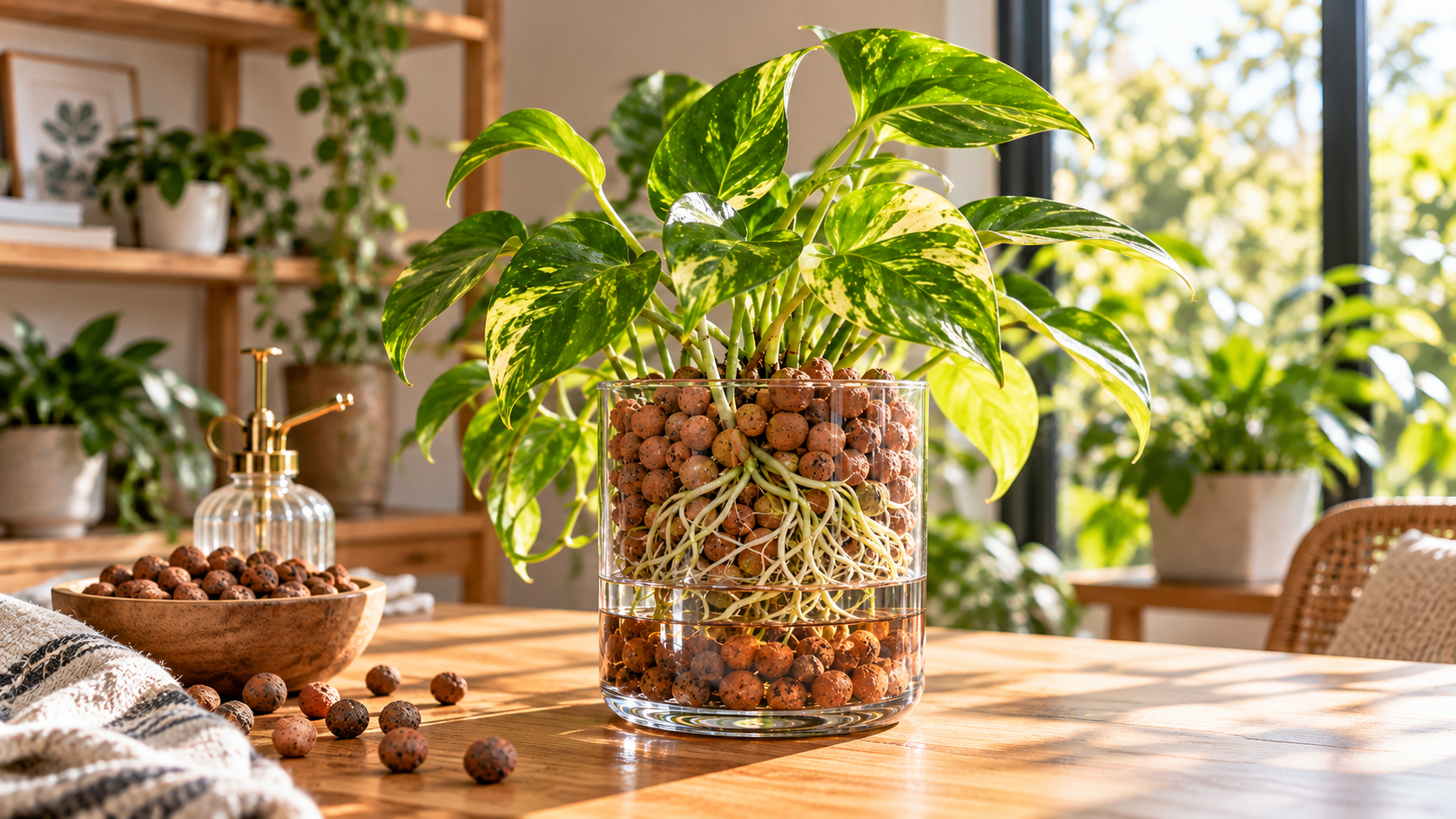
A glass container full of round clay pebbles can make growing a houseplant look wonderfully simple. There is no dark potting mix to spill, the water level seems visible, and the arrangement may suit a tidy indoor shelf. Yet expanded clay pellets—often called LECA, for lightweight expanded clay aggregate—change more than the appearance of a pot. They change how roots encounter moisture, oxygen, and nutrients.
Before transferring a favorite plant, understand which jobs the original potting mix performed and how the replacement system will perform them. LECA itself is mainly physical support; it is not a complete fertilizer, a guarantee against root rot, or proof that watering can be ignored. A monitored trial with one suitable plant is far safer than converting an entire collection on the strength of a beautiful photograph.
What LECA can and cannot replace
Expanded clay pebbles are fired porous particles used in various soilless growing systems. Their relatively large spaces allow air and water to move differently than they do through most fine-textured potting mixes. The pellets provide support around roots and may hold some water on and within their surfaces, but they generally store much less plant-available moisture and nutrition than many organic substrates.
That matters because a conventional mix often performs several jobs at once. It anchors the plant, holds some water between irrigations, provides spaces containing air, and may store or release mineral nutrients. In LECA, those functions depend strongly on the container, watering method, reservoir position, and nutrient solution. Changing the medium without redesigning the routine can leave roots alternately too dry and submerged.
The Oklahoma State University Extension guide to soilless growing media describes expanded clay among aggregate options and stresses the importance of aeration, water retention, and nutrient delivery. That is a general horticultural framework, not a trial showing that every tropical houseplant performs better in pure LECA.
“Semi-hydroponic” is a method, not a magic property
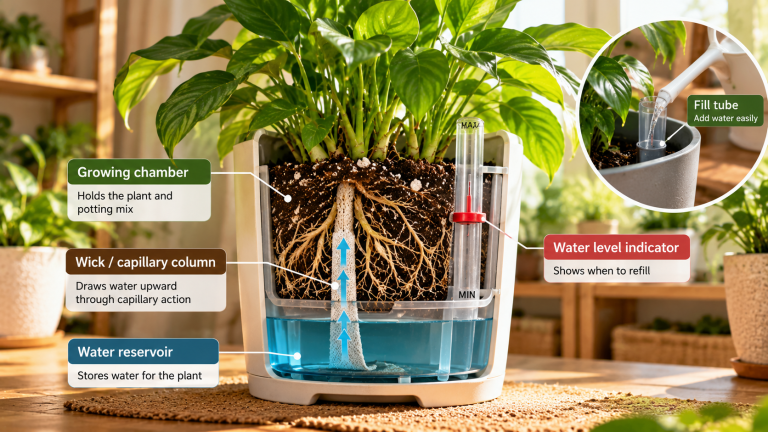
Home growers commonly use the term semi-hydroponic for pots with clay pebbles and a small nutrient-water reservoir. But setups differ. Some use an inner mesh pot inside an outer reservoir; others use a single vessel with holes positioned above the bottom. A few have no drainage at all, making it harder to remove stale solution or correct water levels.
The important question is where the water sits relative to living roots. A shallow reservoir may let some moisture move upward while leaving much of the root zone aerated. If the entire medium is kept under water without an appropriate oxygenation strategy, roots may be deprived of air. If the reservoir empties and the pellets dry rapidly, a plant accustomed to steady root moisture may suffer the opposite problem.
There is no universally safe waterline printed on a bag of pellets. Vessel geometry, pebble size, root distribution, temperature, and species all affect the result. Treat any illustrated fill mark as a starting design to understand—not a rule that overrides signs of root stress.
Choose one plant for a trial
Select a healthy, established plant you can afford to experiment with. A vigorous pothos cutting with developed roots may be easier to monitor than a treasured variegated specimen recovering from root disease. Plants with large, resilient root systems can sometimes adjust more readily than fragile plants with extremely fine roots, though success still depends on conditions.
Avoid using a badly declining plant as proof that the medium is a rescue treatment. A plant with blackened roots, severe dehydration, or pests needs a diagnosis regardless of the substrate. Introducing a major environmental change during recovery can make it harder to know what helped or harmed it.
A 2026 University of Maryland Extension response about houseplants in LECA explicitly notes the lack of dedicated Extension fact sheets for ornamental tropical plants in pure LECA and urges close attention to watering, nutrients, and root health. That limitation deserves space in any honest beginner guide. General hydroponic principles are valuable, but they do not amount to a species-by-species guarantee.
Consider a trial only if you can inspect the roots periodically, change nutrient solution when required, and keep a brief record of results. If your usual routine involves being away from home for weeks, a low-maintenance appearance may be misleading. A self-contained reservoir still needs observation.
Prepare the pellets, tools, and vessel
Use pellets sold for horticultural growing rather than random construction aggregate or unknown decorative stones. Rinse them thoroughly according to the manufacturer’s instructions to remove loose dust and fragments. Take care not to send large quantities of clay sediment down plumbing; collect and dispose of rinse water appropriately where needed.
Choose a stable vessel that allows you to inspect or manage water. A removable inner pot makes it easier to drain, flush, and observe roots without pulling an established plant out of the entire assembly. If the system has a gauge or fill indicator, verify that it reflects the actual water location and that the container stands level.
Clean equipment before use. If reusing a pot from a diseased plant, consider whether the vessel can be cleaned and disinfected safely without leaving chemical residues. Do not mix unknown cleaning chemicals. New clean equipment is often the simplest choice for a first trial.
Have a suitable complete nutrient product available before moving the plant. Pure expanded clay is not a source of all essential mineral nutrients. Ordinary soil fertilizers may not be formulated or dosed for water-based systems. Select a product specifically appropriate for the growing method and follow its label conservatively rather than improvising an aggressive concentration.
Moving an existing plant without damaging every root
Water the original potting mix appropriately before removal if that helps it release from the root ball. Gently loosen the plant and inspect the roots. Remove loose organic material with fingers and water, but do not scrape every root until it looks perfectly white. Fine roots are living tissues, not dirt to scrub away.
A small amount of residual organic matter may remain despite careful work. That does not justify tearing healthy roots apart. However, large pockets of decomposing old mix can complicate hygiene and moisture conditions in a new reservoir system. Balance cleanliness with tissue preservation and use gentle rinsing rather than harsh chemicals.
Position the plant so the crown is supported and living roots can reach suitable moisture without the stem base being buried deeply in a continuously wet area. Fill around it with clean pellets, working gently to avoid crushing roots. The plant may wobble at first; provide a temporary support if necessary rather than packing pellets so tightly that roots are damaged.
Do not assume old roots will function identically in the new environment. Roots formed in conventional potting mix may be adapted to its water and air pattern. A plant moved into a new root-zone system can lose some older roots while developing others, and not every plant makes that transition successfully.
Why water-grown cuttings may be simpler
A rooted cutting that developed in water or an appropriate propagation medium may involve less disturbance than a large plant with an extensive soil-root system. That can make a trial easier to observe, but it is not a universal guarantee. A cutting has fewer reserves and may dry quickly if the new setup is mismanaged.
For a first experiment, compare two similar healthy cuttings of the same species: keep one in a familiar medium and test one in LECA. Give them comparable light and temperature. Record changes over time rather than declaring a winner after three days. This small comparison reduces the temptation to attribute every leaf change solely to clay pellets.
Provide nutrients deliberately
Roots need essential mineral nutrients whether they grow in compost, bark, water, or clay. In a conventional substrate some nutrition may be stored or released in the medium. In an inert aggregate system, the nutrient solution becomes central to maintaining growth. Lack of visible soil does not remove the plant’s need for nitrogen, potassium, calcium, magnesium, and other elements in appropriate amounts.
The Oklahoma State University guidance on pH and electrical conductivity in hydroponics explains why acidity and dissolved salts matter in water-based growing. Electrical conductivity, or EC, estimates the overall concentration of charged dissolved substances; it does not identify the exact amount of each nutrient. A high reading can reflect excess salts rather than “extra healthy fertilizer.”
For a home trial, start with a complete nutrient formulated for soilless culture, at a manufacturer-recommended rate appropriate to the plant and growth stage. Avoid copying concentration targets for greenhouse tomatoes onto ornamental foliage plants. Species, water chemistry, seasonal growth, and container design all affect needs.
Tap water can contribute minerals and alkalinity, so repeated top-ups without refreshing the reservoir may change solution composition over time. If leaves yellow, do not automatically double the feed: inspect root health, water level, temperature, and the condition of the solution as well. Symptoms of deficiency and root stress can overlap.
Observe reservoir water without assuming clarity means safety
A clear outer vessel may make it easy to see the water level, but clear water is not proof of adequate oxygen or balanced nutrients. Over time, fertilizer concentration can change as water evaporates or is taken up at a different rate from dissolved elements. Algae may develop where light reaches the solution.
Design your routine around draining, refreshing, and inspecting the reservoir according to the system and plant response. If your vessel has no practical way to empty old solution, it may be a poor choice for learning. Do not keep adding fertilizer to an unchanged reservoir indefinitely.
Note water levels before and after ordinary days. A reservoir that empties much faster during warm bright periods may require closer attention. A reservoir that stays full while a plant wilts might indicate damaged roots rather than perfect hydration. Combine the gauge reading with leaf and root observations.
Root appearance is also nuanced. Some normal roots darken naturally with age; others may acquire harmless staining from media. Soft, foul-smelling, disintegrating roots are more concerning than color alone. When uncertain, compare several roots and consider whether the entire plant is losing vigor.
What a monitored transition might look like
Suppose you choose one healthy pothos cutting with several mature roots. You rinse an appropriate grade of LECA, prepare a drainable inner pot and stable outer container, and mix nutrients at the product’s conservative starting strength. You label the date and place the plant where it receives familiar, suitable light.
For the first weeks you inspect the water level regularly without repeatedly taking the plant apart. You check new leaves for firmness, examine roots when the removable pot makes that practical, and note whether water remains available without immersing the entire root zone unnecessarily. You refresh the solution according to the system rather than blindly adding more fertilizer.
If the plant remains vigorous and produces healthy new roots, you continue the observation. If leaves collapse, roots become soft, or the reservoir smells foul, you stop treating the experiment as successful and investigate. You may need to alter moisture management, switch back to a suitable conventional medium, or discard unhealthy tissue. The aim is to learn from a controlled trial, not to prove an aesthetic preference correct.
After a full growth period, assess whether the new approach actually improved your routine. Did it make watering easier? Was nutrient maintenance manageable? Did the plant grow well? Did the clear container introduce algae? Your answers are more useful than a social-media claim that LECA is maintenance-free.
Common claims that deserve skepticism
“LECA prevents root rot.” It may provide generous air spaces in a suitable setup, but roots can still decline in poorly managed water, inadequate oxygen, or unsuitable conditions. Clay pellets are not a disease treatment.
“There are no pests.” Changing media can alter habitats for some organisms, yet flying pests, scale insects, mites, and other problems can still occur. A clean initial setup is not permanent immunity.
“You never need to fertilize.” Expanded clay does not supply a complete nutrient program. A plant grown in water-based culture still requires essential elements appropriate to its needs.
“Any plant can switch in one afternoon.” Root systems and stress tolerance vary. Some plants fail to adapt despite careful handling, especially if already weakened.
“Clear glass shows everything important.” It helps with water-level visibility, but it does not measure oxygen or nutrient balance; it can also expose the solution to light that supports algae growth.
A decision checklist before changing your collection
Ask whether you understand the proposed waterline and drainage method. Can you remove and replace old solution? Do you have a suitable nutrient product? Can you observe root health without tearing the plant apart? Do you know the species and why it might tolerate a different moisture pattern? Can you return to an appropriate potting mix if the experiment fails?
If several answers are no, pause and learn on one replaceable plant rather than converting twenty specimens at once. If the trial succeeds over a meaningful period, expand gradually and keep records. If the method proves more demanding than your existing routine, staying with well-managed potting mix is a valid choice.
LECA is best understood as a different root-management system, not an automatic upgrade. Its advantages depend on matching container design, oxygen, water, nutrients, and plant biology. That is what makes a patient one-plant experiment more valuable than a dramatic collection-wide transfer.
References
University of Maryland Extension — Growing houseplants in LECA media: expert response
Oklahoma State University Extension — Soilless Growing Mediums
Oklahoma State University Extension — Electrical Conductivity and pH Guide for Hydroponics