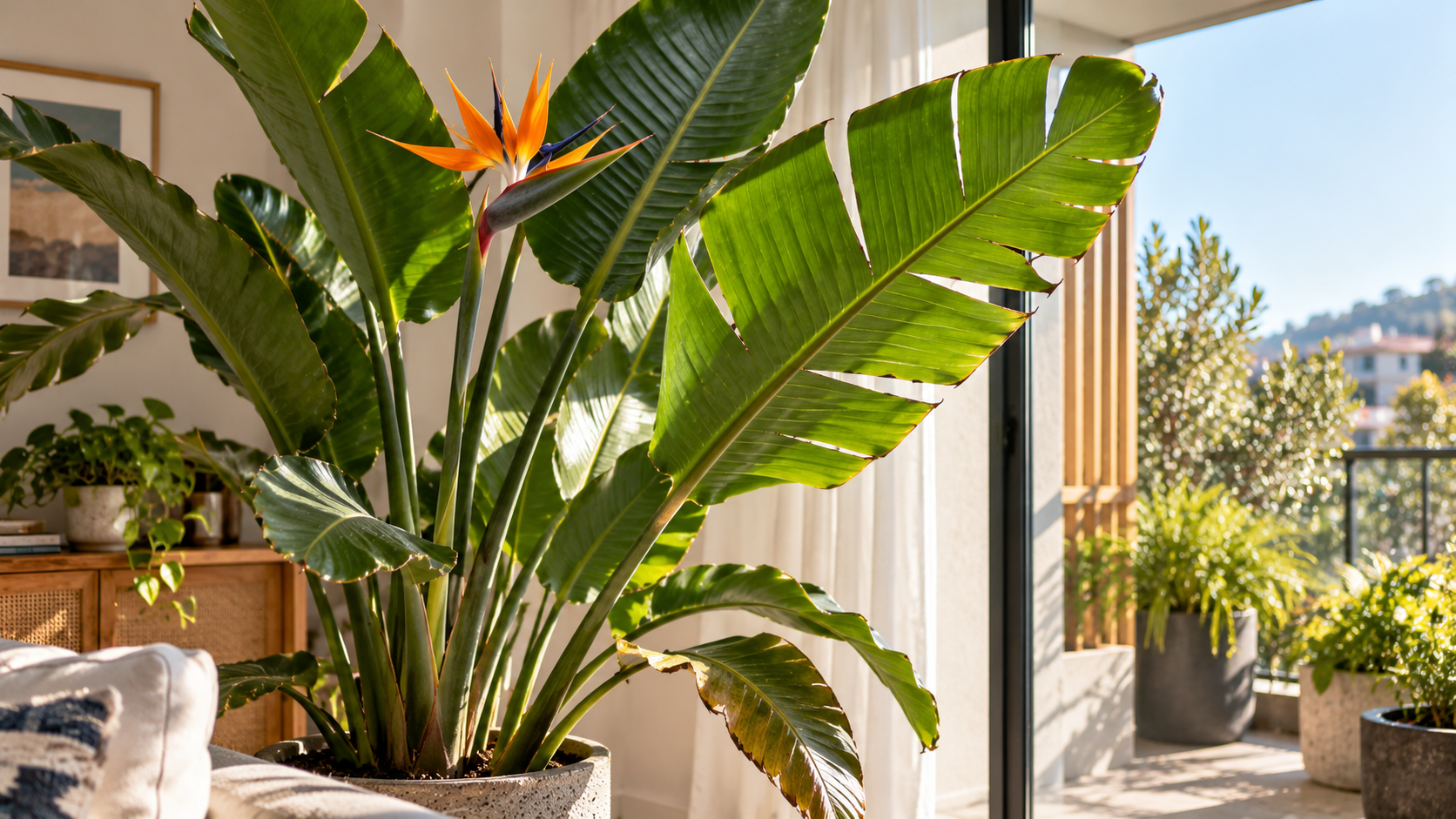
Bird of Paradise Leaves Splitting: Normal Tearing or Stress?
The first long tear down a bird-of-paradise leaf can look alarming. One week the leaf is a broad green paddle; the next it seems to have been cut into ribbons. Because the split may appear after moving the plant, watering it, or opening a nearby window, owners often assume they caused a disease. Yet tearing can be a physical feature of these large leaves, not evidence of an infection.
The practical question is not simply “Why did this leaf split?” It is whether the tear stands alone or arrives with symptoms such as expanding brown tissue, soft stems, insects, and declining new growth. Understanding that distinction prevents unnecessary pruning and gives you a better way to protect a large Strelitzia in a home or balcony setting.
Understand the shape of a Strelitzia leaf
Bird-of-paradise plants develop broad blades carried on long stalks. The familiar orange-and-blue flowering species, Strelitzia reginae, is not identical in mature size or habit to Strelitzia nicolai, the larger white bird of paradise commonly sold as a dramatic indoor foliage plant. Both can develop substantial leaves, but the amount of room and support they need may differ considerably.
A wide leaf catches moving air. Under wind or mechanical pressure, splits can travel along natural lines through the blade. In outdoor settings, divided leaf surfaces can reduce the amount of force acting on a single broad sheet. Inside a house, the same structure can still tear when a leaf brushes a doorway, catches a curtain, or moves sharply in a draft.
That does not mean every tear is healthy or harmless. The leaf’s design explains why a clean-looking split can happen without disease; it does not explain a spreading dark spot, mushy stalk, or leaf that collapses while still unfolding. Think of a split as a shape change to investigate, not a diagnosis on its own.
The Royal Horticultural Society’s Strelitzia growing guide specifically notes that windy outdoor positions can shred leaves, while recommending bright conditions and shelter for plants moved outside. That is different from claiming that every indoor split is wind damage.
Look at the edges of the tear
Begin with the torn leaf, but do not limit the inspection to the tear. A straightforward mechanical split often follows a long line, leaving two relatively clean sections of green blade. The margins may dry slightly after the injury because exposed tissue loses moisture, but the rest of the leaf remains firm and green. New growth may still look vigorous.
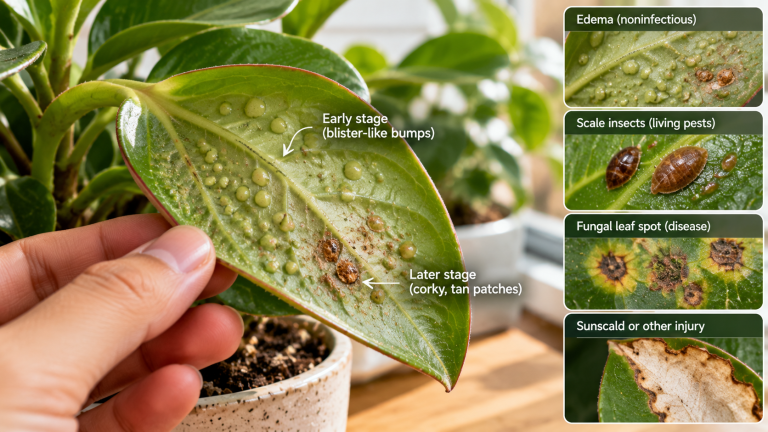
Disease or environmental stress can have a different pattern. Brown, wet-looking, expanding spots are more concerning than stable dry edges. Extensive yellowing, translucent patches, soft tissue, or a foul smell suggest that something beyond a clean tear may be happening. Check both surfaces and the petiole, the stalk connecting leaf to the crown.
Compare several leaves of different ages. If the oldest two leaves have narrow dry tears and the newest leaf emerges undamaged, the plant may be functioning normally. If every newly expanding leaf tears in the same tight location, inspect what it rubs against as it unfurls. A wall, shelf, neighboring leaf stalk, or low ceiling can repeatedly damage young tissue.
Distinguish a tear from a spot
A tear is a physical opening in the blade. You may be able to see light through it. A spot is tissue that has changed color or texture, even if it later becomes brittle and holes appear. Separate those descriptions when taking photos; “a damaged leaf” is too vague to reveal a trend.
Dry brown tips alone are not evidence of a pathogen. Low humidity, irrigation inconsistency, mineral accumulation, and physical abrasion may contribute to edge injury, although the actual cause depends on the whole growing situation. A plant can simultaneously have old wind splits and dry tips from a separate care issue. Address what is active rather than assigning all symptoms to the first visible tear.
Reconstruct what happened before the leaf changed
Write down when the split was first noticed and what changed nearby. Was the plant carried through a narrow doorway? Did it spend two nights outdoors during strong wind? Was the curtain catching the leaf whenever a window opened? Did a pet brush against the stalk? These mundane events often provide a more useful explanation than a speculative fertilizer deficiency.
If the leaf was recently rolled or folded as it emerged, inspect whether it became snagged on an older leaf. New leaves can be delicate, especially when mechanically constrained. Do not force an emerging spear open with your fingers to make it look perfect. Gentle clearance from neighboring objects is safer than prying its tissues apart.
For a plant moved outdoors, monitor several weather variables, not just sunshine. A sheltered balcony corner can experience gusts around a building face, and pot stability matters when a tall crown behaves like a sail. During acclimation, choose a warm, protected position and observe whether moving air causes repetitive bending.
If no distinct event occurred, do not invent one. Photograph the leaf, check its surroundings, and monitor the next leaf. A single split without declining vigor seldom justifies repotting, pesticides, or dramatic cutting.
Check the plant’s growing conditions without treating every problem as one
Bright light supports healthy Strelitzia growth. A plant squeezed into a dim corner may produce weaker or smaller new leaves, but it would be misleading to say that low light directly creates every longitudinal split. Evaluate the light because it affects long-term vigor, not because it is a universal explanation for tears.
Watering also matters, particularly for large plants with substantial leaf surfaces. During active warm growth, the medium should receive thorough watering while retaining appropriate aeration; permanently soggy conditions are not desirable. In slower or cooler conditions, water use changes. Judge root-zone moisture rather than applying an identical volume on a calendar schedule.
Strelitzias appreciate warmth and do not thrive in chilly drafty spots. The RHS guide advises bringing outdoor plants in before nights approach temperatures unsuitable for this tender genus. This is a separate issue from the blade splitting, but cold injury can create additional discolored tissue that makes diagnosis confusing.
Dust-covered leaves can be wiped gently with a damp cloth to improve their surface cleanliness. Support the underside while wiping so the motion does not drag the blade across a split. Skip glossy leaf-shine products; they are not needed to repair tissue, and a freshly torn leaf is not a surface to polish aggressively.
How to protect large leaves during a move
Moving a large bird-of-paradise plant is a physical handling project. First assess height, leaf reach, and the route through doorways. Two people may be needed for a heavy pot or wide plant. Transport the container from its base rather than pulling on the stems, and avoid binding leaf stalks so tightly that they crease.
If temporary support is necessary, gather the leaf stems loosely with soft material; do not force the blades into a sharp bundle. Keep the crown away from radiator heat, air-conditioning outlets, and doors that slam shut. A plant placed in front of a frequently opened balcony door may look magnificent in a photograph but experience constant collisions.
After moving it, give the plant time. Leaf tears do not seal back into an unbroken blade. Repositioning can prevent more injury but cannot erase existing scars. Track whether the next leaf arrives in better condition; that is a fairer measure of whether the move improved the situation.
An exposed-balcony example
Consider a large S. nicolai that spends most of the year in a bright living room. In warm weather its owner moves it to a high balcony for fresh air. Within days, three older leaves have long splits. The petioles remain firm, foliage is otherwise green, and no spots expand. Wind is a plausible cause, especially if the plant was positioned near the open edge.
The owner does not cut every leaf. Instead, the container is relocated to a stable, sheltered position with suitable light, and the leaves are kept clear of a railing. New splits are recorded after windy days. If damage stops while growth continues, the evidence favors physical tearing. If black or soft lesions appear independently, the owner investigates that new symptom separately.
The result may still be a plant with some torn leaves. An outdoor-adapted silhouette does not necessarily mean the plant has failed. The useful outcome is that repeated injury is reduced and the plant remains vigorous.
Should you trim a split leaf?
A green leaf still contributes to the plant even when its blade is divided. Removing every imperfect leaf reduces photosynthetic area and can leave the crown sparse. Retain leaves that remain mostly green and structurally secure, especially when only a narrow tear is present.
If a leaf is largely brown, broken at the stalk, or constantly catches people walking past, removal may be reasonable. Use clean, sharp secateurs and cut the declining leaf stalk appropriately near its base without damaging the crown or adjacent healthy stalks. Avoid cutting into the tightly packed growing point.
Trimming just the brown edge for appearance is a personal choice, not a treatment. A cut margin may itself dry and become visible. If you tidy a torn blade, leave healthy tissue intact rather than sculpting the entire leaf into a smaller shape. When repeated pruning becomes necessary simply to fit a plant in a room, reconsider whether its mature dimensions suit that location.
Do not glue, tape, or staple a torn blade to restore its original form. Adhesives and added weight do not recreate functioning leaf tissue and may create new injury. Support should address unstable stalks or placement, not cosmetic reconstruction of individual splits.
Check for pests only when signs warrant it
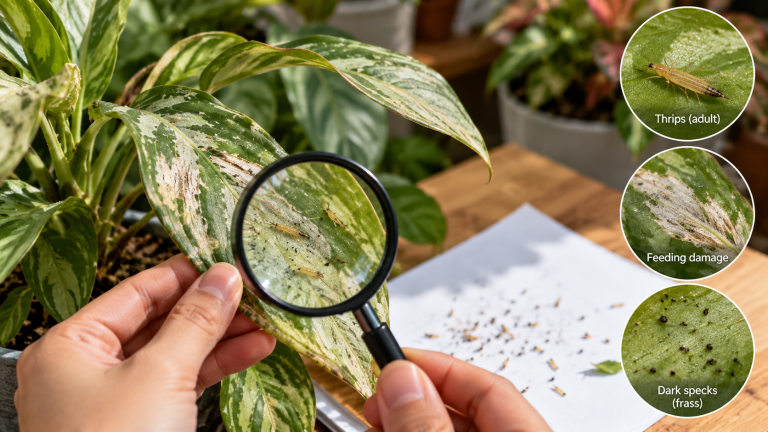
Scale insects, mealybugs, and spider mites may affect houseplants, including Strelitzia. But their presence is a separate question from a clean mechanical split. Inspect the undersides of leaves and protected joints if there is stippling, sticky residue, cottony patches, or repeated decline. A hand lens and a good light are more useful than treating an imaginary pest.
Physical tears do not move from plant to plant as an infectious disease. If a nearby houseplant is healthy, isolating it solely because a Strelitzia blade tore is unnecessary. Conversely, an actual pest problem should be identified and addressed through an appropriate management plan. Do not use pesticides as a reflexive response to a split leaf.
When a lesion grows, tissue becomes mushy, or the crown appears to rot, seek a more specific diagnosis. Photographs of the entire plant and close views of affected tissue can help a local horticultural professional distinguish environmental injury from infection. A clear description of timing is usually more informative than one close-up photo without context.
Give a mature plant enough room
Large white bird-of-paradise plants can eventually outgrow narrow indoor corners. A healthy new leaf may become wider or taller than the available space. Repeatedly moving the pot or bending stalks out of the walkway increases mechanical damage even when care is otherwise good.
If the surrounding space is already crowded, the RootLuma article on arranging indoor plants without crowding provides complementary placement considerations. Measure the space at the plant’s widest point, not only the pot diameter. Leave clearance from curtains, ceiling fans, and door swings. A stable pot matters, but do not respond to every tear by moving into a huge container. Repot based on the roots and the plant’s condition; the RHS notes that newly bought Strelitzia may not need a larger pot immediately.
Small changes can help: turn a pot modestly during routine care to support more balanced growth, relocate furniture that brushes the leaves, or move the plant to a room with more overhead clearance. Replacing a too-large specimen with a smaller plant can be more sustainable than constantly cutting healthy leaves to fit an unsuitable corner.
A quick decision path
If the tear is clean, the rest of the blade is firm, and recent wind or contact is plausible, reduce physical stress and monitor. If several blades are dry at the edges, inspect irrigation, humidity, and exposure in addition to mechanical causes. If fresh lesions enlarge or stems soften, shift from a cosmetic issue to plant-health diagnosis.
Observe the next leaf rather than expecting the old one to heal. The presence of some splits may remain normal for a large-leaved plant; continued shredding in an exposed position is a practical problem worth correcting. Your goal is healthy growth and fewer avoidable injuries, not flawless leaves year-round.
References
Royal Horticultural Society — How to grow Strelitzia