Leggy Jade Plant: How to Improve Shape Without Over-Pruning
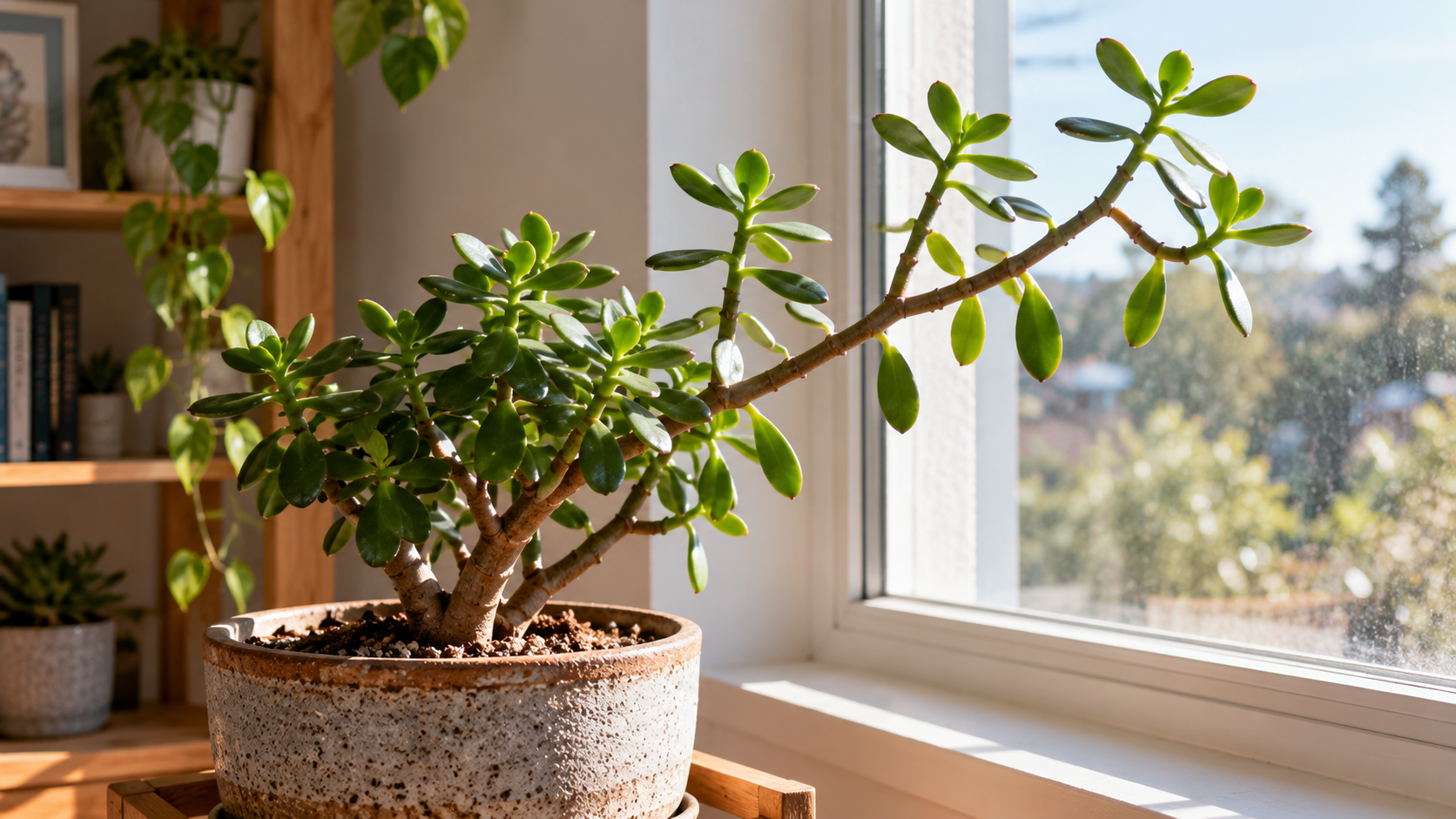
A jade plant can look sturdy for years and then develop a surprising silhouette: long, widely spaced leaf pairs, a leaning stem, and a top-heavy crown that no longer resembles the compact succulent you brought home. The temptation is to cut it back hard immediately. That may produce an even less balanced plant if its growing conditions remain unchanged.
A leggy jade plant usually needs two decisions made in the right order. First, determine whether the stretched growth reflects insufficient light, ordinary age, or a separate health problem. Then decide whether the plant would benefit from gradual relocation, selective pruning, support, or propagation. The old stem will not shrink when light improves; the useful evidence comes from healthier new growth.
What “leggy” means on a jade plant
Jade plant (Crassula ovata) is a succulent shrub with thick leaves and gradually woody stems. Young specimens often have short gaps between successive leaf pairs, making the branches appear densely furnished. With inadequate light, new stems may lengthen faster than they develop strong, compact leaf arrangements. Growers call this elongated growth etiolation.
Compare the newest six or eight leaf pairs with older growth on the same branch. If the spaces between the newer pairs are noticeably longer and the branch is reaching toward the window, light limitation becomes a plausible explanation. Smaller-than-usual leaves, a pale appearance, and a stem that bends under its own weight strengthen that suspicion. One long branch alone does not prove etiolation, however: mature jade plants also develop unevenly shaped woody arms and lose older leaves.
Look at the whole plant, not just the longest shoot. A healthy older jade may have a bare trunk beneath a reasonably compact canopy. A stressed jade may show wrinkled leaves, soft stems, or blackened tissue rather than simply elongated internodes. Those clues point toward watering or root trouble and should be addressed before cosmetic pruning. The RHS plant profile for Crassula ovata recommends bright conditions and a free-draining cactus-type medium; it does not suggest that heavy cutting is routine maintenance.
Assess light before reaching for scissors
Observe the plant where it actually lives. A jade on a shelf two meters from a window experiences a very different light environment from a jade directly beside an unobstructed bright window. Curtain fabric, overhangs, neighboring buildings, window orientation, and seasonal changes all alter light exposure. A room may feel bright to people while providing comparatively little useful light to a succulent.
Check whether the pot is leaning consistently toward the glass. Inspect the younger sections of several branches; if those facing the window are shorter and fuller while shaded branches are longer, the uneven exposure may be driving the shape. Also examine the window over an ordinary day. Direct midday rays on a summer balcony are not equivalent to diffuse winter light inside a room.
There is no single window direction that guarantees success worldwide. South-facing windows can be bright in the Northern Hemisphere; in the Southern Hemisphere the corresponding high-exposure side is usually north-facing. Obstructions and climate matter more than a simple compass rule. If the available location stays dim even at midday, a suitable horticultural grow light may be more useful than repeatedly pruning elongated shoots.
Why a brighter spot is not an instant repair
Moving a poorly acclimated jade straight from dim indoor light into intense sun can damage exposed leaves. The plant needs time to adjust its tissues to stronger light. Start with a brighter position that avoids the harshest direct exposure, then increase exposure over several weeks while checking leaves for bleached, dry, or scorched patches. Protect the pot from cold nights and severe rain if you use an outdoor location.
Do not rotate a recently stressed plant so aggressively that every leaf suddenly faces unfamiliar strong sunlight. Make modest adjustments and observe. If growth resumes, evaluate the spacing of new leaves. The stretched internodes already present will stay stretched. Your aim is for subsequent growth to be more compact and for any future pruning to redirect a healthy plant rather than disguise an ongoing environmental problem.
Decide whether pruning is actually necessary
The broader RootLuma guide to pruning houseplants for balanced growth explains the general rationale; jade calls for an especially conservative version of that approach. Pruning is useful when a particular branch is structurally awkward, when a top-heavy shoot threatens to break, or when the owner wants to shape a healthy plant. It is less useful when a jade has weak roots, shriveled leaves, or multiple soft stems. A plant struggling to sustain existing foliage is a poor candidate for major decorative surgery.
Examine the stem from its base to its tip. A woody trunk may support a long branch safely even if the plant looks asymmetrical. A thin green shoot growing horizontally from a slender junction is less reassuring. Ask what will happen to the plant’s balance if you remove that branch: will the opposite side become heavier, or will the main stem spring back into a safer posture?
For many indoor specimens, the first cut can be small. Removing the very tip of one healthy elongated shoot can encourage branching below the cut, although the exact response varies. Cutting above a node or a well-placed leaf pair leaves a plausible point for new growth. Use clean, sharp shears and avoid crushing succulent tissue. Wear gloves if your skin is sensitive and keep plant clippings away from pets; jade is considered toxic to cats and dogs.
Make a pruning map first
Photograph the jade from the front and from each side. On the picture, mark the branch that is leaning, the intended new outline, and two or three places where new branching would improve balance. This may feel excessive for a houseplant, but it prevents the common mistake of cutting branches one after another without a final shape in mind.
Avoid removing a large share of foliage all at once simply because the plant looks untidy. For a vigorous jade during active growth, test one or two selective cuts first. Allow the plant to show how it responds before making further changes. There is no need to meet a fixed pruning percentage: stem thickness, season, root health, and remaining leaf area are more important than an arbitrary formula.
After cutting, provide bright but not suddenly scorching light, maintain reasonable airflow, and avoid soaking freshly cut or damaged tissue. A cut surface on a succulent should be allowed to dry; constant wetness around damaged stems is unnecessary. If a cut branch is thick and heavy, support it while cutting so it does not tear bark lower down.
Reuse healthy cuttings without assuming every stem will root
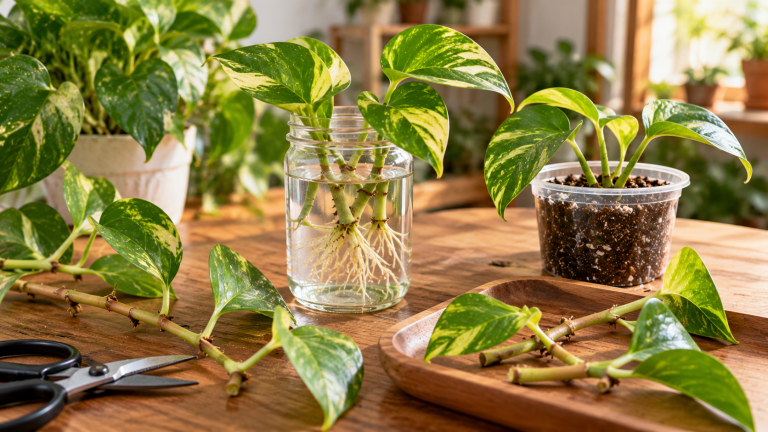
A long branch removed for balance can sometimes become a new jade plant. Choose a firm, healthy section with several nodes and no sign of rot. Make a clean cut, remove leaves that would sit below the eventual planting level, and allow the cut end to dry and callus before placing it in an appropriate, well-draining succulent medium.
The waiting period is not a stopwatch exercise. Thin pieces and thick woody cuttings dry at different rates in humid and dry climates. Check the cut surface rather than following a universal number of hours. Keep the cutting in bright indirect light while it establishes; avoid treating a freshly cut, rootless stem as though it can drink as efficiently as a mature plant.
Root development can take time, and a cutting may remain green while making little progress below the surface. Tugging at it every few days damages delicate new roots. Watch instead for renewed, stable growth and gradual resistance when the cutting becomes established. Not every branch is worth saving: compost clearly rotten tissue rather than using it for propagation.
Leaf propagation is also possible with jade, but it typically produces a much smaller starting plant. A stem cutting from a healthy top-heavy branch is a more practical way to preserve some of the original height and appearance. The botanical source from RHS lists stem and leaf cuttings among Crassula propagation options; it is not evidence that every home attempt will succeed.
Correct the balance of the pot and root system
Sometimes the silhouette looks worse because the entire root ball is tilted. Check whether the pot sits level and whether the stem enters the medium at an angle. If the plant is genuinely unstable, a heavier container with adequate drainage may improve safety. Do not bury a substantial section of previously exposed stem just to make it stand straight; keeping susceptible tissue constantly wet can create new trouble.
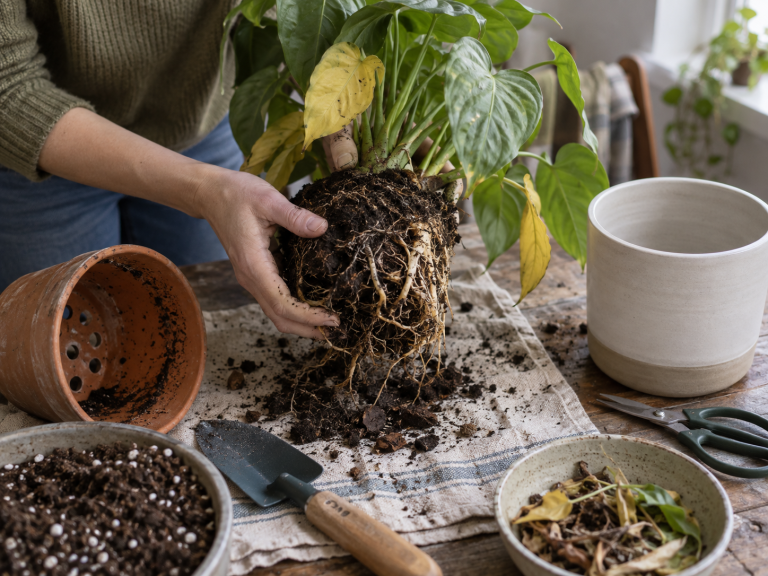
A larger pot is not automatically a better pot. Excess unused mix stays wet longer in some home conditions, especially during cool periods. Repot when the roots or pot condition justify it, not simply because the canopy has become tall. If a healthy plant is securely rooted, judicious branch removal and improved light may be less disruptive than a wholesale soil change.
Check drainage after watering. Water should move through the mix without leaving the root zone waterlogged for extended periods. Jade plants store water in fleshy leaves and usually tolerate substantial drying between waterings once established. A calendar rule such as “every Sunday” cannot account for pot material, temperature, light, and season. Observe the medium and plant before deciding to water.
If the trunk is soft at the soil line, if a dark patch is spreading, or if the pot smells sour, pause the cosmetic project. Root or stem disease is a more urgent concern. Healthy pruned material can be kept for propagation if suitable; decaying parts should not be reused as cuttings.
A realistic case: a jade leaning toward one window
Imagine a five-year-old jade in a glazed ceramic pot on a shelf set back from a bright apartment window. Its older lower stems are woody. Three recent shoots have long spaces between leaf pairs, and one leans across a walkway. The leaves remain firm and the pot drains normally. Nothing suggests an immediate root emergency.
The owner’s first change is to move the pot gradually nearer the window, protecting it from intense direct rays at first. A photograph establishes the original leaf spacing. Over the next several weeks the owner checks how the newest leaves form, rather than repeatedly measuring the old elongated part.
Once fresh growth is visibly healthier, the most awkward shoot is shortened above a healthy pair of leaves. The other shoots remain in place. A cutting from the removed stem is allowed to callus and is planted separately. The owner then waits to see whether new buds emerge below the cut and whether the main crown becomes more balanced.
After several months, the original long gaps remain visible on unpruned wood, but the newer tips may have a denser habit. The plant is still recognizably an older jade, not a perfectly symmetrical nursery specimen. That is a successful recovery: safer structure and better growing conditions, without demanding that old tissues reverse their history.
Mistakes that make a leggy jade worse
Cutting before fixing the light. If the plant continues producing stretched shoots, new branches may repeat the problem. Better light comes first; pruning follows if the shape still needs correction.
Moving straight into harsh sunlight. A succulent’s preference for bright conditions does not remove the need for acclimation. Watch for bleaching or dry burn marks and adjust gradually.
Overwatering to “help it recover.” Removing foliage changes the plant’s water use. Water according to the medium and season, and avoid saturated conditions around vulnerable roots.
Pruning every branch in one session. Staged decisions reveal how the plant responds and preserve foliage to sustain recovery. Sometimes one selective cut is enough.
Using an oversized pot as a counterweight. A large volume of wet media may introduce a root problem while solving a visual problem. Choose a stable but appropriately sized container.
Expecting old internodes to shorten. Existing stretched stem sections will not contract because light improved. Judge progress by new growth and future structure.
A seasonal review that avoids unnecessary interventions
At the beginning of an active growing period, examine root health, support, and light exposure. Identify the one most awkward shoot, if any, and decide whether it needs pruning. During brighter weeks, track the newest leaf pairs and signs of scorch. During slower, darker periods, reduce expectations of rapid change and avoid repeated cutting to force growth.
If the plant spends summer outdoors, watch the forecast and shade changes: intense sun, heavy rain, strong wind, and cool nights can each create stresses different from an indoor shelf. Bring it back to a bright, protected position before temperatures become unsuitable. A jade that experiences stable conditions may take longer to reshape than an owner expects, but repeated environmental upheaval is rarely helpful.
A simple monthly record can contain four details: current position, firmness of leaves and stems, new leaf spacing, and any pruning or repotting performed. There is no need to measure every leaf. The record helps distinguish a genuine long-term improvement from the transient appearance of a newly trimmed tip.
When a leggy jade needs more than shaping
Seek help from a knowledgeable grower or local Extension service if the stem is softening, the base is collapsing, or a spreading lesion appears. A severe pest infestation or root problem can mimic ordinary decline and will not be solved by pruning. Also reconsider the location if a plant repeatedly grows pale, weak branches despite all shaping attempts.
For a fundamentally healthy jade, the least dramatic intervention is often the best one: make the location brighter in a controlled way, let the plant produce a new pattern of growth, and then adjust one structural branch at a time. Compactness is a result of suitable conditions, not simply a haircut.
References
Royal Horticultural Society — Crassula ovata
University of Minnesota Extension — Spring houseplant care