How to Grow Radishes in Containers: Spacing, Depth, and Harvest
Radishes are a satisfying container crop because many varieties reach harvest in a relatively short growing period and need less depth than large fruiting vegetables. Their quick growth also makes mistakes visible: crowded seedlings produce small or misshapen roots, hot weather may encourage bolting or poor texture, and uneven moisture can spoil the crisp result you were hoping for.
Growing them well is more about matching spacing, temperature, and harvest timing than adding elaborate equipment. Radish roots develop directly from the young seedling, so direct sowing into the final container is generally preferable to transplanting crowded sprouts later. Choose a suitable cultivar and plan the pot around the mature root shape.
Choose a variety for your container
Round salad radishes are often easier to fit into a shallow-to-moderate container than long daikon-type radishes. Read the seed packet for expected root length, spacing, maturity range, and preferred temperature. Long-rooted types require more depth and may be poorly suited to a shallow balcony box. A “radish” is not one standard root size.
Check seasonal guidance for your climate. Many familiar salad radishes perform best in cooler conditions. In hot weather, plants may bolt, roots may become pithy or pungent, and harvest quality can decline. In tropical or warm regions, locally adapted varieties and cooler planting windows are especially important. Do not follow a northern spring planting calendar literally if your climate is different.
Choose fresh seed from a reputable vegetable supplier. Radish seed is generally sown directly; you do not need to soak it in chemical stimulants or start every seed in a small plug. Keep the packet after planting so you can compare actual growth with the variety’s expected harvest window.
Use a draining container with adequate root depth
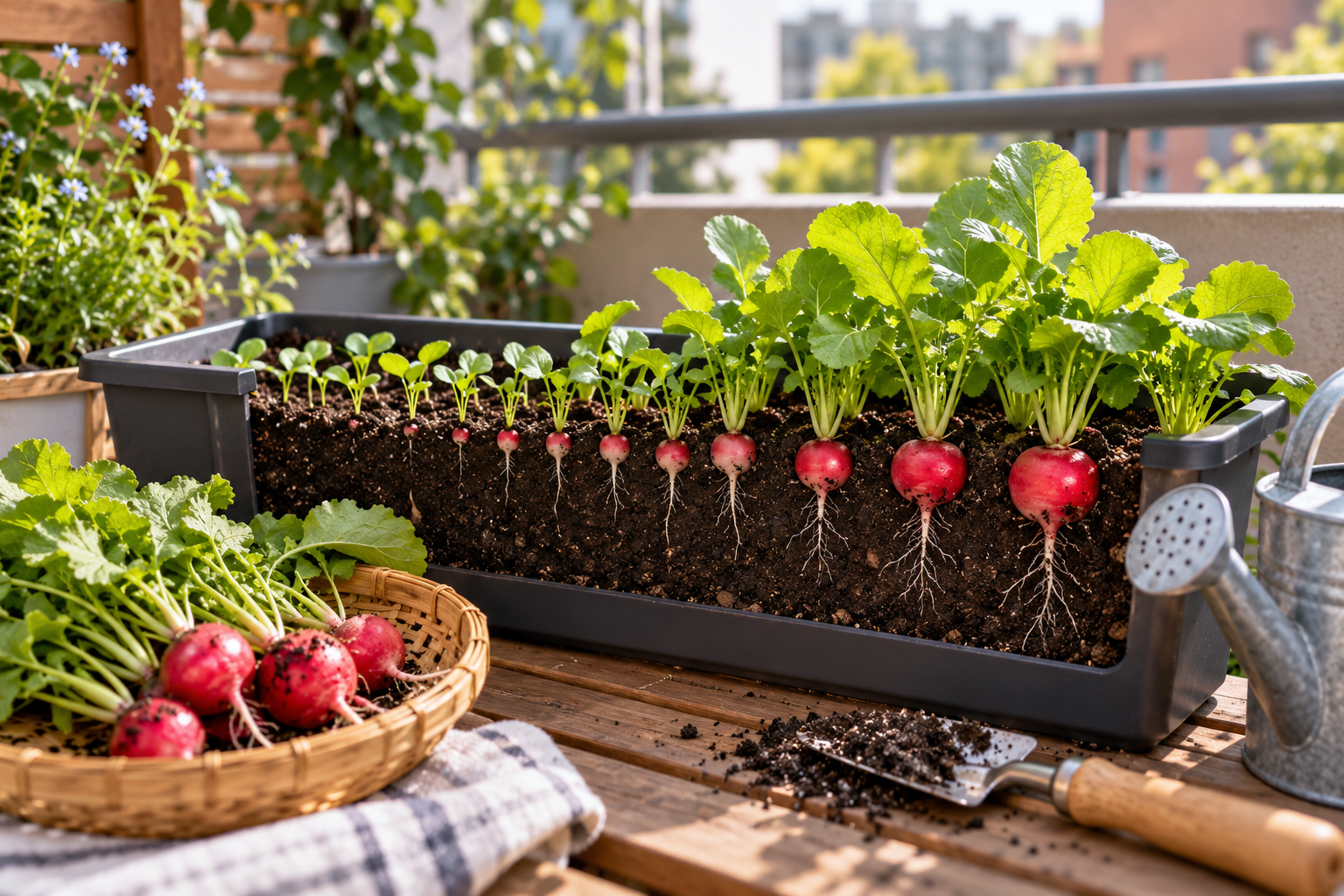
A window box or broad pot with drainage holes can support a modest radish crop. Container depth must accommodate the developing root and enough moist, aerated medium below it; long varieties need more space. A very shallow decorative dish can restrict roots and dry quickly even if seedlings initially emerge well.
Use fresh, loose potting mix intended for edible containers. Avoid compacted garden soil or a dense blend with large stones occupying the root zone. Radishes need unobstructed space to develop their intended shape. Mixes that crust hard on top may also hinder uniform emergence. Pre-moisten the medium before sowing and level it gently without compressing all air spaces.
Do not add a thick gravel layer at the bottom as a supposed drainage cure. Effective drainage requires holes and appropriate medium structure. A coarse layer under fine material does not necessarily improve root-zone aeration and takes space away from the crop.
Sow directly at a sensible spacing
Follow the seed packet’s sowing depth and mature spacing for the particular variety. A common beginner mistake is scattering an entire packet over a small tray and assuming tiny seedlings will sort themselves out. They will compete for light, nutrients, and physical room, often producing impressive foliage but disappointing roots.
Make shallow furrows or individual positions, sow seeds, cover at the appropriate depth, and moisten carefully. If you sow a little closer than final spacing to account for germination losses, thin seedlings promptly when they can be handled without uprooting neighbors. Use scissors near the surface where pulling one seedling would disturb the roots of another.
Thinned radish greens may be edible when correctly identified and safely grown, but handle them as fresh produce and do not consume plants treated with chemicals inappropriate for food crops. Do not treat thinning as a wasted step; it is the space-management decision that allows the remaining plants to form roots.
Why transplanting is rarely the best first choice
Moving a seedling with an actively developing taproot can bend or damage it. For quick-growing root crops, that disturbance can affect final shape or delay growth. Direct sowing avoids the problem. If an unexpected transplant is necessary, handle carefully, but do not plan a system that requires pulling up dozens of overcrowded plants and moving them at the last minute.
Water for even growth
Radishes need moisture to germinate and maintain rapid root expansion. Repeated severe drying and sudden soaking can stress plants and contribute to poor texture or cracking, although variety and temperature also matter. In a small balcony pot, check moisture below the surface rather than waiting for leaves to wilt dramatically.
Water gently enough that seed is not washed into corners. Once established, apply water as needed to moisten the root zone and allow excess to drain. An exposed railing box may dry faster in wind than a pot on a sheltered floor. If you use mulch, choose a light layer that does not smother small seedlings or hide their crowns.
More water is not always better. Saturated medium reduces oxygen and can encourage disease. Assess the whole root zone, particularly after rain, rather than topping up every morning out of habit. A small container may need frequent checks but not necessarily frequent irrigation in cool weather.
Keep light and temperature in view
Radishes grow best when they have suitable sunlight and favorable temperatures. In deep shade, plants may put energy into stretched foliage while roots remain small. In excessive heat, rapid bolting can divert growth away from the desired storage root. A reasonably bright balcony with cooler conditions is often more promising than a scorching south-facing wall during the hottest part of the year.
This is a crop for which timing can matter more than fertilizer. If repeated sowings fail during a hot period, consider waiting for a cooler planting window rather than applying ever-stronger nutrients. Local extension planting calendars can help you choose the right season and variety. A plant cannot be fertilized out of temperature stress.
A balanced growing medium may provide adequate nutrition for a short crop, depending on product and conditions. Excess nitrogen can encourage leaves at the expense of root quality. Apply additional fertilizer only when justified by the mix and the product’s safe instructions for edible crops.
Harvest before roots lose quality
Inspect the crown and compare actual root size with the cultivar’s expected maturity. Some radishes push their shoulders above the soil as roots develop, making it possible to estimate size without digging up every plant. When a representative root reaches useful size, harvest a few and assess texture and flavor.
Leaving quick-growing salad radishes in the pot for too long can result in oversized, pithy, woody, or excessively spicy roots. The exact time depends on cultivar and conditions, so the packet date is a planning estimate rather than a deadline. In hot spells, inspect more closely; a crop can change texture faster than expected.
Pull gently while supporting surrounding soil or use a small tool if roots are tightly held. Remove leaves if storing according to usual fresh-vegetable handling, wash produce before eating, and refrigerate appropriately. Discard roots showing serious decay rather than trimming a visibly spoiled harvest into a meal.
Succession sowing without overwhelming the pot
Instead of sowing one huge tray that all matures at the same time, try a modest new sowing at suitable intervals during the growing season. Use separate rows or containers so younger seedlings are not shaded by older foliage. Staggering harvest can keep the kitchen supplied with smaller, fresher batches and make it easier to evaluate the effect of changing weather.
Do not replant immediately into a diseased or exhausted medium without checking its condition. Remove old root debris and refresh as needed. A quick crop cycle does not mean sanitation or nutrient management can be ignored indefinitely.
Problem Likely factor to investigate Better adjustment
Lots of leaves, tiny roots Crowding, heat, excess nitrogen, or low light Improve spacing and seasonal placement
Split or cracked roots Uneven growth conditions may contribute Keep moisture more consistent
Long thin roots Variety, crowding, or insufficient conditions Compare with packet shape and growing conditions
Hot, pithy roots Late harvest or heat stress Harvest promptly and sow in cooler weather
Poor emergence Seed depth, dry surface, crusting, or seed quality Recheck sowing method and moisture
A realistic balcony trial
Use two modest containers of the same radish variety rather than a single overcrowded pot. Sow at the recommended spacing in the first and, if you want to learn, keep a separate observational tray with a slightly different location while all other factors remain similar. Record emergence date, thinning, water behavior, and the point when roots become harvestable.
Compare the result. Did the more exposed container dry faster? Did the shaded location produce smaller roots? A comparison cannot prove every cause, but it helps you plan the next sowing under the conditions your balcony actually offers. Do not deliberately overcrowd a food crop when a simple journal will teach enough.
The RootLuma guide to growing leafy greens on a balcony covers related container fundamentals, but radishes add a specific challenge: the edible storage root must expand without competition or disturbance. That is why direct sowing and thinning deserve special attention here.
Match radish roots to the shape of the container
A container that looks large from above may still be unsuitable for a long-rooted radish. Check actual usable depth after allowing space below for drainage and above for a sensible watering rim. A broad shallow trough can work well for round salad radishes but may force long roots to bend or stop expanding normally. Conversely, a deep narrow pot may contain enough soil but offer too little surface area for several plants at proper spacing.
Do not solve this with large stones under the medium. They occupy the space roots could use. Select the container shape for the cultivar’s mature form, add a structured potting mix, and make sure water can drain. If a previous crop produced forked or stunted roots, review stones, compaction, crowding, and transplant disturbance rather than assuming only fertilizer was missing.
Use one small harvest to calibrate the next
Harvest two representative roots when they seem close to ready. Cut one and assess texture, tenderness, and flavor; inspect the other for cracking or unusual shape. If both are still small and mild, the variety may need more time under those conditions. If both are woody or pithy, you may have waited too long or grown them under excessive heat.
Record the sowing and harvest dates, but also the weather. A packet’s estimated maturity period is a guide based on typical conditions, not a promise. A short observation log makes your next sowing more predictable than simply repeating the same calendar date.
Troubleshoot leafy tops without usable roots
If the foliage is vigorous but storage roots remain thin, investigate four factors together: spacing, temperature, light, and nitrogen supply. Crowding may prevent expansion even while leaves look attractive. Excessive warmth can encourage bolting or poor texture. Weak light limits photosynthesis, and excess nitrogen can favor leaves. Choose the clearest mismatch and correct it in the next sowing; trying to salvage overmature roots with more fertilizer rarely succeeds.
If bolting begins, harvest what remains useful and plan another crop for a more favorable season. The resulting flowers may be interesting, but they are no substitute for tender salad roots if that was the original goal.
Three container-radish outcomes and what to change next
The leaves look abundant, but roots remain tiny. Check seedling spacing first, followed by temperature and light. Thin early enough that individual roots have room to expand, and avoid automatically increasing nitrogen fertilizer in response to lush foliage.
The roots crack or turn coarse. Review irregular drying and rewetting, weather changes, and delayed harvest. Radishes are usually a crop to check frequently near their expected maturity rather than leave in a pot for another month.
The seedlings become leggy before useful roots form. Ask whether the location supplies enough light for a root crop. A bright indoor windowsill may still be inadequate, especially behind shaded glass. A shallower pot does not solve light shortage; choose an appropriate outdoor season or a suitable growing-light arrangement where practical.
For the next sowing, use the seed packet’s spacing and depth guidance for your actual variety, particularly if it forms a long root. Direct sowing usually avoids unnecessary root disturbance.
Treat radishes as a spacing and timing crop
A successful pot of radishes starts with the right variety, a draining container, direct sowing, and prompt thinning. Favor a suitable cool growing window, keep moisture reasonably consistent, and harvest as soon as roots meet your kitchen needs. The most helpful improvement is often not another product but a little more room around each seedling and closer attention to harvest timing.
References
Virginia Cooperative Extension — Container vegetable gardening
University of Maryland Extension — Growing vegetables containers and salad tables