Air Plant Care Indoors: How to Water and Dry Tillandsia
An air plant can grow without a pot of soil, but it cannot grow without water. Tillandsia species absorb moisture through specialized scales, or trichomes, on their leaves, and many grow attached to branches or other surfaces in nature. Indoors, a decorative glass sphere or driftwood mount changes how quickly water evaporates after you wet the plant. That drying period is just as important as the watering itself.
The most common mistake is treating every Tillandsia like the same object. A silvery, heavily trichomed species adapted to brighter, drier conditions may need a different routine from a greener species from more humid environments. The exact species, room temperature, airflow, light, and mounting arrangement should determine the care plan—not a rigid weekly soaking command printed on a generic store tag.
Know which plant you have
Tillandsia is a large genus within the bromeliad family. Many species are epiphytic and use roots primarily for attachment rather than growing in ordinary potting soil. Their leaves vary enormously in shape and texture. Some are densely covered with silvery trichomes; others are greener and smoother. These visible differences offer clues about adaptation but do not identify a species perfectly.
Look for the botanical name on the label and compare it with reputable horticultural information. A shop description of “air plant” is often too broad to support a precise watering schedule. If no species is given, start conservatively, observe how quickly the plant dries, and avoid keeping water trapped in the leaf bases. Mount and container choices can influence care more than the marketing name suggests.
Roots that extend from the base can be normal attachment structures. Do not bury the plant in moist garden soil because you assume every root needs potting medium. In a mounted display, secure the plant without cutting or constricting its base, and use materials that will not leave harmful residues on living tissue.
Understand how trichomes and air movement interact
Trichomes give many Tillandsia leaves a silvery appearance and help interact with water at the leaf surface. Their density varies by species. These adaptations do not mean a plant can live permanently on ambient humidity alone in an ordinary heated room. Most indoor specimens need deliberate watering, adjusted to the plant and environment.
Water must then leave vulnerable pockets. A plant placed upright in an unventilated glass globe may hold droplets between leaves for hours, particularly in cool, still air. Persistent wetness near the crown can promote rot. A plant mounted in open air near gentle circulation may dry considerably faster. That is why care advice that only specifies how long to soak, without explaining how to dry, is incomplete.
Avoid scraping or polishing off the leaf trichomes. They belong to the plant. Do not rub the leaves with oils, leaf shine, or household detergents. Gentle handling preserves the structures that support its natural water relations.
Choose a watering method you can control
Some Tillandsia can be watered by thorough wetting or soaking, while sensitive species or mounted arrangements may be better managed by a different approach. Research the species where possible, and avoid using one universal soaking time as a guarantee. If using a basin, choose clean water at a reasonable temperature and avoid leaving the plant submerged for prolonged periods contrary to its needs.
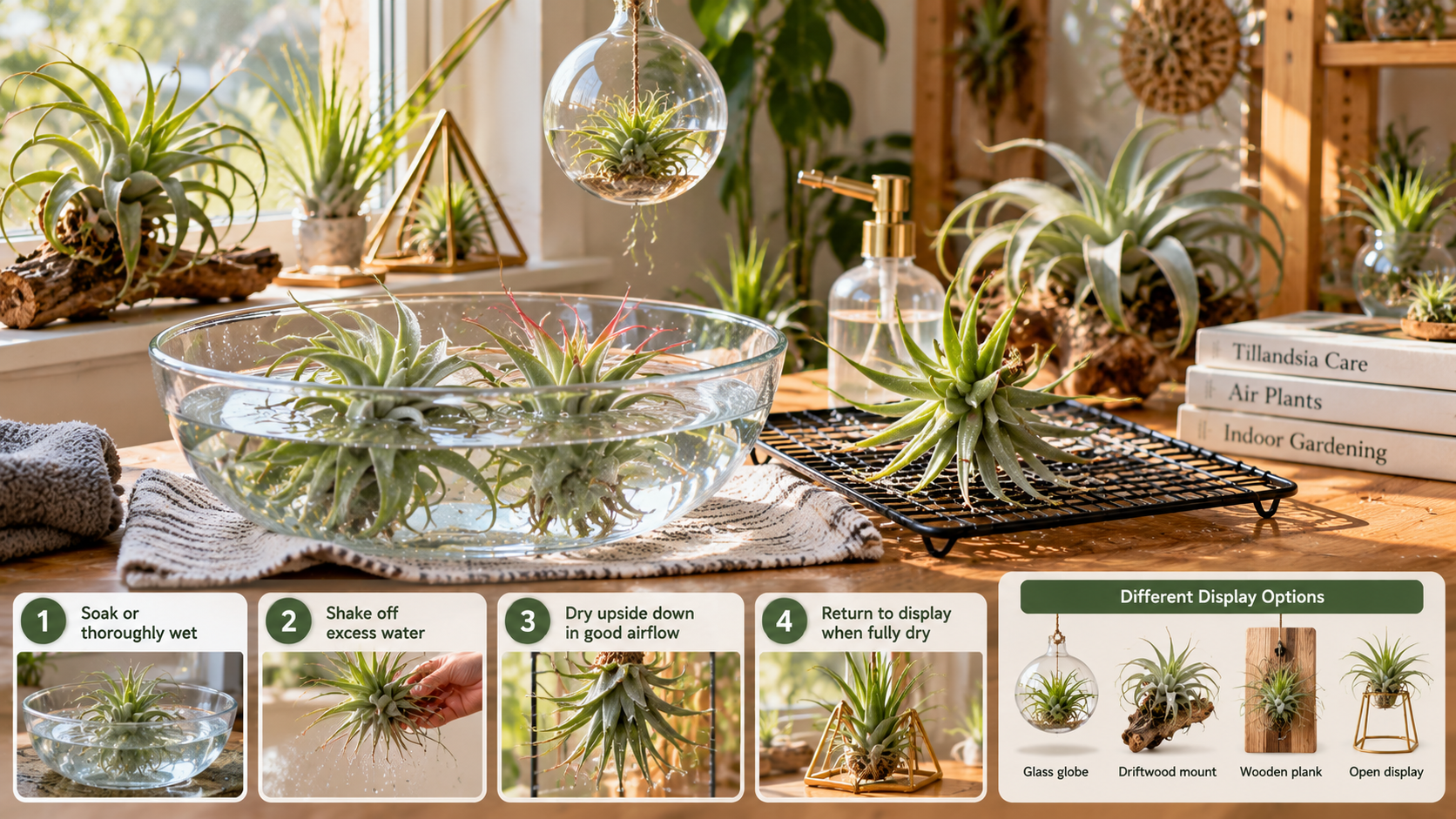
After watering, gently shake away excess water and position the plant so trapped droplets can drain out of leaf axils and the central rosette. Many growers dry plants upside down or at an angle for a period in a well-ventilated location, depending on species and form. Return it to its display only when it is appropriately dry. Do not leave a freshly soaked plant inside a sealed glass ornament.
The type of water may also matter. If mineral deposits accumulate, evaluate local water hardness and the species’ sensitivity; avoid assuming all distilled or treated waters are interchangeable. Do not add fertilizer to every watering unless you are following species-appropriate, dilute bromeliad guidance. Salt buildup and concentrated feeding can damage plants without soil to buffer the solution.
Misting versus thorough watering
A quick surface mist may evaporate before the plant receives enough moisture, especially in a warm dry room. But repeated misting into an enclosed display can keep the crown persistently damp. Neither method is automatically safe or sufficient. The better choice is one that adequately hydrates the particular plant and then allows it to dry before dangerous moisture accumulates.
Observe leaf flexibility, posture, and growth over time. Severe curling or dry, crispy tips may suggest water stress, but light, heat, salts, and ordinary leaf aging can contribute as well. A soft dark base is more concerning for rot. Use symptoms alongside the display’s drying behavior rather than treating any curled leaf with longer soaking immediately.
Provide suitable light and temperature
Many commonly sold air plants appreciate bright filtered light, with species-specific differences. Too little light can slow growth; harsh sun through a window may overheat leaves or a glass container. A plant on a hot south-facing windowsill inside a closed globe experiences a different microclimate from one mounted in open air a short distance away.
Keep Tillandsia away from extreme cold and direct hot-air blasts. Comfortable indoor conditions work for many common types, but do not use the room thermostat as the only measurement if the plant is next to cold glass or an exposed balcony door. Good gentle air movement helps the plant dry, while constant hard drafts can increase desiccation.
The RootLuma guide to indoor plant corners discusses light and airflow for ordinary indoor collections. Air plants make the tradeoff unusually visible because their leaves directly encounter the watering and drying environment, without a conventional potting medium to moderate it.
Pick a display that does not trap water
Open wire stands, ventilated shelves, appropriate cork or wood mounts, and hanging structures can provide good access and airflow. Choose materials that allow you to remove the plant for watering when necessary. Avoid gluing living leaf bases with inappropriate adhesives or using sharp wire that cuts tissue as it grows.
Glass globes can be attractive but require attention. An open, well-ventilated container is very different from a sealed terrarium. If condensation remains on the glass or water collects at the base, the setup may not be suitable for a freshly watered plant. Decorative shells and dense moss arrangements can also hold moisture around the base if they are poorly ventilated.
A display suspended above electrical appliances or delicate furniture should account for drips after watering. Dry the plant thoroughly away from sensitive surfaces, then return it to a secure mount. A practical display is one that makes correct watering easy rather than discouraging it because the whole arrangement must be dismantled.
Learn signs of normal growth and decline
Tillandsia may produce offsets, commonly called pups, after flowering. The mother plant’s life cycle varies by species, and a gradual change in the older plant after blooming is not always proof of poor care. Do not pull a tiny pup away before it has developed enough to survive; leaving offsets attached can form attractive clumps.
Healthy growing tissue is generally firm for its species and shows gradual new leaves or offsets. A base that becomes soft, dark, or foul-smelling after repeated trapped moisture can indicate rot. A completely dry, brittle plant may be beyond recovery, but one brown outer leaf does not justify discarding a firm core. Assess the whole rosette and its recent care.
Sign Possible interpretation Better investigation
Silvery leaf surface Normal trichomes on some species Verify species, not a damage diagnosis
Leaves wrinkle or curl unusually Water stress or environmental change Check watering, heat, and drying history
Soft dark center or base Possible rot Stop pooling water; assess tissue condition
Slow new growth after flowering Natural life-cycle change may be involved Look for offsets and overall firmness
Recurrent condensation in display Drying may be inadequate Improve ventilation and display arrangement
A practical observation routine
Begin by recording the species if known, its display type, and how quickly it dries after watering. The first goal is finding a repeatable rhythm that prevents both dehydration and prolonged wetness. After watering, check the leaf bases and mount before returning it to its ordinary position. On later days, compare leaf texture and posture with that baseline.
A room heater switched on for winter may change watering demand. A humid summer may slow drying. If you move the plant from an open mount into glass, treat that as a real environmental change and reassess the routine. Successful care means adjusting to what the plant experiences, not continuing an old schedule simply because it once worked.
The drying test is as important as the watering method
After watering, place the Tillandsia in a clean, airy spot and observe where droplets collect. Check the bases of leaves and the center of the rosette, not just the tips. A plant can feel dry at the outer leaf edges while water remains trapped deeper inside. Tilting or inverting the plant briefly may help drainage, but do not shake so violently that foliage is damaged.
Try keeping a note of how long it takes the specific species and display to become appropriately dry under different seasonal conditions. On a cool, humid day, the process may be slower than during a warm dry period. If a mounted plant returns to an enclosure while still wet, you are effectively extending that drying period in a confined environment. That can matter more than whether the initial watering lasted a few minutes longer or shorter.
What about a plant that dries too quickly?
Very dry indoor air and strong heating drafts can cause moisture to evaporate before a plant has received useful hydration. Consider changing placement or watering method in a species-appropriate way rather than merely misting the room every few hours. A larger open plant shelf with gentle air movement may perform differently from a small spot directly beneath a heat vent. Evaluate both adequate water uptake and safe drying; one does not replace the other.
Read a flowering air plant correctly
Many Tillandsia bloom once from a given rosette, then may produce offsets as part of their life cycle. That does not mean the entire display must be discarded after the flower fades. Watch for small pups near the base and allow them to gain strength. The timing and number of offsets vary, so avoid pulling one away merely because it has appeared.
When separating an offset is appropriate, preserve its base and avoid tearing healthy tissue from the parent. Some growers retain attached pups to form a clump, which may suit a hanging display. Others separate robust offsets to create individual mounts. Both choices need adequate airflow and watering access; a dense clump can trap moisture among its inner leaves if care is not adjusted.
Do not confuse age with failure
An older rosette may gradually decline after completing reproduction even while healthy offsets continue growing. That is different from sudden soft blackening after water has remained trapped in the center. Diagnose the pattern, timing, and tissue firmness before changing all the care conditions. A plant at a normal life stage does not need rescue fertilizer or repeated soaking to reverse biology.
Be cautious with fertilizer and mounting adhesives
If feeding is appropriate for the species, use a product and dilution suitable for bromeliads and follow directions. Strong ordinary fertilizer solutions can leave damaging salts on foliage. Similarly, household craft adhesives may contain ingredients or curing conditions unsuitable for living plants. Mechanical mounting with gentle ties or materials known to be plant-safe is usually easier to reverse when the display needs cleaning.
Frequently asked questions
Do air plants live on air alone? No. They still require water, light, and nutrients, though many grow without conventional soil.
Should I mist daily? Not universally. Frequency depends on species and conditions; daily misting can be inadequate hydration or excessive trapped moisture.
Can they grow inside closed terrariums? A poorly ventilated sealed display can trap water and encourage rot. Favor access and appropriate airflow.
Do aerial roots need burying? Generally not. Many roots serve attachment in epiphytic Tillandsia.
Can I separate the pups? Often yes once sufficiently developed, but wait until offsets are robust and use species-specific guidance.
Water well, then let the plant breathe
Tillandsia care is about a complete cycle: adequate hydration, removal of trapped water, and an environment where leaves can dry safely. Identify the plant as closely as possible, choose a display that permits that cycle, and revise your routine when the room changes. A simple ventilated mount and careful observation usually teach you more than an elaborate glass arrangement with no way to see whether the plant is staying wet.
References
Iowa State University Extension — All about air plants
Royal Horticultural Society — Air plants