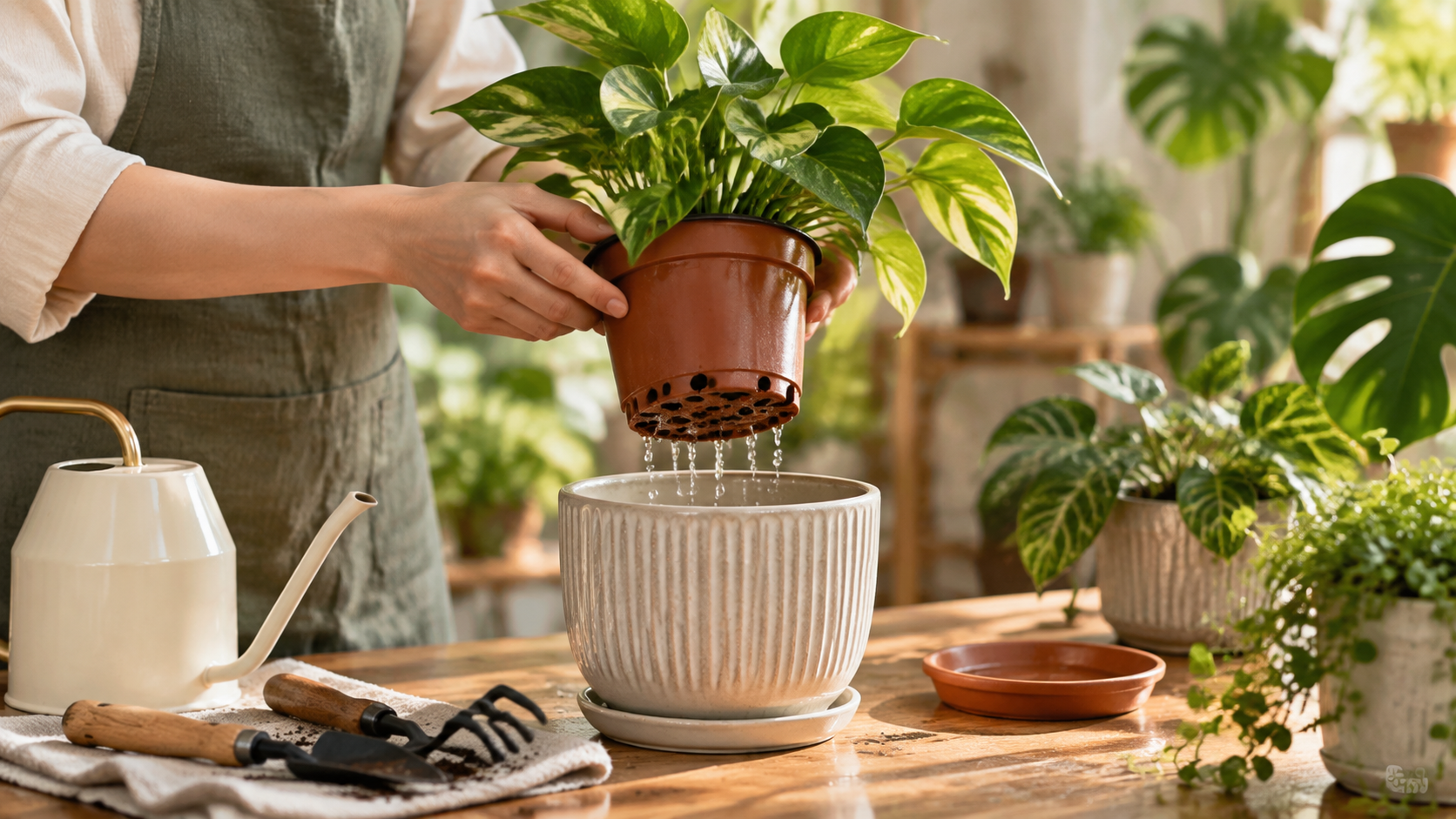
Why Drainage Holes Matter for Houseplants and How to Use Cachepots Safely
Good indoor gardening is usually less about perfect routines and more about noticing how a plant responds to a specific place. When you understand why drainage holes matter for houseplants and how to use cachepots safely as a process instead of a fixed rule, the advice becomes easier to adapt to different plants and rooms. The central principle is that drainage holes give excess irrigation water a predictable exit and make it easier to fully wet the mix without leaving the root zone saturated indefinitely. That matters here because decorative cachepots can work well when the plant remains in a draining inner pot and standing water is removed after watering. Repotting is most useful when it solves a specific problem such as crowding, degraded mix, or poor drainage in place of being done by calendar alone. Because indoor plants grow at different rates through the year, the same action can be helpful in active growth and unnecessary during a slower period. By the end, you should have a simple decision process that can be used again when that particular plant or growing area changes with the season.
What the Plant Is Responding To
The underlying process can be summarized this way: Drainage holes give excess irrigation water a predictable exit and make it easier to fully wet the mix without leaving the root zone saturated indefinitely. Understanding that mechanism keeps the rest of the advice from turning into a list of disconnected instructions. A clear mechanism also makes later troubleshooting faster because you know which variables are capable of producing the pattern you are seeing. Once the process is understood, individual observations become easier to rank instead of being treated as equal evidence. The best comparison is usually the plant against its own recent healthy pattern in place of against a perfect specimen in a photograph. Root-zone problems are often hidden until the leaves respond, which makes drainage behavior and soil condition useful clues. With that foundation in place, the next inspection can focus on evidence rather than on every possible explanation.
How to Read the Pattern
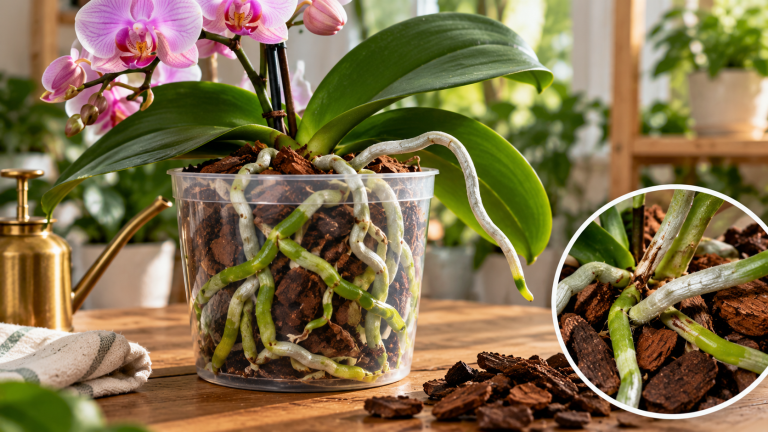
Useful evidence is spread across more than one part of the setup. Look closely at water exiting the pot, standing water in a saucer, drying time, blocked holes, root-zone odor, and whether the container design traps moisture. When two or three of those details agree, you have a stronger basis for action than you would get from one dramatic symptom. Checking neighboring plants can also be useful because a shared pattern may point to an environmental condition rather than an individual plant problem. In this particular care decision, if one clue conflicts with the others, note the disagreement instead of forcing it to fit the first diagnosis that came to mind. A consistent inspection gives you a baseline that becomes more valuable each time it is repeated.
Why Location Changes the Outcome
Environmental context helps explain why two similar plants can respond differently. Here, decorative cachepots can work well when the plant remains in a draining inner pot and standing water is removed after watering. Check the actual position of the leaves and root zone rather than relying on broad labels such as bright room, warm corner, or sheltered balcony. Check what the plant experiences at leaf level and in the pot, not what the room feels like from the doorway. Nearby plants can shade one another, reduce airflow, or change how easy it is to water and inspect each pot. Root-zone problems are often hidden until the leaves respond, which makes drainage behavior and soil condition useful clues. That context helps explain why care needs can shift even when the plant itself has not moved.
Correct the Strongest Issue First
A measured response is usually safer than a dramatic reset. Use this approach: Choose a system that lets you water thoroughly and then remove excess water instead of relying on tiny measured sips. If the assumption is correct, the next checks should become easier to interpret; if not, you still have room to adjust without having created several new variables. If the step involves a product, use the label in place of increasing concentration or frequency in an attempt to speed up the result. If roots or soil are involved, make sure the container can drain before adding water intended to correct another problem. Container and display choices affect care because they change stability, drainage access, weight, and how easily a plant can be inspected. The next useful information comes from what the plant does next, not from adding another intervention immediately.
Use the Previous Week as Evidence
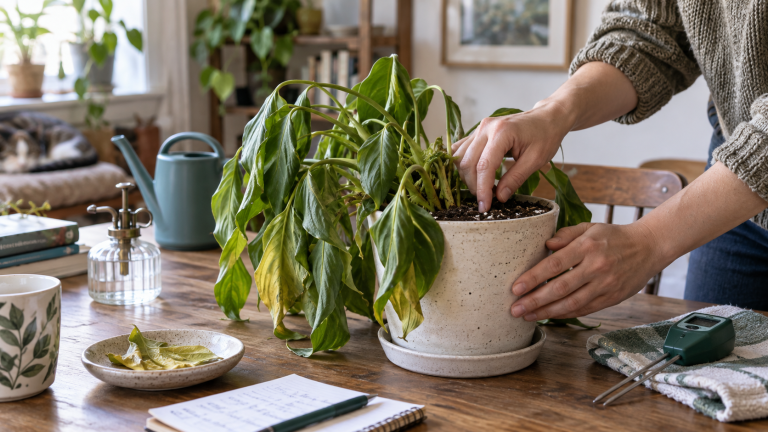
Use a short care history as part of the diagnosis. A quick note about the previous week—water, light, temperature, products used, movement, and repotting—can reveal whether the timing supports one explanation more strongly than another. Repeated problems at the same time of year often suggest that the routine has not yet adjusted to changing light or temperature. If several changes happened together, start with the one most directly connected to the plant’s water, light, roots, or temperature. If you are building a more complete routine, pair this advice with How to Tell When a Houseplant Needs Water so the two care decisions support rather than contradict each other. The clearer the sequence, the less likely you are to mistake the effect of a recent change for a separate new problem.
Tempting Fixes That Backfire
Watch especially for letting nursery pots sit in water, assuming a layer of stones replaces drainage holes, and forgetting to check hidden water inside decorative covers. Each shortcut removes useful information from the next check, which is why slower, more deliberate care often produces a clearer result. When the plant is already stressed, unnecessary repotting or moving can make it harder to separate the original issue from transplant or acclimation stress. Switching between remedies too quickly can produce a confusing mix of responses that is harder to interpret than the original problem. For this plant care topic, a setup that looks simple but blocks watering or traps runoff often creates more maintenance than it saves. Keeping the basics stable gives you a much better chance of understanding what actually changed.
Old Damage Is Not the Same as Ongoing Damage
The next two or three checks usually tell you more than an immediate visual inspection. Stability, predictable care needs, and healthy new development are stronger evidence than the disappearance of damage that has already occurred. If decline continues despite appropriate basics, consider whether the original explanation was incomplete and move to the next most plausible factor. If several plants improve or decline together, the shared environment deserves another look. The most reliable baseline is the plant’s own recent pattern: how quickly it dries, how firm the leaves feel, and what healthy new growth looks like. For the setup described here, if you are building a more complete routine, pair this advice with Root Rot in Houseplants so the two care decisions support rather than contradict each other. That is a more reliable measure of success than expecting old damage to disappear.
Use Consistency Without Becoming Rigid
Long-term confidence comes from a routine you will actually use. make emptying saucers or cachepots part of the same watering session so excess water is never left unnoticed. Add notes or photos only when they help you recognize patterns; the goal is clarity, not a complicated tracking system. If one plant repeatedly needs special handling, consider whether its location or container is creating unnecessary maintenance. The routine is successful when it becomes simpler to notice unusual changes without spending more time on the collection. For the setup described here, another helpful reference is Why Potting Soil Becomes Compacted and How to Improve Root-Zone Airflow, especially when the symptoms overlap and one visible sign could have several causes. a repeatable routine built this way stays useful even when the plant’s growth rate or the room conditions change.
Final Notes for Everyday Care
Bring the process back to one idea: drainage holes give excess irrigation water a predictable exit and make it easier to fully wet the mix without leaving the root zone saturated indefinitely. Observe first, rank the likely causes, make a proportionate change, and watch the trend. That sequence keeps everyday plant care understandable even when the exact answer differs from one home to another. over the next checks, the plant’s own history becomes the most useful reference for what normal looks like in your home. When the space and routine are easy to understand, small problems can be addressed before they trigger a chain of unnecessary corrections. The most reliable baseline is the plant’s own recent pattern: how quickly it dries, how firm the leaves feel, and what healthy new growth looks like. Used consistently, it reduces guesswork without requiring perfect control over the growing environment.