Potatoes in Grow Bags: Hilling, Drainage, and Safe Harvest
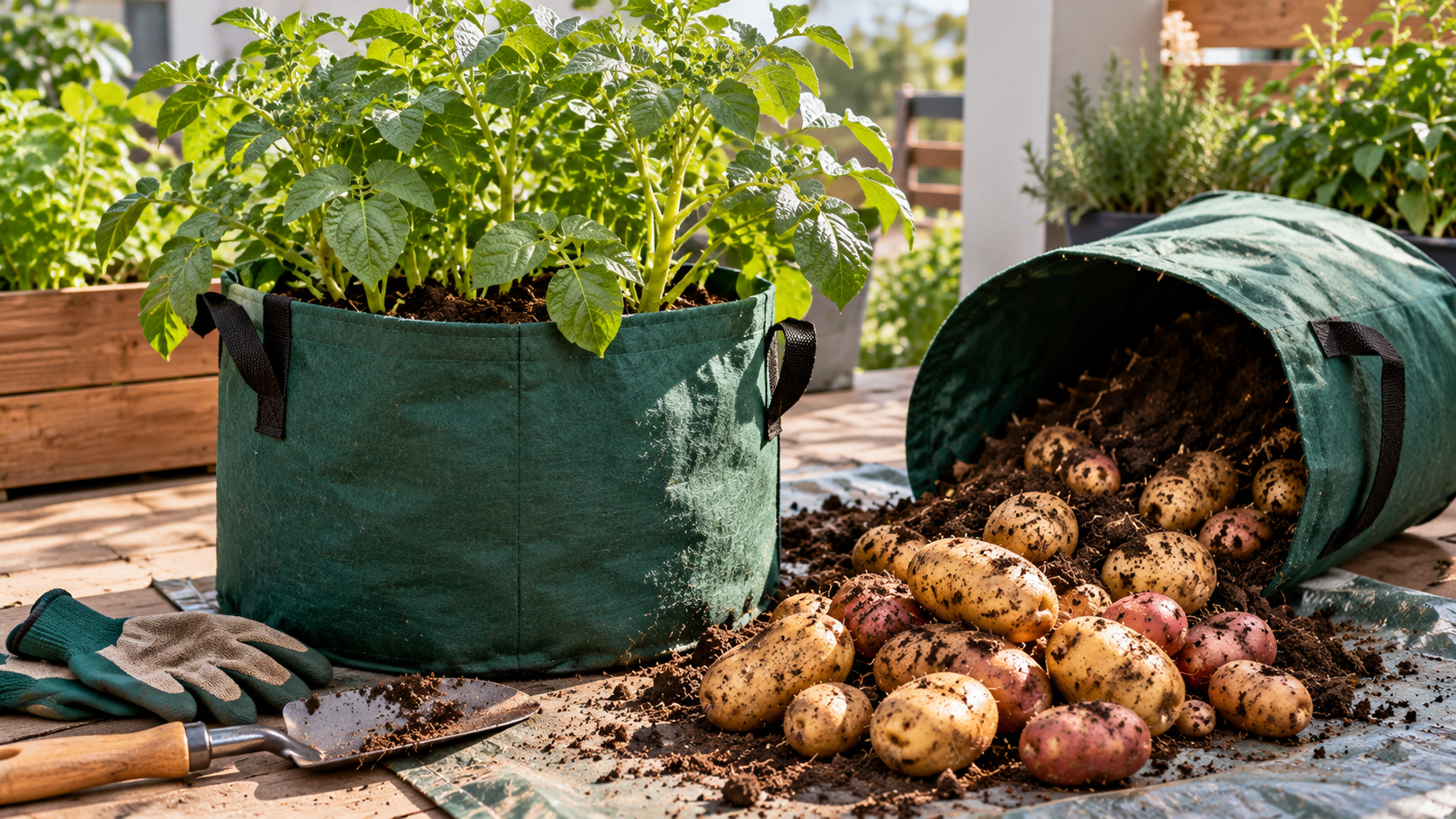
A grow bag promises an appealing shortcut to homegrown potatoes: unfold the fabric container, add growing mix and seed potatoes, then harvest by tipping out the bag. In practice, the crop is sensitive to temperature, light around developing tubers, moisture consistency, and the amount of room available underground. A bag can make harvest easier, but it does not eliminate these biological requirements.
To grow potatoes successfully in a small space, start with healthy certified seed potatoes of a suitable variety, choose a substantial draining container, and manage the medium as shoots and tubers develop. Hilling can help shield developing potatoes from light, but piling endless layers of soil into a bag does not guarantee a towering stack of extra tubers. Safety matters too: green or badly damaged potatoes should not be treated as an ordinary edible harvest.
Choose a variety and suitable seed potatoes
Potatoes differ in maturity time, growth habit, tuber shape, and suitability for a growing season. Early varieties may be useful where the available warm-enough growing window is limited, while later cultivars can require more time and root-zone resources. Consult local horticultural recommendations about planting dates, disease concerns, and available varieties.
Use certified disease-free seed potatoes when possible. A supermarket potato is not automatically safe planting material; it may carry disease or have been treated to suppress sprouting. Healthy seed stock helps reduce one avoidable source of crop failure, although it cannot prevent every pathogen or pest that may occur later.
Some larger seed potatoes can be cut into sections with suitable eyes, but handling and curing practices depend on local guidance. Cutting creates wounds that can rot in wet conditions. A novice with limited space may find it simpler to use appropriately sized whole seed potatoes rather than trying to multiply planting pieces aggressively.
Do not overcrowd a bag. Several seed pieces placed too closely in a modest volume compete for water and nutrients. A large foliage canopy is not proof that the roots have room to develop a worthwhile harvest. Plan the density according to container capacity and the chosen cultivar.
Select a grow bag that can actually support the crop
Fabric bags are breathable and often drain rapidly, but their behavior varies by material, thickness, location, and underlying surface. Plastic grow bags can work too if they have sufficient drainage, but a sealed liner can trap water around roots. Choose a container with adequate volume and a design that allows excess irrigation to escape.
Potatoes require room for roots and developing stolons and tubers. A tall narrow bag may provide depth but become unstable in wind; a broader bag can offer a more stable base. Consider the load when wet. A large container full of moist growing mix is heavy, and balcony rules or structural limits must be respected.
Place the bag where runoff can be managed without damaging floors or neighboring property. Keep it accessible so you can check moisture and add hilling material without pulling at stems. An exposed elevated surface may dry rapidly in wind, while a bag against a hot wall can overheat during summer.
The University of Maryland Extension potato guide is written largely for garden soil, but it explains the crop’s important requirements for water, temperature, hilling, and harvest. Applying those principles to a bag still requires attention to container limitations.
Plant for the available growing season
Potatoes are generally a cool-season crop relative to many tropical fruiting vegetables. Extremely hot root-zone temperatures can inhibit tuber development, even when the aboveground shoots look vigorous. In a warm climate, the timing of planting may matter more than buying a larger grow bag.
Consult local extension or agricultural guidance for planting dates and varieties. A method recommended for early spring in a temperate region should not be copied blindly into a hot wet tropical summer. Frost, prolonged rain, and extreme heat each create different risks.
Fill the lower portion of the bag with an appropriate loose, well-draining growing medium and place seed potatoes at a depth suited to the planting plan. Cover them adequately, water gently, and keep the mix moist enough for sprouting without leaving it saturated. As shoots grow, there may be opportunities to add material around them, but do not bury all growing foliage repeatedly.
Be cautious with claims that potatoes must be layered through a towering container to create harvests at every level. Tuber formation depends on the variety’s physiology and where stolons develop. Hilling chiefly helps protect developing tubers from light, maintain suitable moisture, and support the crop; it is not an unlimited multiplication technique.
Understand hilling without turning it into a contest
Hilling means drawing or adding growing medium around the lower stems as the plants develop. In traditional gardens this helps cover shallow tubers and can protect them from light exposure. In a bag, the technique usually involves adding compatible growing medium gradually as growth becomes tall enough.
Do not smother a small emerging shoot completely each time it appears. Healthy leaves must remain exposed to photosynthesize, and repeated deep burial can stress plants if done excessively. Use the cultivar and local guidance to judge how much covering is useful.
The goal is to keep developing potatoes shielded from light. Tubers exposed at the surface can develop green tissue associated with glycoalkaloid risk. Covering exposed tubers with suitable medium or mulch during growth is helpful, but tubers that later become extensively green should not simply be declared safe because they are buried again.
If rain or irrigation washes away the upper mix, restore coverage as needed. Check bag seams and edges where soil may settle, revealing shallow potatoes. A loose medium is important; packing in successive layers so tightly that drainage suffers undermines the purpose.
Keep moisture even while tubers enlarge
Potato plants need adequate moisture, particularly while tubers develop. Severe dry periods followed by heavy irrigation can contribute to irregular growth and other tuber disorders, although several environmental factors interact. An elevated fabric bag may dry more quickly than a garden bed, so monitor moisture below the upper few centimeters.
Water thoroughly when needed and let excess drain. Avoid keeping a catch tray permanently full. Waterlogged conditions can encourage root and tuber problems, while excessively dry media limit growth. A simple test of the root zone and bag weight is more useful than a fixed daily volume copied from another region.
Heavy overhead watering may wet foliage and can facilitate disease spread in some situations. Apply water carefully to the medium when practical. Do not force plants to stay dry during a hot spell simply because wet leaves may be undesirable; roots still need sufficient moisture.
Mulch or surface coverage can help moderate evaporation if compatible with the bag setup, but check for hidden saturation. A fabric exterior that looks dry does not prove the inner root zone is dry or adequately aerated.
Feed reasonably, not excessively
A vigorous leafy potato plant requires balanced nutrition, but excess nitrogen can favor aboveground growth without improving tuber yield. Start with a suitable container mix and fertilize according to reliable potato guidance and the product label. Account for nutrients already present in the mix.
Do not apply concentrated fertilizer at every watering to compensate for limited space. Accumulated salts can injure roots in containers. If foliage appears pale, consider water, temperature, and disease along with nutrient availability before deciding that more fertilizer is the answer.
A grow bag has a finite volume of media, so fertility and water availability may change quickly as plants mature. Use a measured care routine and observe the whole crop rather than reacting to individual yellowing older leaves in isolation.
If the plant appears healthy but produces few tubers, look at root-zone heat, cultivar suitability, light, crop duration, and planting density. An additional scoop of fertilizer cannot create a favorable tuber-development temperature when the bag is baking against concrete.
Watch for pests and plant disease
Potato foliage can attract insects and develop fungal or other diseases depending on region. Identify symptoms before applying treatments, especially on a food crop. Blight-like lesions, rapid collapse, and unusual tuber rot deserve specific local advice rather than generic spraying.
Remove obviously diseased plant debris appropriately, clean tools, and avoid composting suspect infected material where local recommendations discourage it. In small-scale container production, moving an infected bag away from other susceptible plants may help limit contact, but it does not replace correct identification.
Choose a stable, airy placement rather than crowding potato foliage against dense plants and a damp wall. Monitor the undersides of leaves as well as the top canopy. When using any pesticide, follow the local label for edible potatoes, application timing, and harvest restrictions.
Do not save tubers from a diseased crop for next season simply because they look superficially sound. Certified seed potatoes are usually the safer starting point for a new planting.
Harvest at a stage suited to the variety
Some varieties can be harvested as small “new” potatoes before the crop fully matures. Others are better left until vines naturally senesce and skins develop for storage. Read cultivar guidance and local advice rather than treating flowering as an exact universal harvest signal.
A grow bag makes inspection possible without digging a garden bed, but resist reaching into the medium so roughly that developing tubers are bruised or cut. For a modest crop, gently tipping or opening the bag onto a clean surface after maturity can simplify harvest. If you use a bag with a side flap, be cautious about claims that you can repeatedly extract large harvests without disturbing roots.
Avoid harvesting from extremely wet media when possible, especially for storage potatoes, because handling wet and bruised tubers can increase decay risks. Brush off excess soil and allow potatoes to dry appropriately before storage according to reputable guidance. Do not leave harvested potatoes exposed to sunlight.
Wash potatoes before cooking, but storage practices differ: tubers intended for longer keeping are often stored unwashed in a cool, dark, ventilated place after appropriate curing. The temperature and duration depend on cultivar and local storage conditions.
Green potatoes and food safety
Light exposure can cause a potato’s surface to turn green due to chlorophyll. Greening is also a warning that the tuber may contain elevated glycoalkaloids, including solanine and chaconine. The chlorophyll itself is not the toxin, and not every green patch indicates the same chemical concentration, but visible greening is a useful reason for caution.
Do not advise readers to eat strongly green, bitter, or severely sprouted potatoes. Discard questionable tubers, particularly when greening is extensive or the taste is bitter. Cooking is not a reliable method for making a severely glycoalkaloid-affected potato safe.
This issue is why hilling and dark storage matter. Protecting tubers from light during growth and after harvest is part of safe edible production, not merely a cosmetic effort to make the potatoes look marketable.
Keep harvested potatoes away from pets and children when they are sprouting or deteriorating. Do not use rotting tubers as food. The Maryland Extension guidance explains the link between greening and glycoalkaloids and emphasizes proper storage.
A balcony case: many leaves, few potatoes
An apartment gardener plants several seed pieces in a small black fabric bag on a south-facing balcony. The foliage grows vigorously, and the owner repeatedly adds growing mix until the bag is almost full. During a hot spell the bag becomes very warm, and the media dries severely between heavy waterings.
At harvest, the crop is disappointing. Rather than concluding that the seed variety was defective, the gardener notes the container’s limited root volume, high heat exposure, crowding, and uneven moisture. For the next planting, the gardener chooses a larger stable bag, fewer seed pieces, and a season with cooler suitable conditions. Hilling is used to shield tubers, not as a magical vertical-yield strategy.
The owner also monitors the bag more carefully for drainage and drying rate, using observations rather than a universal watering schedule. Tubers that develop normally are harvested with less damage and stored out of light.
A different gardener in a cool rainy region may face the opposite problem: waterlogged media and disease pressure. The appropriate decisions should match the actual setting, not the photograph on a grow-bag advertisement.
A practical grow-bag checklist
Before planting, verify the variety and season, healthy seed source, bag volume, drainage, stable placement, and manageable runoff. During growth, inspect shoot health and root-zone moisture, add hilling material when needed, and protect tubers from light. During harvest, handle tubers gently, reject unsafe green or rotten potatoes, and store appropriate produce in a dark, ventilated place.
Record the planting density and resulting harvest. If a crop disappoints, those records help you improve one variable at a time. Growing potatoes in bags can be rewarding and convenient, but the successful strategy is not maximum soil height. It is matching a cool-season tuber crop to the right container, temperature, moisture, and safe harvest practices.
References
University of Maryland Extension — Growing Potatoes in a Home Garden
University of Maryland Extension — Growing Vegetables in Containers