How to Support a Climbing Monstera With a Moss Pole or Stake
A young monstera may sit neatly on a table, but as it matures its stems become heavier and its growth can wander sideways. In nature, Monstera deliciosa can climb supports using aerial roots. Indoors, a sturdy pole or stake can guide the plant upward, reduce sprawling, and provide a structure against which new leaves can develop. The support is not a magic switch for larger holes or mature leaf shape; light, plant maturity, roots, and overall vigor still matter.
The best time to plan support is before the plant has become a tangled mass of stems. However, an older plant can often be trained gradually if you handle it with care. The main challenge is protecting stems and roots while choosing a support that will remain stable as the foliage grows.
Understand the plant’s growth habit
Monstera deliciosa produces stems with nodes, petioles, and often aerial roots that extend from the nodes. New leaves emerge from growing points, while older leaves may remain lower on the plant. The petiole connects a leaf blade to the stem; it is not the same as the stem segment that should be secured to a support.
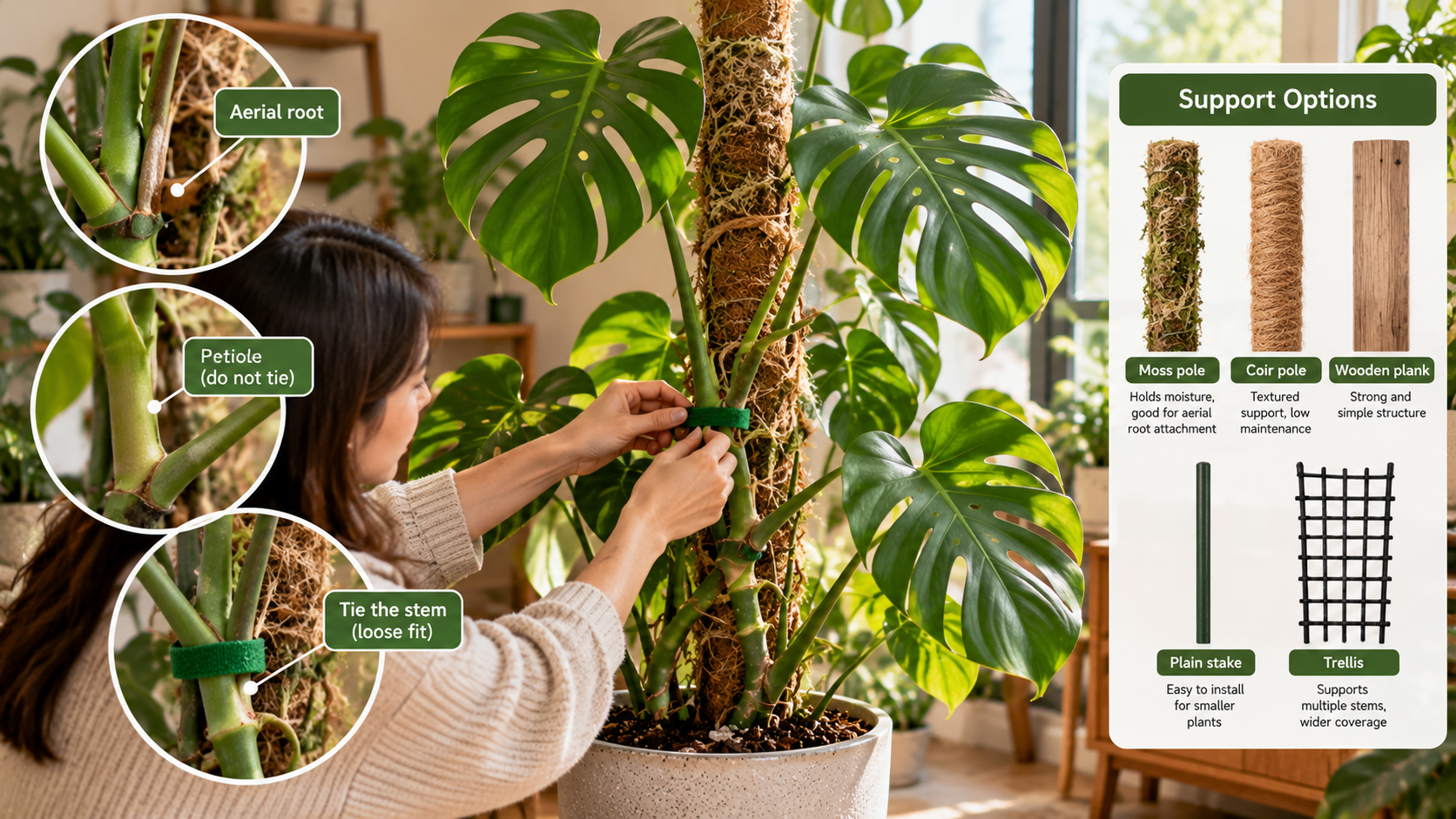
Tying petioles tightly to a pole is a frequent mistake. Petioles need some freedom as leaves orient toward light. Restricting them can create bending or breakage. Instead, guide the actual stem and use loose, soft ties between nodes where necessary. The aerial roots may reach toward the support, but do not force rigid roots to bend sharply around it.
A monstera can also live without a pole, growing outward in a sprawling form. Supporting it is therefore partly a space-management choice. If you want a narrower footprint in a small apartment, a vertical structure can be useful, but the pot and stand must be stable enough to counter the weight above.
Compare moss poles, coir poles, planks, and stakes
A true moss pole usually contains or holds moisture-retentive moss and provides a textured surface where aerial roots may attach when conditions are appropriate. Keeping the pole moist can help some roots engage, but it adds water management and maintenance. A coir-wrapped pole offers rough texture and basic support, though it may not behave like a consistently moist moss column.
A plank or sturdy wooden stake can provide mechanical support without requiring irrigation of a moss sleeve. It may be particularly suitable when you prefer a low-maintenance setup. A plain stake will not necessarily encourage the same root contact as a moist textured support, but climbing direction and stability may be the primary goals in your room.
Think about your plant’s size. A tiny coir stick inserted shallowly into a large top-heavy pot may topple under the weight of mature foliage. A broad pole anchored securely near the stem base can be more practical. Avoid treated wood or sharp hardware that could damage plant tissue, and consider whether the support will need to be extended later.
Support type Strength Main tradeoff
Moist moss pole Texture and potential aerial-root contact Requires moisture and maintenance
Coir-wrapped pole Lightweight textured support Attachment and moisture behavior vary
Wooden plank Strong, simple vertical structure Less flexible placement after growth
Plain stake Easy to install for modest stems Limited surface for root attachment
Trellis Spreads several stems across a plane Requires extra width and careful ties
Choose the moment to install support
A plant ready for repotting can be a convenient opportunity because roots and stem positions are already being assessed. But do not repot an otherwise healthy monstera solely to install a pole if you can anchor it safely without major root disturbance. Examine the pot size, the direction of the main stem, and the room available for future leaves.
Position the support close enough to the primary climbing stem to provide guidance without crushing the root ball. In an established pot, forcing a thick pole through the center can sever substantial roots. Work gradually and stop if significant resistance suggests a dense root mass. If a complete repot is justified, place the support first, then arrange roots and medium around it so the base is secure.
The RootLuma guide to pruning houseplants is useful if you must manage an overgrown vine, but prune only for a specific reason. Trimming healthy mature leaves merely to make the plant fit a decorative pole can slow the plant’s growth and reduce its ability to support new development.
Secure stems without restricting growth
Use soft plant ties or wide flexible tape rather than narrow wire directly against stems. Place the tie around the climbing stem and support, leaving enough room for thickening and slight movement. Avoid trapping a new leaf spear or an aerial root tip under the tie. Revisit ties as the plant grows; one that was loose in spring can become constricting months later.
Guide an old stem in small increments rather than bending it into a new vertical line in one session. Mature stems can be rigid and may snap under sudden pressure. Where a plant has several independent growing points, you may need more than one support or a wider trellis. Forcing all growth onto one narrow pole is often less practical than using a structure matched to the plant’s natural spread.
Some roots may attach to the pole and others may continue into the surrounding air or medium. Not every aerial root needs intervention. Avoid cutting them simply for appearance; they are living structures. If a root is growing toward furniture, gently redirect it early if flexible, or place a protective barrier rather than sharply bending a mature root.
Light still determines much of the leaf development
Monstera leaves can become larger and more deeply fenestrated as the plant matures under suitable conditions. Climbing support can be one part of that growth habit, but low light may still limit vigor. A tall pole in a dim corner will not guarantee dramatic mature leaves. Place the plant where it receives appropriate bright indirect light and enough space for expanding blades.
The RootLuma indoor plant-corner guide discusses spacing and airflow. With a trained monstera, those factors become even more important because mature leaves can shade neighboring pots and block routine access. Rotate or reposition thoughtfully without repeatedly twisting newly attached roots off their support.
Do you have to keep a moss pole wet?
If you use moist moss specifically to encourage aerial-root attachment, regular moisture management may be part of its function. But constantly saturating the entire pot to wet the pole is not appropriate. Water the pole separately as needed, manage drips, and consider whether it creates excessive humidity or mold against a wall. If you cannot maintain it without soaking furniture, a simpler dry support may be better.
There is no universal benefit to feeding liquid fertilizer through a moss pole. Nutrient needs should be assessed as part of overall plant care, not assumed from the presence of aerial roots.
A practical setup for a medium monstera
Imagine a monstera with two main stems leaning toward the window. Its pot is stable but large leaves now extend into a walkway. Instead of forcing the oldest leaves against a pole, identify which stem sections are capable of guiding upward. Select a support tall enough for some future growth, anchor it without unnecessary root damage, and tie the actual stems loosely at a few points.
Over the next month, check whether the plant remains stable and whether new growth follows the support. Adjust ties before they constrict. If one old leaf continues extending horizontally, allow it; training a plant does not require every leaf to face forward like a flat display. The goal is a healthier, manageable growth direction, not rigid symmetry.
If the pole leans, investigate the anchoring and pot balance rather than tightening ties around delicate stems. A heavier pot or a differently positioned support may be warranted, but consider the floor’s load and the risk to children or pets before adding heavy decorative stones.
Troubleshooting common training problems
The support keeps falling sideways. It may be too narrow, shallow, or poorly positioned for the foliage mass. Reevaluate pot balance and anchoring instead of adding more ties to the plant.
New leaves remain small. Examine plant maturity, light, root health, and watering. Support alone cannot make up for poor growing conditions.
Aerial roots ignore the pole. They may not be positioned to contact it, or its surface may not suit attachment. The plant can still benefit from mechanical support.
An old stem cracks when moved. Stop bending it and protect the damaged section. Future growth can be directed more gradually rather than forcing the old stem into the idealized shape.
Moss smells stale or grows unwanted material. Assess whether the pole stays excessively wet and whether room airflow is adequate. A dry or simpler support may be more suitable in that environment.
Understand the difference between stem direction and leaf direction
A monstera has a three-dimensional growth habit. The stem moves through space as nodes develop, while individual leaves orient their blades to capture light. If you tie every petiole to a straight vertical pole, the plant may look more orderly for a day but lose the freedom to position its leaves normally. The right training points are the main stem segments, using ties loose enough for growth.
Stand beside the pot and identify which direction the stem naturally advances. The side with aerial root emergence often tells you where support contact is likely to develop, although individual plants vary. Position the pole so the growing stem can reach it without twisting the whole plant into an uncomfortable shape. A support at the wrong angle can require constant tightening, which is a clue the initial placement needs reconsideration.
When several stems share one pot
Commercial monsteras are sometimes sold as multiple cuttings in one container. Each may have its own growing tip and direction. Trying to gather all of them onto one slim stake can create a crowded, unstable column. A wider support, two stakes, or a modest repot into separate groups may be more practical depending on root condition. Never tear intertwined roots apart solely to achieve an ideal Instagram silhouette.
Photograph the pot from above before changing anything. Mark the position of each main stem and the location of the proposed pole. That simple plan can prevent driving a support through the center of a major root mass or tying a new leaf into a narrow bend. Install the structure deliberately, then guide new growth gradually.
Reassess support as the plant gains weight
The first pole may be suitable for a juvenile plant but inadequate after another season of large leaves. Check whether the pole can be extended securely, whether the pot base still resists tipping, and whether ties have become tight. A pole leaning at the base may indicate structural failure rather than a plant seeking light.
Do not solve instability by adding heavy loose stones to the soil surface where they may damage roots or create household hazards. A broad stable planter and properly anchored support are more reliable. In apartments, consider furniture stability and walkways as part of the horticultural design.
Aerial roots and furniture protection
Aerial roots may adhere to walls or textured supports. Keep the plant away from surfaces you cannot afford to damage, and monitor new root tips as they approach painted plaster or wood. Gently redirect flexible roots toward the support or medium when feasible; older attached roots may be difficult to move without tearing. Protect furniture before a root becomes established on it.
Frequently asked questions
Does every monstera need a moss pole? No. Support is optional and depends on the plant’s form and your available space.
Should I tie the leaf stalks to the pole? Tie the climbing stems, not tightly restrain the petioles that need to move.
Will a pole automatically make leaves split? No. Fenestration relates to maturation and growing conditions; a pole alone is not a guarantee.
Can I attach aerial roots manually? Guide flexible roots gently if appropriate, but do not bend or staple living roots into place.
Is a wooden plank acceptable? Yes, if it is stable and safe for the plant and household. It offers support even without moist moss.
Support the plant you actually have
A good monstera support respects stem anatomy, root health, and the limitations of your room. Select a sturdy structure, anchor it carefully, tie stems loosely, and allow new growth to adjust over time. Whether you choose moss, coir, or wood, the most useful outcome is a plant that can grow naturally without becoming unstable or impossible to maintain.
References
University of Wisconsin Extension — Monstera deliciosa